



Question: Suppose the spacing between the two slits was smaller than the wavelength of light youwere trying to measure, how many orders of maxima would you
Suppose the spacing between the two slits was smaller than the wavelength of light youwere trying to measure, how many orders of maxima would you expect to see?
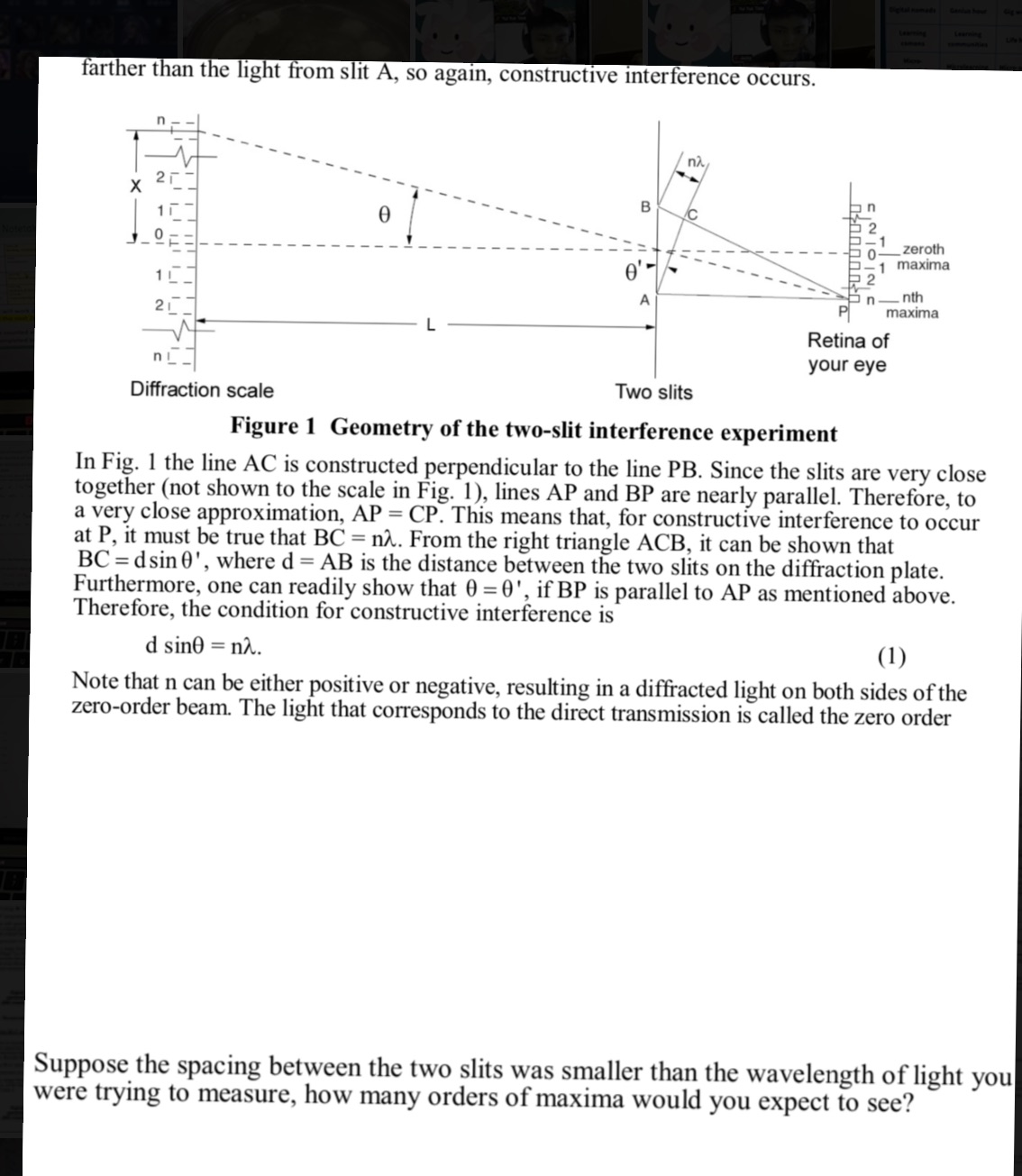
Retina of your eye Diffraction scale Two slits Figure 1 Geometry of the two-slit interference experiment In Fig. l the line AC is constructed perpendicular to the line PB. Since the slits are very close together (not shown to the scale in Fig. 1), lines AP and BP are nearly parallel. Therefore, to a very close approximation, AP = CP. This means that, for constructive interference to occur at P, it must be true that BC = 11).. From the right triangle ACB, it can be shown that BC = dsin 9', where d = AB is the distance between the two slits on the diffraction plate. Furthermore, one can readily show that 6 = 0', if BP is parallel to AP as mentioned above. Therefore, the condition for constructive interference is dsinB=n7L. (1) Note that n can be either positive or negative, resulting in a difacted light on both sides of the zero-order beam The light that corresponds to the direct transmission is called the zero order Suppose the Spacing between the two slits was smaller than the wavelength of light you were trying to measure, how many orders of maxima would you expect to see
Step by Step Solution
There are 3 Steps involved in it

Get step-by-step solutions from verified subject matter experts