







Question: Suppose there are three routers between a source host and a destination host. Ignoring fragmentation, an IP datagram sent from the source host to the
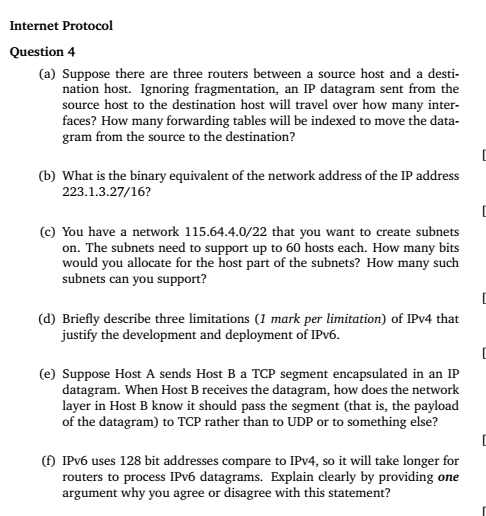
Suppose there are three routers between a source host and a destination host. Ignoring fragmentation, an IP datagram sent from the source host to the destination host will travel over how many interfaces? How many forwarding tables will be indexed to move the datagram from the source to the destination? (b) What is the binary equivalent of the network address of the IP address 223.1.3.27/16? (c) You have a network 115.64.4.0/22 that you want to create subnets on. The subnets need to support up to 60 hosts each. How many bits would you allocate for the host part of the subnets? How many such subnets can you support? (d) Briefly describe three limitations (1 mark per limitation) of IPv4 that justify the development and deployment of IPv6. (e) Suppose Host A sends Host B a TCP segment encapsulated in an IP datagram. When Host B receives the datagram, how does the network layer in Host B know it should pass the segment (that is, the payload of the datagram) to TCP rather than to UDP or to something else? (f) IPv6 uses 128 bit addresses compare to IPv4, so it will take longer for routers to process IPv6 datagrams. Explain clearly by providing one argument why you agree or disagree with this statement
Step by Step Solution
There are 3 Steps involved in it

Get step-by-step solutions from verified subject matter experts
 Study Help