







Question: Suppose there are two consumers, each with a different willingness to pay for a monopolists product, as shown in Table 3. Assume that the monopolists
Suppose there are two consumers, each with a different willingness to pay for a monopolist’s product, as shown in Table 3. Assume that the monopolist’s marginal and fixed costs are zero. The monopolist knows that there are two types of consumers with the preferences shown in Table 3.
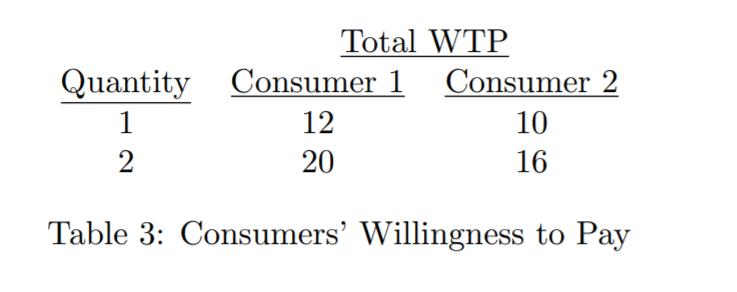
(a) Suppose the firm can engage in first-degree price discrimination. What are the prices that the firm charges, and what is its profit? Explain and show work.
(b) Suppose the firm cannot observe exactly which consumer is which type.
i. If the firm successfully engages in second-degree price discrimination, what are the prices it charges? What is its profit? Explain and show work.
ii. If the firm instead sets prices so that both consumers buy two units, what are the prices it charges? What is its profit? Explain and show work.
Quantity 1 2 Total WTP Consumer 1 Consumer 2 12 10 20 16 Table 3: Consumers' Willingness to Pay
Step by Step Solution
3.38 Rating (170 Votes )
There are 3 Steps involved in it
a In 1st degree Pricedisoumination WTP Monopolist hen... View full answer

Get step-by-step solutions from verified subject matter experts
 Study Help