







Question: Suppose there are two people: P1 and P2. Using propositional logic, we want to determine the game P2 plays, given the following clues. 1 Suppose
Suppose there are two people: P1 and P2. Using propositional logic, we want to determine the game P2 plays, given the following clues.
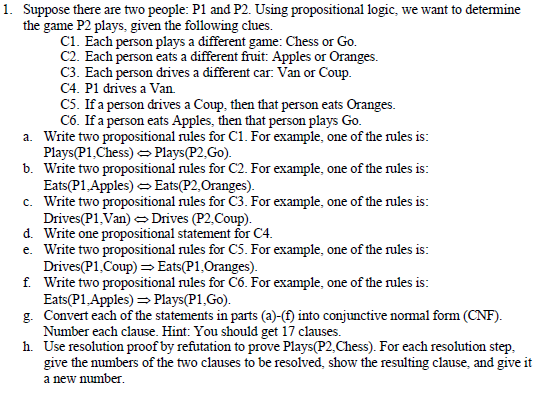
1 Suppose there are two people: P1 and P2. Using propositional logic, we want to determine the game P2 plays, given the following clues. C1. Each person plays a different game: Chess or Go. C2. Each pon eats a different fruit: Apples or Oranges. C3. Each person drives a different car. Van or Coup C4. P1 drives a Van. C5. If a person drives a Coup, then that person eats Oranges. a. Write two propositional rules for C1. For example, one of the rules is b. Write two propositional rules for C2. For example, one of the rules is c. Write two propositional rules for C3. For example, one of the rules is d. Wr C6. If a person eats Apples, then that person plays Go Plays(PLChess)Plays(P2.Go). Eats(Pl Apples)Eats(P2. Oranges) Drives(PLVan)> Drives (P2. Coup) e. Write two propositional rules for C5. For example, one of the rules is f. Write two propositional rules for C6. For example, one of the rules is g. Convert each of the statements in parts (a)-(f) into conjunctive normal form (CNF). h. Use resolution proof by refutation to prove Plays(P2,Chess). For each resolution step ite one propositional statement for C4 Drives(P1 .Coup) =Eats(P1,Oranges) Eats(P1.Apples) > Plays(P1,Go). Number each clause. Hint: You should get 17 clauses. give the numbers of the two clauses to be resolved, show the resulting clause, and give it a new number
Step by Step Solution
There are 3 Steps involved in it

Get step-by-step solutions from verified subject matter experts
 Study Help