



Question: Suppose there are two types of workers. Type 1 workers have a marginal product of labor (MPL) = 1. That is, if a firm
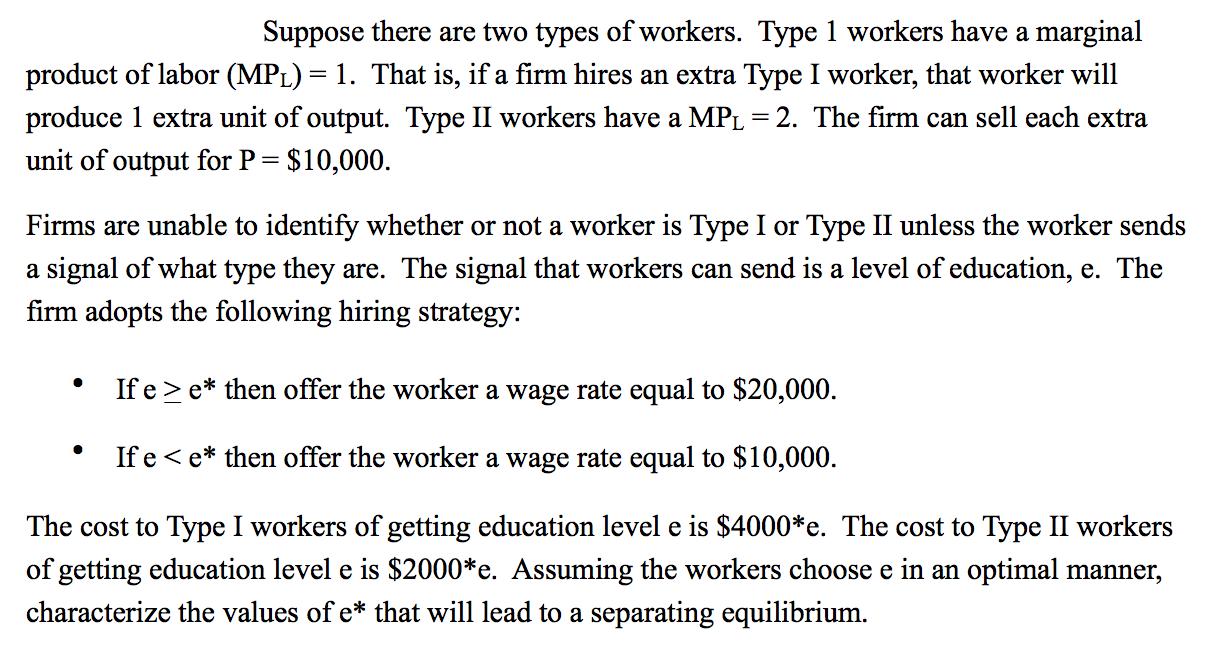
Suppose there are two types of workers. Type 1 workers have a marginal product of labor (MPL) = 1. That is, if a firm hires an extra Type I worker, that worker will produce 1 extra unit of output. Type II workers have a MP = 2. The firm can sell each extra unit of output for P = $10,000. Firms are unable to identify whether or not a worker is Type I or Type II unless the worker sends a signal of what type they are. The signal that workers can send is a level of education, e. The firm adopts the following hiring strategy: If ee* then offer the worker a wage rate equal to $20,000. If ee* then offer the worker a wage rate equal to $10,000. The cost to Type I workers of getting education level e is $4000*e. The cost to Type II workers of getting education level e is $2000*e. Assuming the workers choose e in an optimal manner, characterize the values of e* that will lead to a separating equilibrium.
Step by Step Solution
There are 3 Steps involved in it
According to Given data we know that Given data Type 1 Output ... View full answer

Get step-by-step solutions from verified subject matter experts