







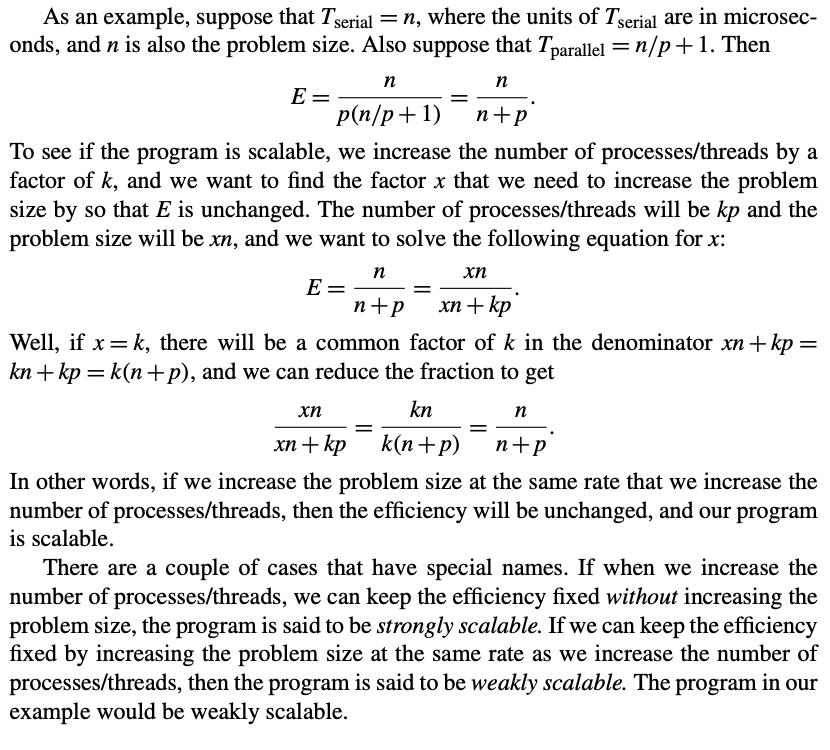
Question: Suppose Tserial = n and Tparallel = n / p + log 2 ( p ) , As ( an example, suppose that T s
Suppose Tserial n and Tparallel np logp As an example, suppose that where the units of are in microsec
onds, and is also the problem size. Also suppose that Then
To see if the program is scalable, we increase the number of processesthreads by a
factor of and we want to find the factor that we need to increase the problem
size by so that is unchanged. The number of processesthreads will be and the
problem size will be and we want to solve the following equation for :
Well, if there will be a common factor of in the denominator
and we can reduce the fraction to get
In other words, if we increase the problem size at the same rate that we increase the
number of processesthreads then the efficiency will be unchanged, and our program
is scalable.
There are a couple of cases that have special names. If when we increase the
number of processesthreads we can keep the efficiency fixed without increasing the
problem size, the program is said to be strongly scalable. If we can keep the efficiency
fixed by increasing the problem size at the same rate as we increase the number of
processesthreads then the program is said to be weakly scalable. The program in our
example would be weakly scalable.where times are in microseconds. If we increase p by
a factor of k find a formula for how much well need to increase n in order to maintain constant efficiency.
How much should we increase n by if we double the number of processes from to Is the parallel program
scalable? I worked out that the efficiency equation would be E n np p logp but I am having trouble with the increasing by a factor of k aspect. I found an example in my textbook and from there got to E xn xnkp kp logkp kpkp Can someone help?
Step by Step Solution
There are 3 Steps involved in it
1 Expert Approved Answer
Step: 1 Unlock

Question Has Been Solved by an Expert!
Get step-by-step solutions from verified subject matter experts
Step: 2 Unlock
Step: 3 Unlock
 Study Help