







Question: Suppose users share a 8.4 Mbps communication link. Also suppose that the traffic generation process of each user alternates (independently of the other users)
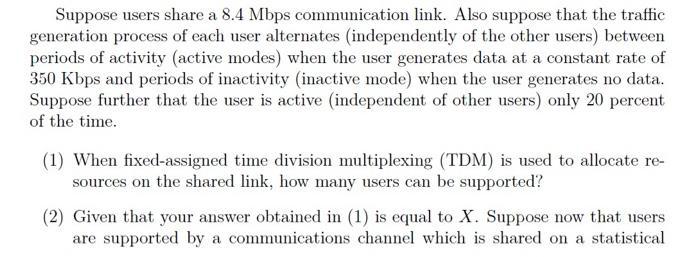
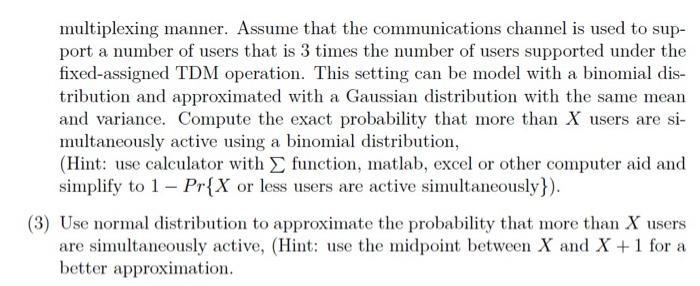
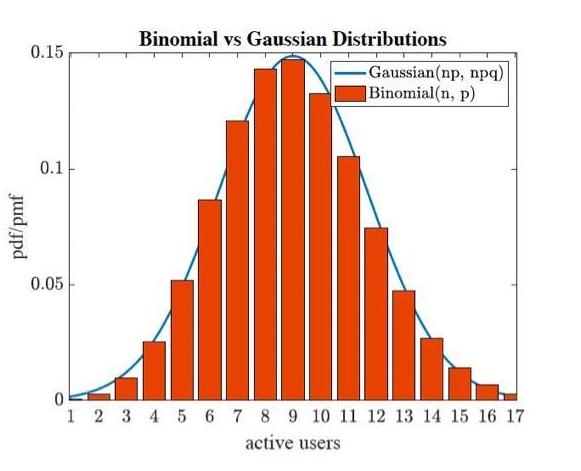
Suppose users share a 8.4 Mbps communication link. Also suppose that the traffic generation process of each user alternates (independently of the other users) between periods of activity (active modes) when the user generates data at a constant rate of 350 Kbps and periods of inactivity (inactive mode) when the user generates no data. Suppose further that the user is active (independent of other users) only 20 percent of the time. (1) When fixed-assigned time division multiplexing (TDM) is used to allocate re- sources on the shared link, how many users can be supported? (2) Given that your answer obtained in (1) is equal to X. Suppose now that users are supported by a communications channel which is shared on a statistical multiplexing manner. Assume that the communications channel is used to sup- port a number of users that is 3 times the number of users supported under the fixed-assigned TDM operation. This setting can be model with a binomial dis- tribution and approximated with a Gaussian distribution with the same mean and variance. Compute the exact probability that more than X users are si- multaneously active using a binomial distribution, (Hint: use calculator with function, matlab, excel or other computer aid and simplify to 1 - Pr{X or less users are active simultaneously}). (3) Use normal distribution to approximate the probability that more than X users are simultaneously active, (Hint: use the midpoint between X and X+1 for a better approximation. pdf/pmf 0.15 0.1 0.05 Binomial vs Gaussian Distributions -Gaussian(np, npq) Binomial(n, p) 0 1 2 3 4 5 6 7 8 9 10 11 12 13 14 15 16 17 active users
Step by Step Solution
3.50 Rating (147 Votes )
There are 3 Steps involved in it
SOLUTION 1 When fixedassigned time division multiplexing TDM is used to allocate resources on the shared link we need to consider the bandwidth requir... View full answer

Get step-by-step solutions from verified subject matter experts
 Study Help