







Question: Suppose v1; v2; v3 2 R4. The function f : R4 ! R : x 7! det v1 v2 v3 x is linear. (Recall, the
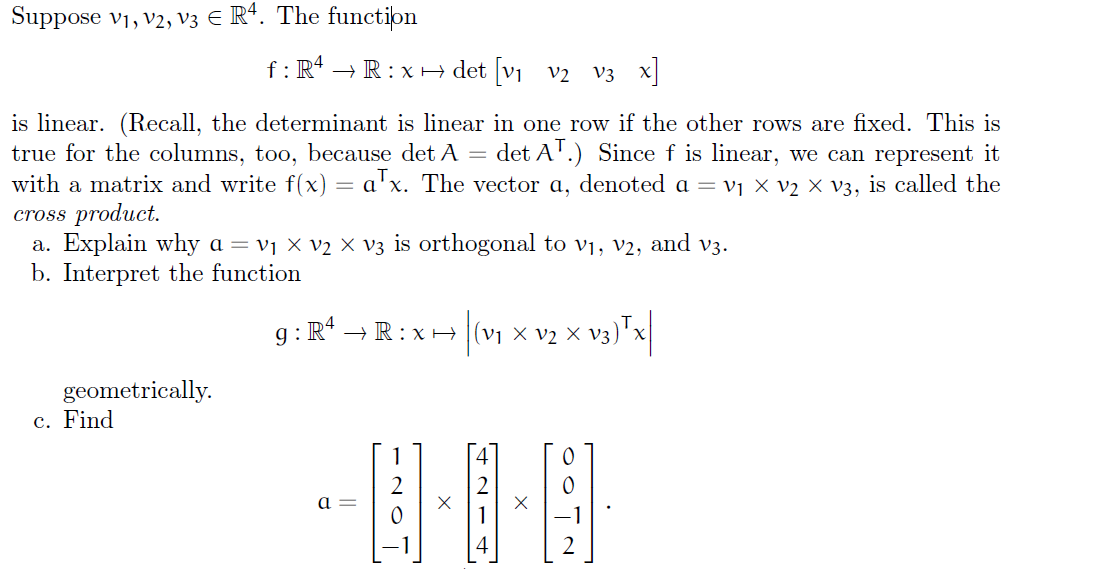
Suppose v1; v2; v3 2 R4. The function
f : R4 ! R : x 7! det
v1 v2 v3 x
is linear. (Recall, the determinant is linear in one row if the other rows are xed. This is
true for the columns, too, because detA = detAT .) Since f is linear, we can represent it
with a matrix and write f(x) = aTx. The vector a, denoted a = v1 v2 v3, is called the
cross product.
a. Explain why a = v1 v2 v3 is orthogonal to v1, v2, and v3.
b. Interpret the function
g : R4 ! R : x 7!
(v1 v2 v3)Tx
geometrically.
c. Find
a =
2
664
1
2
0
-1
3
775
2
664
4
2
1
4
3
775
2
664
0
0
-1
2
3
775
:
1
Suppose v1,v2, V3 E R4. The functibn f:R4>R:xr>det [v1 v2 v3 74] is linear. (Recall, the determinant is linear in one row if the other rows are xed. This is true for the columns, too, because detA : det AT.) Since f is linear, we can represent it with a matrix and write f [x] : aTx. The vector 0, denoted a : w x v; X v3, is called the cross product. a. Explain why a : 1)] X v2 >]R:XI> [v1xvzxv3JTx geometrically. c. Find 1 4 0 (1 _ 2 X 2 X 0 _ 0 1 1 1 4 2
Step by Step Solution
There are 3 Steps involved in it

Get step-by-step solutions from verified subject matter experts
 Study Help