







Question: Suppose we are given a directed graph G rightarrow with n vertices, and let M be the n Times n adjacency matrix corresponding to G
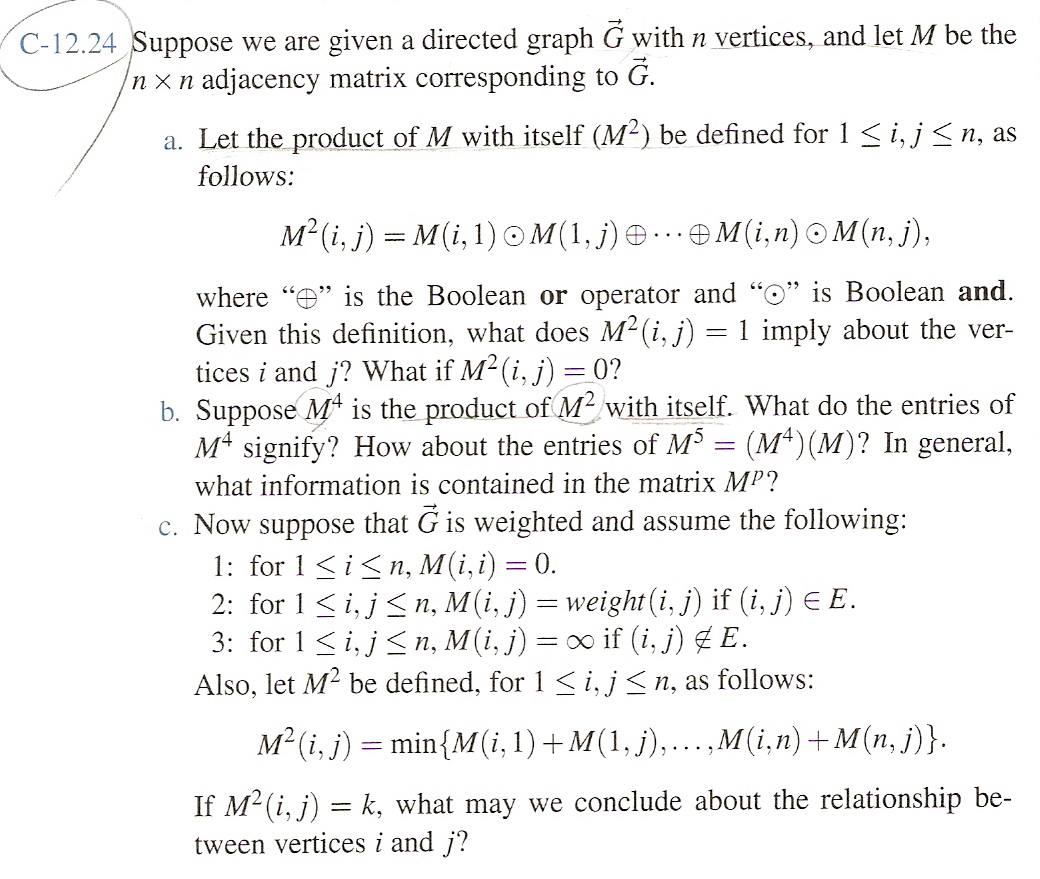
Suppose we are given a directed graph G rightarrow with n vertices, and let M be the n Times n adjacency matrix corresponding to G rightarrow. Let the product of M with itself (M^2) be defined for 1 LE i, j LE n, as follows: M^2(i, j) = M(i, 1) M(1, j) M(i, n) M(n, j), where " " is the Boolean or operator and " " is Boolean and. Given this definition, what does M^2(i, j) = 1 imply about the vertices i and j? What if M^2(i, j) = 0? Suppose M^4 is the product of M^2 with itself. What do the entries of M^4 signify? How about the entries of M^5 = (M^4)(M)? In general, what information is contained in the matrix M^p? Now suppose that G is weighted and assume the following: for 1 LE i LE n, M(i, i) = 0. for 1 LE i, j LE n, M(i, j) = weight (i, j) if (i, j) E. 3: for 1 LE i, j LE n, M(i, j) = infinity if (i, j) E. Also, let M^2 be defined, for 1 LE i, j LE n, as follows: M^2(i, j) = min{M(i, 1) + M(1, j),...,M(i, n) + M(n, j)}. If M^2 (i, j) = k, what may we conclude about the relationship between vertices i and j? Suppose we are given a directed graph G rightarrow with n vertices, and let M be the n Times n adjacency matrix corresponding to G rightarrow. Let the product of M with itself (M^2) be defined for 1 LE i, j LE n, as follows: M^2(i, j) = M(i, 1) M(1, j) M(i, n) M(n, j), where " " is the Boolean or operator and " " is Boolean and. Given this definition, what does M^2(i, j) = 1 imply about the vertices i and j? What if M^2(i, j) = 0? Suppose M^4 is the product of M^2 with itself. What do the entries of M^4 signify? How about the entries of M^5 = (M^4)(M)? In general, what information is contained in the matrix M^p? Now suppose that G is weighted and assume the following: for 1 LE i LE n, M(i, i) = 0. for 1 LE i, j LE n, M(i, j) = weight (i, j) if (i, j) E. 3: for 1 LE i, j LE n, M(i, j) = infinity if (i, j) E. Also, let M^2 be defined, for 1 LE i, j LE n, as follows: M^2(i, j) = min{M(i, 1) + M(1, j),...,M(i, n) + M(n, j)}. If M^2 (i, j) = k, what may we conclude about the relationship between vertices i and j
Step by Step Solution
There are 3 Steps involved in it

Get step-by-step solutions from verified subject matter experts
 Study Help