







Question: Suppose we are thinking about replacing an old computer with a new one. The old one cost us $1,360,000; the new one will cost $1,620,000.
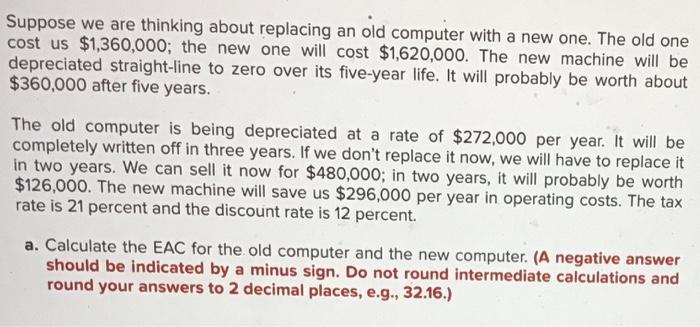
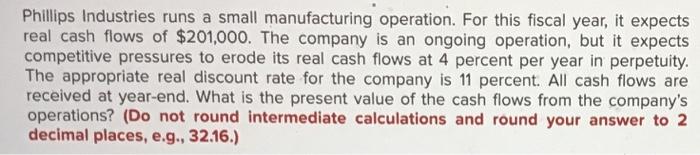
Suppose we are thinking about replacing an old computer with a new one. The old one cost us $1,360,000; the new one will cost $1,620,000. The new machine will be depreciated straight-line to zero over its five-year life. It will probably be worth about $360,000 after five years. The old computer is being depreciated at a rate of $272,000 per year. It will be completely written off in three years. If we don't replace it now, we will have to replace it in two years. We can sell it now for $480,000; in two years, it will probably be worth $126,000. The new machine will save us $296,000 per year in operating costs. The tax rate is 21 percent and the discount rate is 12 percent. a. Calculate the EAC for the old computer and the new computer. (A negative answer should be indicated by a minus sign. Do not round intermediate calculations and round your answers to 2 decimal places, e.g., 32.16.) Phillips Industries runs a small manufacturing operation. For this fiscal year, it expects real cash flows of $201,000. The company is an ongoing operation, but it expects competitive pressures to erode its real cash flows at 4 percent per year in perpetuity. The appropriate real discount rate for the company is 11 percent. All cash flows are received at year-end. What is the present value of the cash flows from the company's operations? (Do not round intermediate calculations and round your answer to 2 decimal places, e.g., 32.16.)
Step by Step Solution
There are 3 Steps involved in it

Get step-by-step solutions from verified subject matter experts
 Study Help