







Question: Suppose we divide an image into 2 by 2 blocks (just so they are small enough to compute by hand). Consider the following 2 by
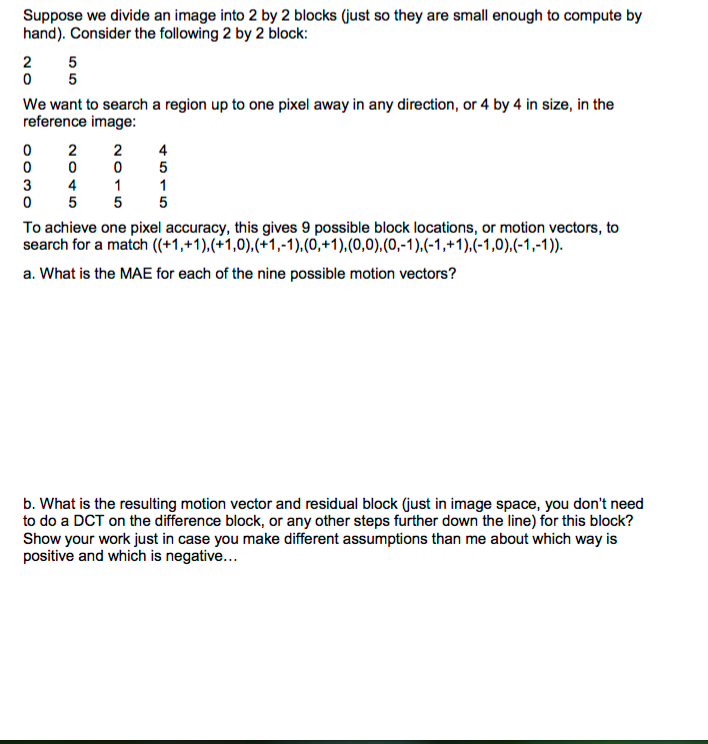
Suppose we divide an image into 2 by 2 blocks (just so they are small enough to compute by hand). Consider the following 2 by 2 block: We want to search a region up to one pixel away in any direction, or 4 by 4 in size, in the reference image: To achieve one pixel accuracy, this gives 9 possible block locations, or motion vectors, to search for a match ((+1, +1), (+1, 0), (+1, -1), (0, +1), (0, 0), (0, -1), (-1, +1), (-1, 0), (-1, -1)). a. What is the MAE for each of the nine possible motion vectors? b. What is the resulting motion vector and residual block (just in image space, you don't need to do a DCT on the difference block, or any other steps further down the line) for this block? Show your work just in case you make different assumptions than me about which way is positive and which is negative... Suppose we divide an image into 2 by 2 blocks (just so they are small enough to compute by hand). Consider the following 2 by 2 block: We want to search a region up to one pixel away in any direction, or 4 by 4 in size, in the reference image: To achieve one pixel accuracy, this gives 9 possible block locations, or motion vectors, to search for a match ((+1, +1), (+1, 0), (+1, -1), (0, +1), (0, 0), (0, -1), (-1, +1), (-1, 0), (-1, -1)). a. What is the MAE for each of the nine possible motion vectors? b. What is the resulting motion vector and residual block (just in image space, you don't need to do a DCT on the difference block, or any other steps further down the line) for this block? Show your work just in case you make different assumptions than me about which way is positive and which is negative
Step by Step Solution
There are 3 Steps involved in it

Get step-by-step solutions from verified subject matter experts
 Study Help