







Question: Suppose we have a Extremely Simple File System (ESFS), which is similar to the VSFS discussed in class (but even simpler). The disk that
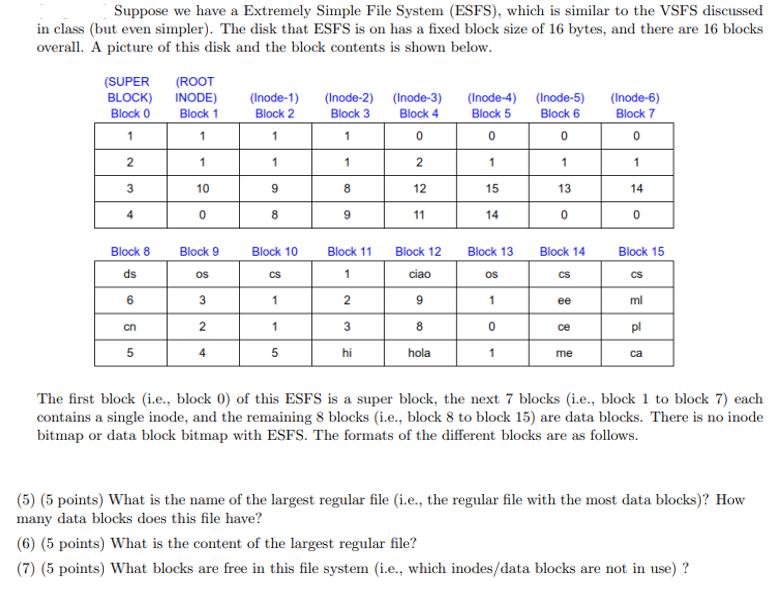
Suppose we have a Extremely Simple File System (ESFS), which is similar to the VSFS discussed in class (but even simpler). The disk that ESFS is on has a fixed block size of 16 bytes, and there are 16 blocks overall. A picture of this disk and the block contents is shown below. (SUPER BLOCK) Block 0 1 2 3 4 Block 8 ds 6 cn 5 (ROOT INODE) Block 1 1 1 10 0 Block 9 OS 3 2 4 (Inode-1) Block 2 1 1 9 8 Block 10 CS 1 1 5 (Inode-2) Block 3 1 1 8 9 Block 11 1 2 3 hi (Inode-3) Block 4 0 2 12 11 Block 12 ciao 9 8 hola (Inode-4) Block 5 0 1 15 14 Block 13 OS 1 0 1 (Inode-5) Block 6 0 1 13 0 Block 14 CS ee ce me (Inode-6) Block 7 0 1 14 0 Block 15 CS ml pl ca The first block (i.e., block 0) of this ESFS is a super block, the next 7 blocks (i.e., block 1 to block 7) each contains a single inode, and the remaining 8 blocks (i.e., block 8 to block 15) are data blocks. There is no inode bitmap or data block bitmap with ESFS. The formats of the different blocks are as follows. (5) (5 points) What is the name of the largest regular file (i.e., the regular file with the most data blocks)? How many data blocks does this file have? (6) (5 points) What is the content of the largest regular file? (7) (5 points) What blocks are free in this file system (i.e., which inodes/data blocks are not in use) ?
Step by Step Solution
There are 3 Steps involved in it
What is the name of the largest regular file ie the regular file with ... View full answer

Get step-by-step solutions from verified subject matter experts
 Study Help