







Question: Suppose we have a relational database with five tables. Table Key_attributes S (sid, A) sid. T (tid, B) tid U.(uid, C) uid R(sid, tid, D)
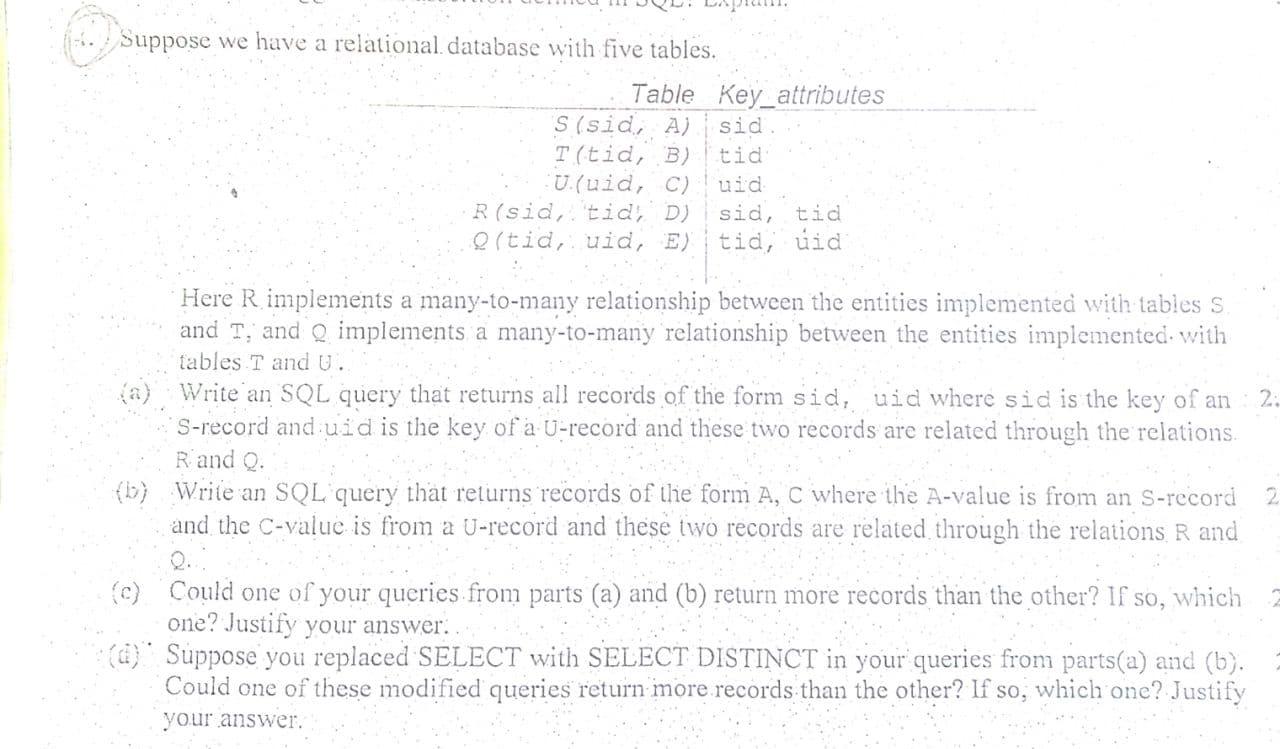
Suppose we have a relational database with five tables. Table Key_attributes S (sid, A) sid. T (tid, B) tid U.(uid, C) uid R(sid, tid, D) sid, tid Q(tid, uid, E) tid, uid Here R implements a many-to-many relationship between the entities implemented with tables S. and T, and o implements a many-to-many relationship between the entities implemented with tables T and U. a) Write an SQL query that returns all records of the form sid, uid where sid is the key of an 2. S-record and uid is the key of a U-record and these two records are related through the relations Rand O. (b) Write an SQL query that relurns records of the form A, C where the A-value is from an S-record 2 and the C-value is from a U-record and these two records are related through the relations R and Could one of your queries from parts (a) and (b) return more records than the other? If SO, which one? Justify your answer. (0) Suppose you replaced SELECT with SELECT DISTINCT in your queries from parts(a) and (b). Could one of these modified queries return more records than the other? If so, which one? Justify your
Step by Step Solution
There are 3 Steps involved in it

Get step-by-step solutions from verified subject matter experts
 Study Help