



Question: Suppose we have a system that takes input K(t) and gives output J(t). Further suppose we have a set of inputs Kj(t) and the corresponding
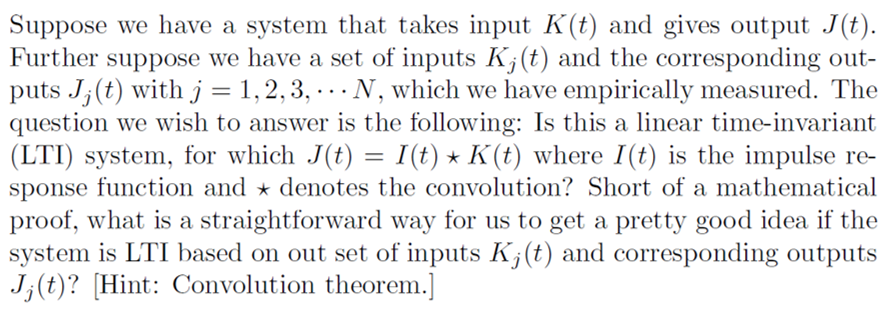
Suppose we have a system that takes input K(t) and gives output J(t). Further suppose we have a set of inputs Kj(t) and the corresponding out- puts J;(t) with j = 1,2,3, ... N, which we have empirically measured. The question we wish to answer is the following: Is this a linear time-invariant (LTI) system, for which J(t) = I(t) *K(t) where I(t) is the impulse re- sponse function and * denotes the convolution? Short of a mathematical proof, what is a straightforward way for us to get a pretty good idea if the system is LTI based on out set of inputs Kj(t) and corresponding outputs J;(t)? (Hint: Convolution theorem.] Suppose we have a system that takes input K(t) and gives output J(t). Further suppose we have a set of inputs Kj(t) and the corresponding out- puts J;(t) with j = 1,2,3, ... N, which we have empirically measured. The question we wish to answer is the following: Is this a linear time-invariant (LTI) system, for which J(t) = I(t) *K(t) where I(t) is the impulse re- sponse function and * denotes the convolution? Short of a mathematical proof, what is a straightforward way for us to get a pretty good idea if the system is LTI based on out set of inputs Kj(t) and corresponding outputs J;(t)? (Hint: Convolution theorem.]
Step by Step Solution
There are 3 Steps involved in it

Get step-by-step solutions from verified subject matter experts