







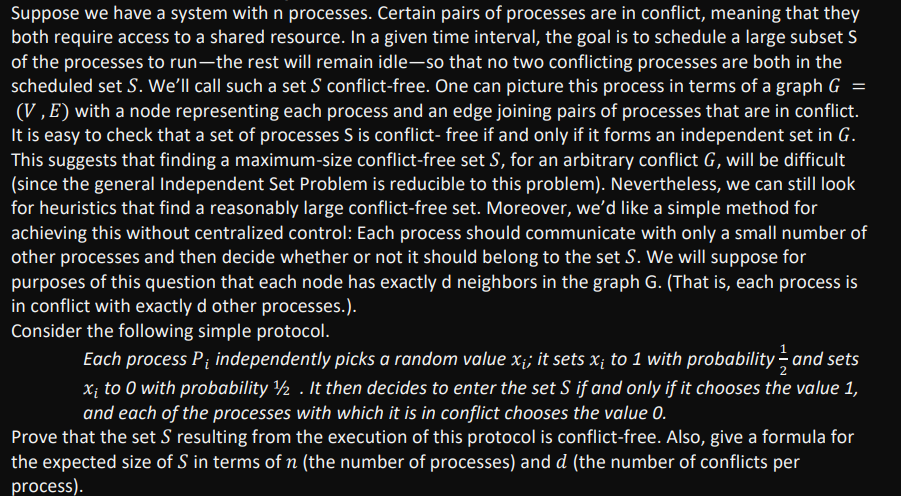
Question: Suppose we have a system with n processes. Certain pairs of processes are in conflict, meaning that they both require access to a shared resource.
Suppose we have a system with processes. Certain pairs of processes are in conflict, meaning that they
both require access to a shared resource. In a given time interval, the goal is to schedule a large subset
of the processes to runthe rest will remain idleso that no two conflicting processes are both in the
scheduled set We'll call such a set conflictfree. One can picture this process in terms of a graph
with a node representing each process and an edge joining pairs of processes that are in conflict.
It is easy to check that a set of processes is conflict free if and only if it forms an independent set in
This suggests that finding a maximumsize conflictfree set for an arbitrary conflict will be difficult
since the general Independent Set Problem is reducible to this problem Nevertheless, we can still look
for heuristics that find a reasonably large conflictfree set. Moreover, we'd like a simple method for
achieving this without centralized control: Each process should communicate with only a small number of
other processes and then decide whether or not it should belong to the set We will suppose for
purposes of this question that each node has exactly neighbors in the graph That is each process is
in conflict with exactly d other processes.
Consider the following simple protocol.
Each process independently picks a random value ; it sets to with probability and sets
to with probability It then decides to enter the set if and only if it chooses the value
and each of the processes with which it is in conflict chooses the value
Prove that the set resulting from the execution of this protocol is conflictfree. Also, give a formula for
the expected size of in terms of the number of processes and the number of conflicts per
process
Step by Step Solution
There are 3 Steps involved in it
1 Expert Approved Answer
Step: 1 Unlock

Question Has Been Solved by an Expert!
Get step-by-step solutions from verified subject matter experts
Step: 2 Unlock
Step: 3 Unlock
 Study Help