



Question: Suppose we have three tables t (A, B), t2(B, C), and t3(B, D), with all attributes de- clared as not null. Consider the expressions
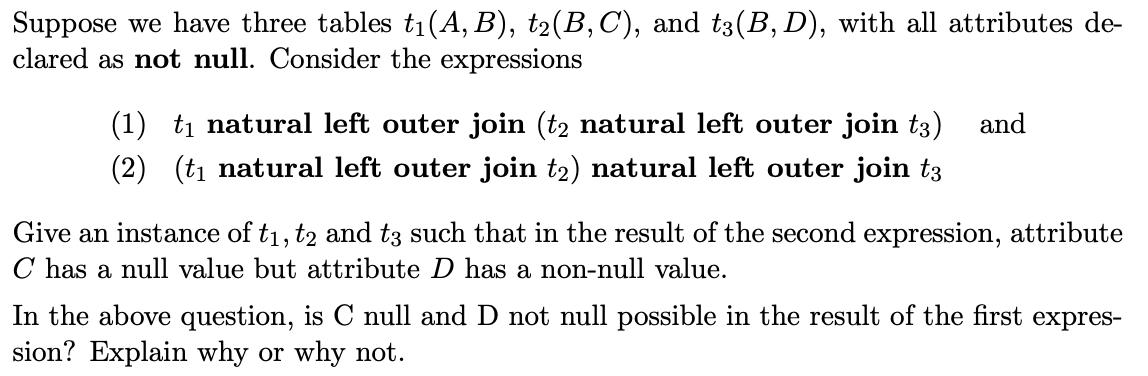
Suppose we have three tables t (A, B), t2(B, C), and t3(B, D), with all attributes de- clared as not null. Consider the expressions (1) t natural left outer join (t2 natural left outer join t3) and (2) (t natural left outer join t2) natural left outer join t3 Give an instance of t1, t2 and t3 such that in the result of the second expression, attribute C has a null value but attribute D has a non-null value. In the above question, is C null and D not null possible in the result of the first expres- sion? Explain why or why not.
Step by Step Solution
There are 3 Steps involved in it
Certainly Ill provide an example that demonstrates the scenario where in the result of the second ex... View full answer

Get step-by-step solutions from verified subject matter experts