







Question: Suppose we model the parameter as a random variable. In this case, frequentist sufficiency is defined by: If p ( x | T ( x
Suppose we model the parameter
as a random
variable. In this case, frequentist sufficiency is defined by:
If
p
(
x
|
T
(
x
)
,
) =
p
(
x
|
T
(
x
))
,
then
T
(
x
)
is a sufficient statistic for
, where
T
(
x
)
is a function of
x
and it is not a function of
.
The Bayesian Sufficiency is defined by:
If
p
(
|
x
) =
p
(
|
T
(
x
))
.
then
T
(
x
)
is a sufficient statistic for
.
Prove that two definitions given above are equivalent. Note that it is enough to show,
p
(
|
x
) =
p
(
|
T
(
x
))
p
(
x
|
T
(
x
)
,
) =
p
(
x
|
T
(
x
))
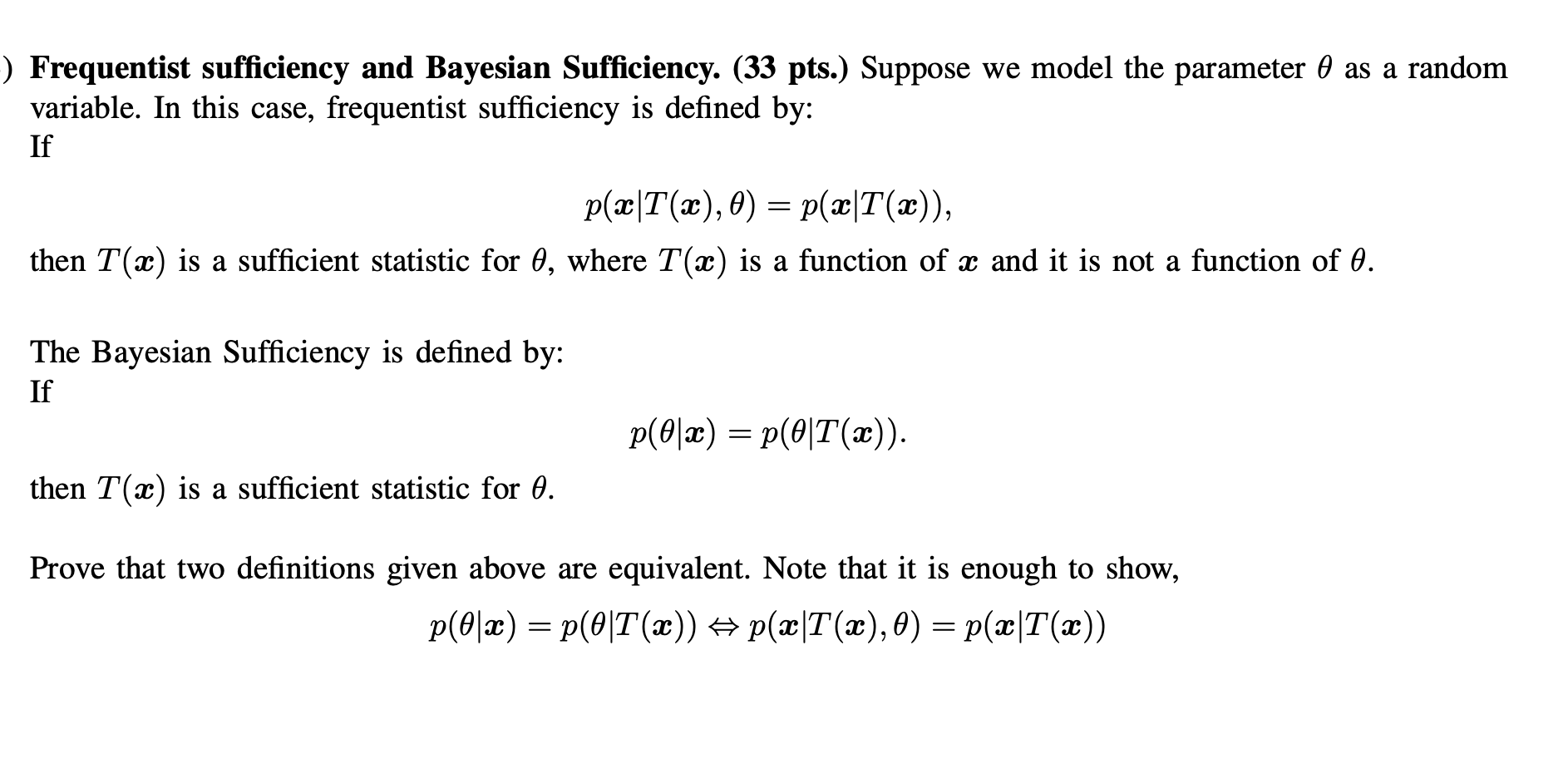
Frequentist sufficiency and Bayesian Sufficiency. (33 pts.) Suppose we model the parameter 0 as a random variable. In this case, frequentist sufficiency is defined by: If pac T(ac), 0) = p(ac|T(ac) ), then T(a) is a sufficient statistic for 0, where T(ac) is a function of a and it is not a function of 0. The Bayesian Sufficiency is defined by: If p(0| ac) = P(0|T(a) ). then T(x) is a sufficient statistic for 0. Prove that two definitions given above are equivalent. Note that it is enough to show, p(0| ac) = p(0|T(ac)) + p(ac T(ac), 0) = p(ac |T(ac) )
Step by Step Solution
There are 3 Steps involved in it

Get step-by-step solutions from verified subject matter experts
 Study Help