



Question: Suppose we use a transition metal oxide to make a sensor: For the sensor to work, the reactions that need to occur are oxidation to
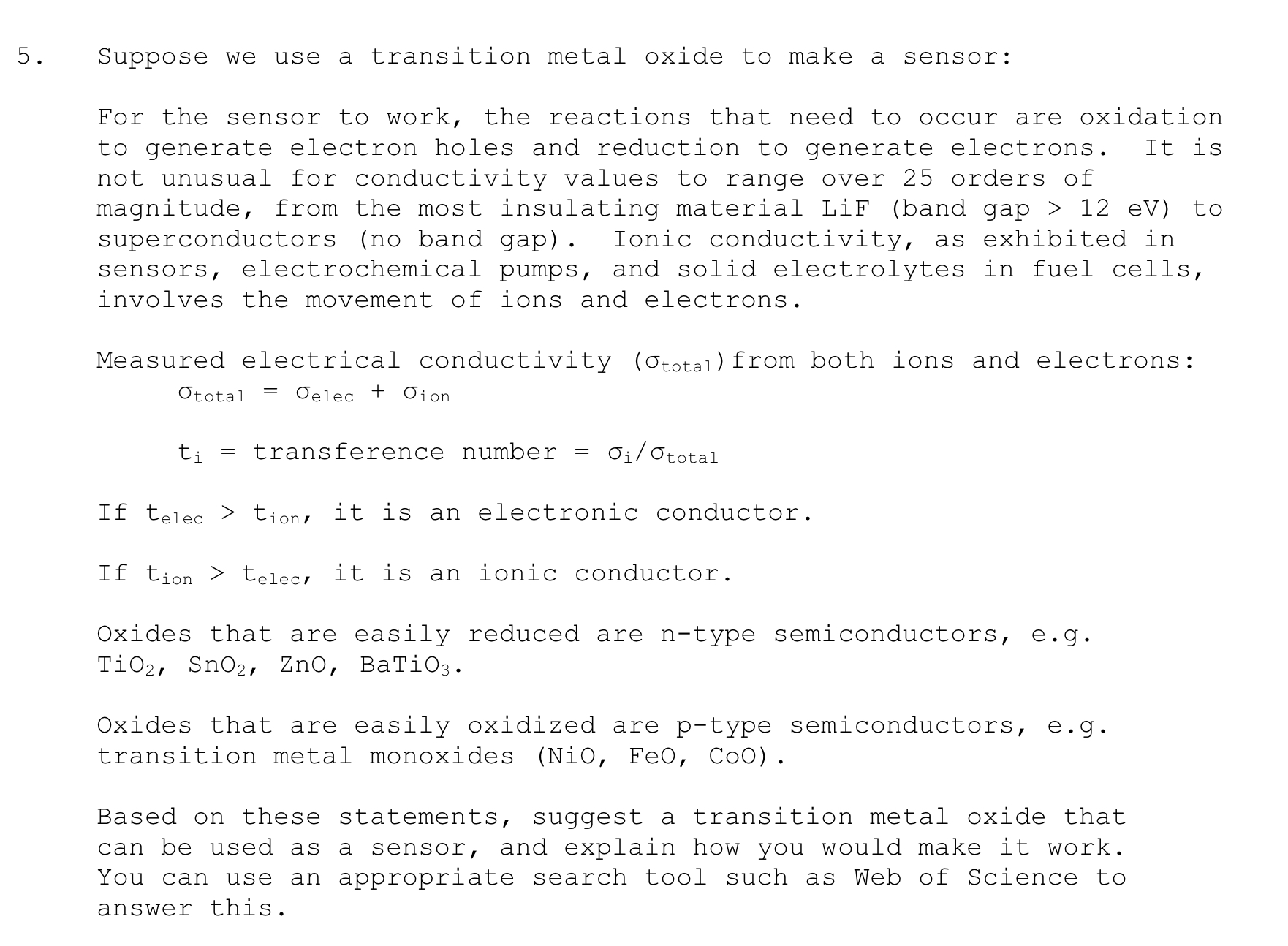
Suppose we use a transition metal oxide to make a sensor:
For the sensor to work, the reactions that need to occur are oxidation to generate electron holes and reduction to generate electrons. It is not unusual for conductivity values to range over orders of magnitude, from the most insulating material Lif band gap to superconductors no band gap Ionic conductivity, as exhibited in sensors electrochemical pumps, and solid electrolytes in fuel cells, involves the movement of ions and electrons.
Measured electrical conductivity from both ions and electrons:
transference number
If it is an electronic conductor.
If it is an ionic conductor.
Oxides that are easily reduced are ntype semiconductors, egZnO,
Oxides that are easily oxidized are ptype semiconductors, eg transition metal monoxides NiO FeO, CoO
Based on these statements, suggest a transition metal oxide that can be used as a sensor and explain how you would make it work. You can use an appropriate search tool such as web of Science to answer this.
Step by Step Solution
There are 3 Steps involved in it
1 Expert Approved Answer
Step: 1 Unlock

Question Has Been Solved by an Expert!
Get step-by-step solutions from verified subject matter experts
Step: 2 Unlock
Step: 3 Unlock