







Question: Suppose we want to learn a classifier using kernelized perceptron algorithm. Start from the following dual weights: ?1=0; ?2=0; ?3=0; ?4=0; and ?5=0. Please do
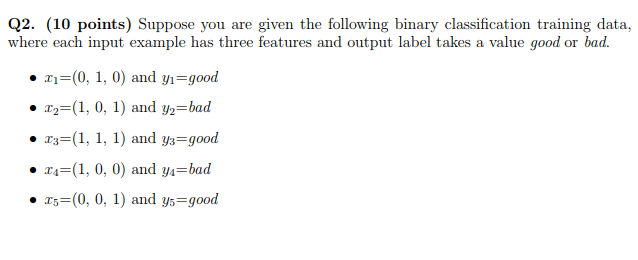
Suppose we want to learn a classifier using kernelized perceptron algorithm. Start from the following dual weights: ?1=0; ?2=0; ?3=0; ?4=0; and ?5=0. Please do hand calculations to show how dual weights change after processing examples in the same order (i.e., one single pass over the five training examples). Do this separately for the following kernels: (a) Linear kernel: K(x, x')=x x' ; and (b) Polynomial kernel with degree 3: K(x, x')=(x x' + 1)^3 , where x x' stands for dot product between two inputs x and x' . See Algorithm 30 in http://ciml.info/dl/v0_99/ciml-v0_99-ch11.pdf. You can ignore the bias term b
Q2. (10 points) Suppose you are given the following binary classification training data where each input example has three features and output label takes a value good or bacd. . x,-(0, i, 0) and y,-good 2 (1, 0,1) and y2 bad . 23 (1, 1, 1) and y,-good x,-(1, 0, 0) and y,-bad s-(0, 0,1) and ys-good Q2. (10 points) Suppose you are given the following binary classification training data where each input example has three features and output label takes a value good or bacd. . x,-(0, i, 0) and y,-good 2 (1, 0,1) and y2 bad . 23 (1, 1, 1) and y,-good x,-(1, 0, 0) and y,-bad s-(0, 0,1) and ys-good
Step by Step Solution
There are 3 Steps involved in it

Get step-by-step solutions from verified subject matter experts
 Study Help