







Question: Suppose you are solving a problem on infinitely repeated games, taking to be the probability that the game continues next period. Specifically, you are checking
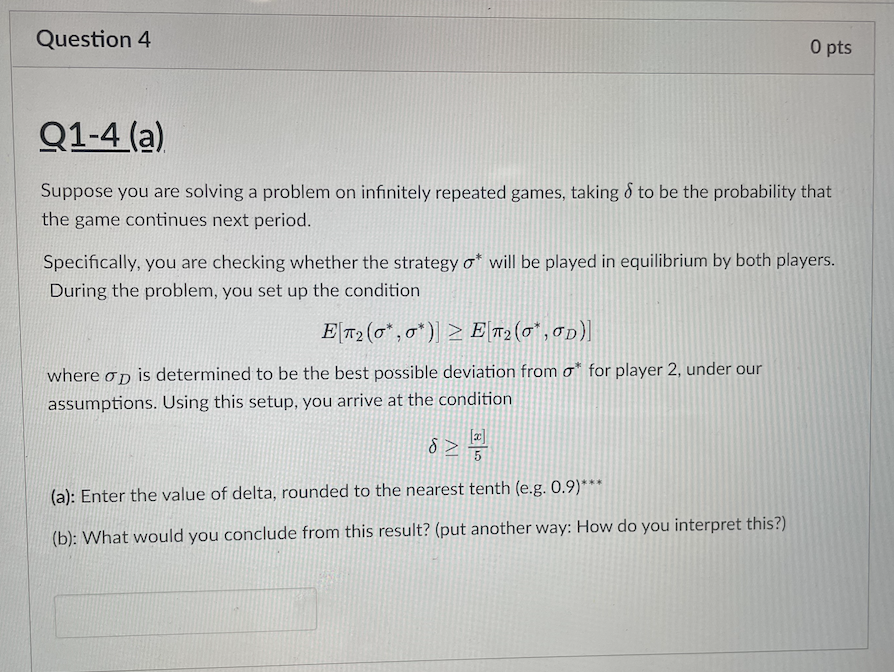
Suppose you are solving a problem on infinitely repeated games, taking to be the probability that the game continues next period. Specifically, you are checking whether the strategy will be played in equilibrium by both players. During the problem, you set up the condition E[2(,)]E[2(,D)] where D is determined to be the best possible deviation from for player 2 , under our assumptions. Using this setup, you arrive at the condition 5[x] (a): Enter the value of delta, rounded to the nearest tenth (e.g. 0.9) (b): What would you conclude from this result? (put another way: How do you interpret this?) Suppose you are solving a problem on infinitely repeated games, taking to be the probability that the game continues next period. Specifically, you are checking whether the strategy will be played in equilibrium by both players. During the problem, you set up the condition E[2(,)]E[2(,D)] where D is determined to be the best possible deviation from for player 2 , under our assumptions. Using this setup, you arrive at the condition 5[x] (a): Enter the value of delta, rounded to the nearest tenth (e.g. 0.9) (b): What would you conclude from this result? (put another way: How do you interpret this?)
Step by Step Solution
There are 3 Steps involved in it

Get step-by-step solutions from verified subject matter experts
 Study Help