







Question: Suppose you have been given responsibility for developing the six month aggravate production plan at Sotogalore, a manufacturer of soft rings. Your company makes three
Suppose you have been given responsibility for developing the six month aggravate production plan at Sotogalore, a manufacturer of soft rings. Your company makes three types of soft drinks: regular, diet, and super caffeinated. Fortunately all three types are made using the same production process, and the costs related to switching between the three types are so minimal that they can be ignored. thus, you can treat your problem as an aggregate planning exercise were planning unit is case of soft rings, regardless of what type of during they are. 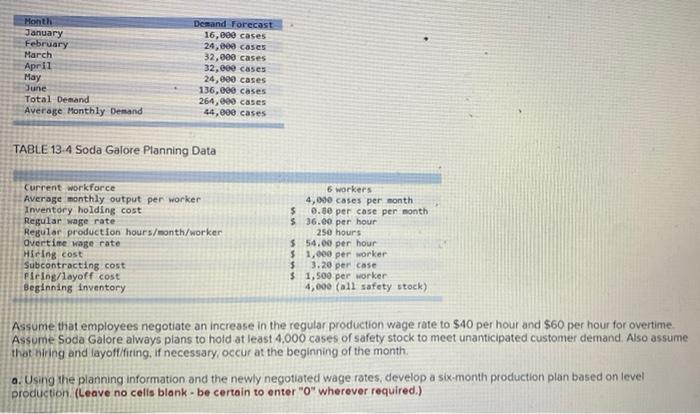
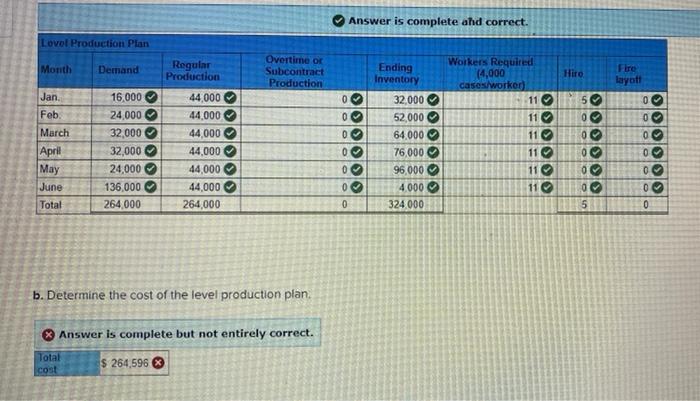
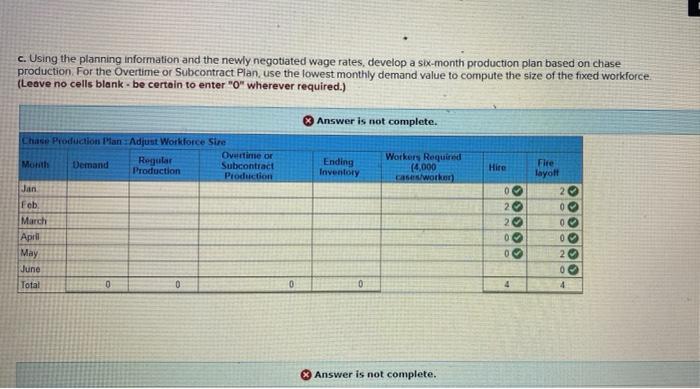
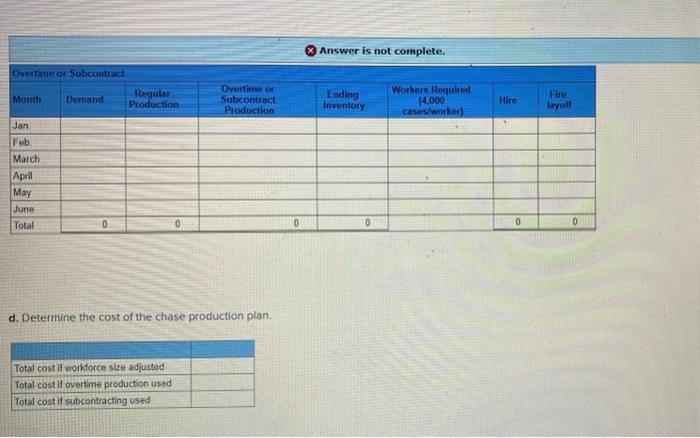
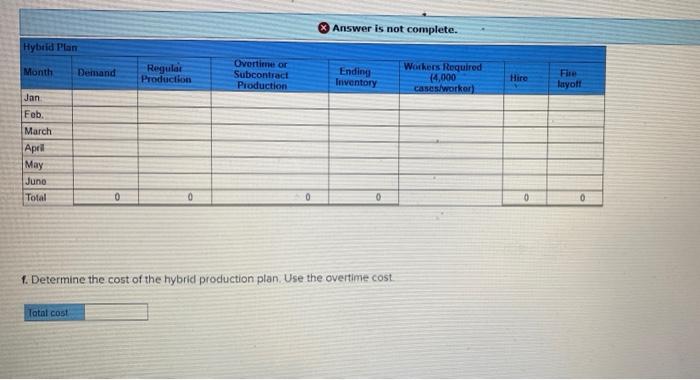
Month January February. March April May June Total Demand Average Monthly Demand TABLE 13-4 Soda Galore Planning Data Current workforce 6 workers Average monthly output per worker Inventory holding cost 4,000 cases per month 0.80 per case per month Regular wage rate Regular production hours/month/worker Overtime wage rate Hiring cost Subcontracting cost Firing/layoff cost Beginning inventory 4,000 (all safety stock) Assume that employees negotiate an increase in the regular production wage rate to $40 per hour and $60 per hour for overtime. Assume Soda Galore always plans to hold at least 4,000 cases of safety stock to meet unanticipated customer demand. Also assume that hiring and layoff/firing, if necessary, occur at the beginning of the month. a. Using the planning information and the newly negotiated wage rates, develop a six-month production plan based on level production (Leave no cells blank - be certain to enter "0" wherever required.) Demand Forecast 16,000 cases 24,000 cases 32,000 cases 32,000 cases 24,000 cases 136,000 cases 264,000 cases 44,000 cases $ $36.00 per hour 250 hours $ 54.00 per hour $1,000 per worker 3.20 per case 1,500 per worker. $ $ Lovel Production Plan Month Demand Regular Production Jan. 44,000 Feb. 44,000 March 44,000 April 44,000 May 44,000 June 136,000 44,000 Total 264,000 264,000 b. Determine the cost of the level production plan. Answer is complete but not entirely correct. Total cost $ 264,596 16,000 24,000 32,000 32,000 24,000 3 > Overtime or Subcontract Production Answer is complete and correct. Ending Inventory Workers Required (4,000 cases/worker) 0- 0 00 03 03 07 0 32,000 52,000 64.000 76,000 96,000 4.000 324.000 000000 11 11 110 11 11 11 Hiro 500000 09 03 03 0 5 Fire layoff 0 00 00 03 00 04 0 c. Using the planning information and the newly negotiated wage rates, develop a six-month production plan based on chase production. For the Overtime or Subcontract Plan, use the lowest monthly demand value to compute the size of the fixed workforce. (Leave no cells blank- be certain to enter "0" wherever required.) Answer is not complete. Chase Production Plan: Adjust Workforce Sire Overtime or Fire Month Demand Regular Production Hire Ending Inventory Subcontract Production layoff Jan Feb. March April May June Total 0 0 0 Workers Required (4,000 cases/worker) 0 Answer is not complete. 00 20 20 04 04 4 20 00 00 00 20 00 4 Overtime or Subcontract Month Demand Regular Production Jan Feb. March April May June Total 0 d. Determine the cost of the chase production plan. Total cost if workforce size adjusted Total cost if overtime production used Total cost if subcontracting used Overtime or Subcontract Production 0 Answer is not complete. Ending Inventory 0 Workers Required (4,000 cases/worker) Hire 0 Fire layott 0 Answer is not complete. Ending Inventory Overtime or Subcontract Production Hybrid Plan Month Demand Regulat Production Jan Feb. March April May Juno Total 0 0 0 0 f. Determine the cost of the hybrid production plan. Use the overtime cost. Total cost Workers Required (4,000 cases/worker) Hire 0 Fire layoff 0 Step by Step Solution
There are 3 Steps involved in it
1 Expert Approved Answer
Step: 1 Unlock

Question Has Been Solved by an Expert!
Get step-by-step solutions from verified subject matter experts
Step: 2 Unlock
Step: 3 Unlock
 Study Help