







Question: Suppose you have designed a certain experiment to test items'1 or L'subjects'1 for some condition. The condition could be a medical one. or L'being defective.
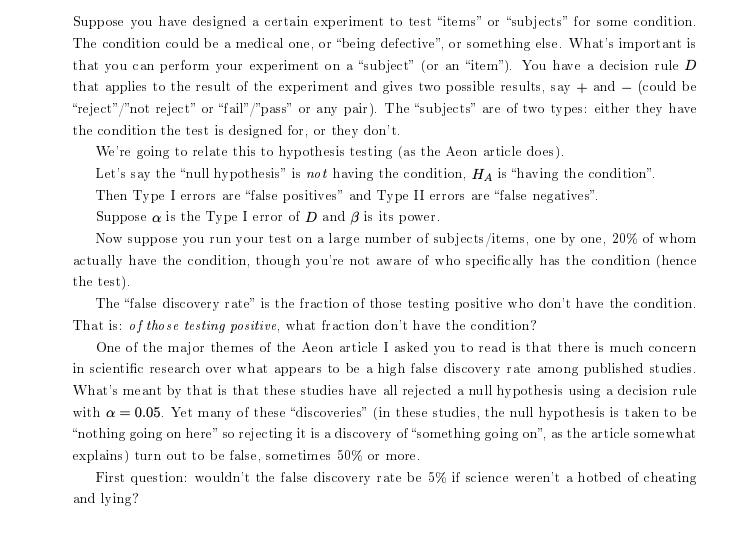
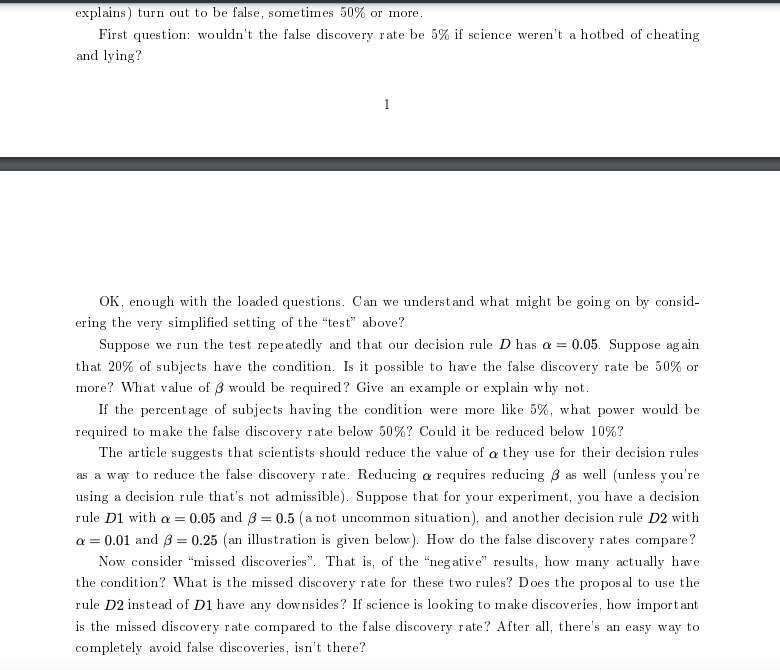
Suppose you have designed a certain experiment to test "items'1 or L'subjects'1 for some condition. The condition could be a medical one. or L'being defective\". or something else. 1What's import ant is that you can perform your experiment on a L'subject'1 [or an L'item":|. You have a decision rule D that applies to the result of the experiment and gives two possible results. say + and [could be L'reject".-""not reject'1 or L'fail".-""pass'1 or any pair]. The L'subjects'1 are of two types: either they have the condition the test is designed for. or they don't. 1We're going to relate this to hypothesis testing [as the Aeon article does]. Let's say the L'null hypothesis'1 is not having the condition. HA is L'having the condition\". Then Type I errors are L'false positives'1 and Type II errors are L'false negatives\". Suppose a is the Type I error of D and .8 is its power. Now suppose you run your test on a large number of subjects.-'items. one by one. 23% of whom actually have the condition. though you're not aware of who specic ally has the condition [hence the test]. The L'false discovery rate'1 is the fraction of those testing positive who don't have the condition. That is: of those testing positive. what fraction don't have the condition? Cine of the major themes of the Aeon article I asked you to read is that there is much concern in scientic research over what appears to be a high false discovery rate among published studies. 1What's me ant by that is that these studies have all rejected a null hypothesis using a decision rule with a = [1.135. Yet many of these L'discoveries'1 [in these studies. the null hypothesis is taken to be L'nothing going on here'1 so rejecting it is a discovery of L'something going on\". as the article somewhat explains] turn out to be false. sometimes 53% or more. First question: wouldn't the false discovery rate be 5% if science weren't a hotbed of cheating and lying? explains] turn out to be false. sometimes 50% or more. First question: wouldn't the false discovery rate be 5% if science weren't a hotbed of cheating and lying? UK. enough with the loaded questions. Can we understand what might be going on by consid- ering the very simplied setting of the \"test" above? Suppose we run the test repeatedly and that our decision rule D has = 0.05. Suppose again that 20% of subjects have the condition. Is it possible to have the false discovery rate be 50% or more? 1What value of .3 would be required? IGive an example or explain why not. If the percent age of subjects having the condition were more like 5%. what power would be required to make the false discovery rate below 50%? Could it be reduced below 10%? The article suggests that scientists should reduce the value of a: they use for their decision rules as a way to reduce the false discovery rate. Reducing .1 requires reducing .6 as well [unless you're using a decision rule that's not admissible). Suppose that for your experiment. you have a decision rule D1 with o: = ll and .6 = [LS [a not uncommon situation]. and another decision rule D2 with a = lll and .3 = 0.25 [an illustration is given below]. How do the false discovery rates compare? Now consider "missed discoveries\". That is. of the "negative'1 results. how many actually have the condition? Mat is the missed discovery rate for these two rules? Does the proposal to use the rule D2 instead of D1 have any downsides? If science is looking to make discoveries. how important is the missed discovery rate compared to the false discovery rate? After all. there's an easy way to completely avoid false discoveries. isn't there
Step by Step Solution
There are 3 Steps involved in it

Get step-by-step solutions from verified subject matter experts
 Study Help