







Question: Suppose you have the function f(x)= e2 .x + 3. x2+ 3 8 5 . x what is the Taylor expansion to the third-order at
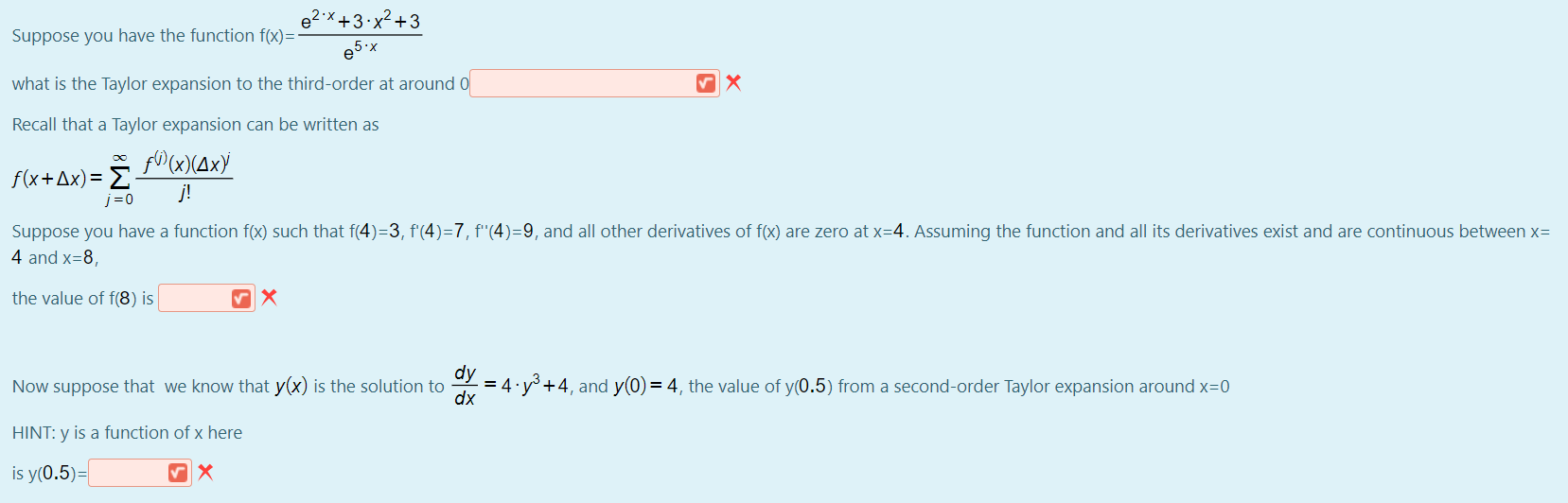
Suppose you have the function f(x)= e2 .x + 3. x2+ 3 8 5 . x what is the Taylor expansion to the third-order at around O V X Recall that a Taylor expansion can be written as f (x+Ax) = fi ( x ) ( 4 x) " M 8 j! Suppose you have a function f(x) such that f(4)=3, f'(4)=7, f"(4)=9, and all other derivatives of f(x) are zero at x=4. Assuming the function and all its derivatives exist and are continuous between x= 4 and x=8, the value of f(8) is VX Now suppose that we know that y(x) is the solution to - = 4 . y3 +4, and y(0) = 4, the value of y(0.5) from a second-order Taylor expansion around x=0 HINT: y is a function of x here is y(0.5)= V X
Step by Step Solution
There are 3 Steps involved in it
1 Expert Approved Answer
Step: 1 Unlock

Question Has Been Solved by an Expert!
Get step-by-step solutions from verified subject matter experts
Step: 2 Unlock
Step: 3 Unlock
 Study Help