



Question: Suppose you were an auditor testing internal controls.The population is 2,000.The control you want to test is the requirement that any check of more than
Suppose you were an auditor testing internal controls.The population is 2,000.The control you want to test is the requirement that any check of more than $25,000 needs to be approved by two officials.Because of limitations in technology (i.e. the inability to use a machine to scan all checks for signatures), it is deemed too expensive to manually audit all 2,000 checks.Instead, we decide to rely on a random sample of 100 checks (i.e we will test 5 percent of the population).The auditor believes that up to 10 percent of all checks do not have the required controls, but that is ok.In other words, the auditor is willing to rely on the controls if the deviation rate is 10 percent, but not if the deviation rate is higher than 10 percent.The purpose of the audit will be to obtain evidence that the deviation rate in the population is no larger than 10 percent.
Questions
1.Discuss the difference between the following terms (ex ante means before observing the sample evidence; ex post means after observing the sample evidence):
a.Expected population deviation rate, ex ante
b.Expected sample deviation rate, ex ante
c.Observed sample deviation rate, ex post
d.Expected upper limit of population, ex post
2.Based on the information above, what is the expected ex ante sample deviation rate? Explain (not a trick question)
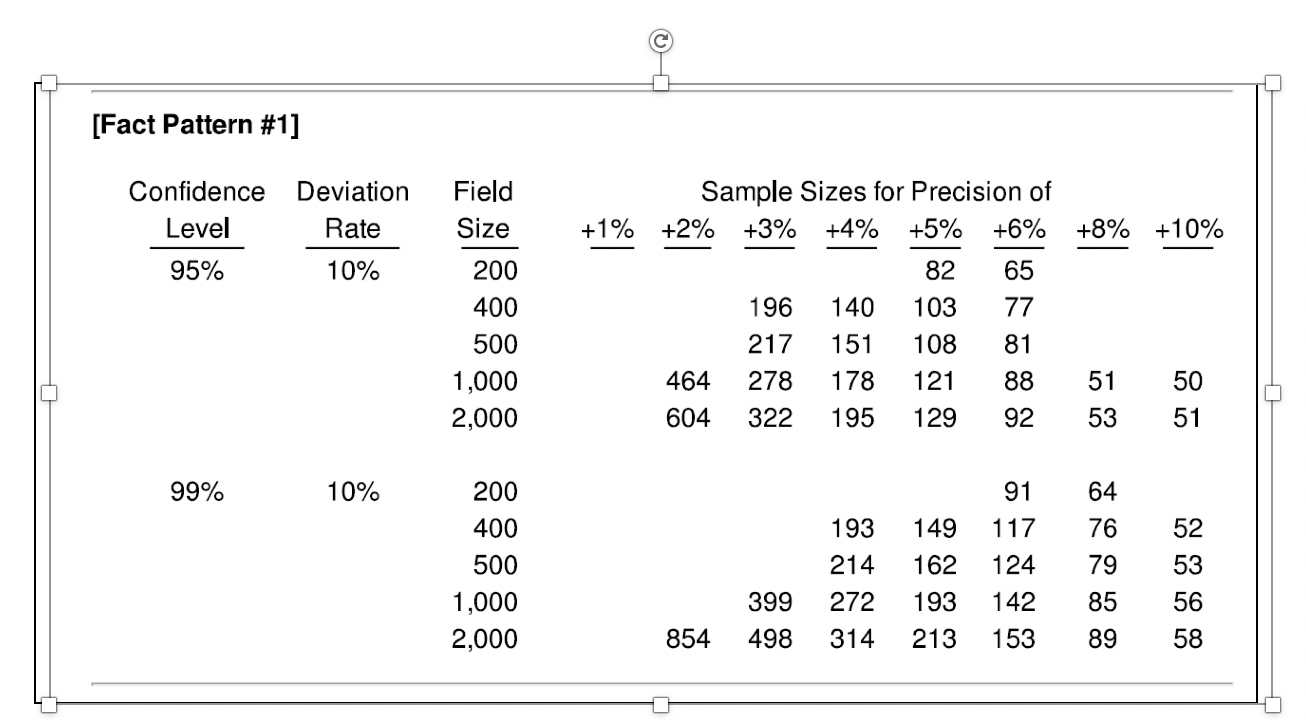
[Fact Pattern #1] Confidence Deviation Sample Sizes for Precision of Level Rate +1 % +2% +3% +4% +5% +15% +8% +10% 95% 10% 82 65 196 140 103 77 217 151 108 81 278 178 121 88 322 195 129 92 99% 1 0% 91
Step by Step Solution
There are 3 Steps involved in it

Get step-by-step solutions from verified subject matter experts