







Question: Suppose you're looking at a flow network G with source s and sink t, and you want to be able to express something like the
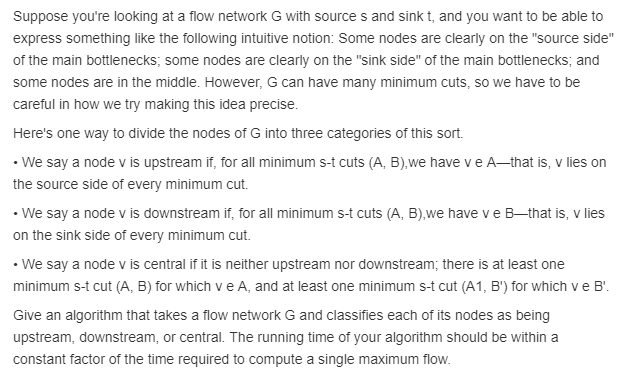
Suppose you're looking at a flow network G with source s and sink t, and you want to be able to express something like the following intuitive notion: Some nodes are clearly on the "source side" of the main bottlenecks, some nodes are clearly on the "sink side" of the main bottlenecks, and some nodes are in the middle. However, G can have many minimum cuts, so we have to be careful in how we try making this idea precise Here's one way to divide the nodes of G into three categories of this sort. .We say a node v is upstream if, for all minimum s-t cuts (A, B),we have v e A-that is, v lies on the source side of every minimum cut. . We say a node v is downstream if, for all minimum s-t cuts (A, B),we have v e B-that is, v lies on the sink side of every minimum cut. . We say a node v is central if it is neither upstream nor downstream, there is at least one minimum s-t cut (A. B) for which v e A, and at least one minimum s-t cut (A1, B') for which v e B' Give an algorithm that takes a flow network G and classifies each of its nodes as being upstream, downstream, or central. The running time of your algorithm should be within a constant factor of the time required to compute a single maximum flow
Step by Step Solution
There are 3 Steps involved in it

Get step-by-step solutions from verified subject matter experts
 Study Help