







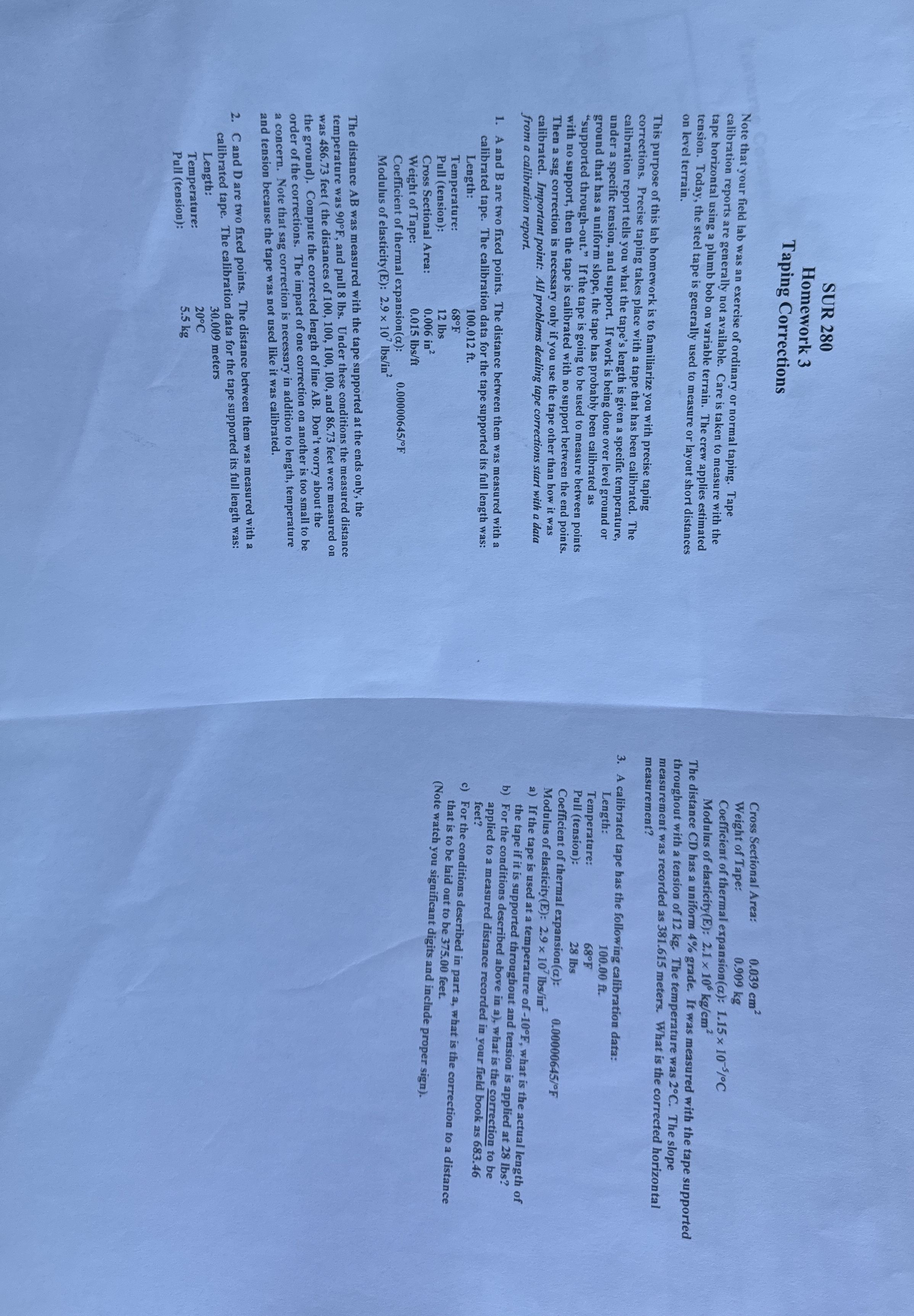
Question: SUR 2 8 0 Homework 3 Taping Corrections Note that your field lab was an exercise of ordinary or normal taping. Tape calibration reports are
SUR
Homework Taping Corrections
Note that your field lab was an exercise of ordinary or normal taping. Tape calibration reports are generally not available. Care is taken to measure with the tape horizontal using a plumb bob on variable terrain. The crew applies estimated tension. Today, the steel tape is generally used to measure or layout short distances on level terrain.
This purpose of this lab homework is to familiarize you with precise taping corrections. Precise taping takes place with a tape that has been calibrated. The calibration report tells you what the tape's length is given a specific temperature, under a specific tension, and support. If work is being done over level ground or ground that has a uniform slope, the tape has probably been calibrated as "supported throughout." If the tape is going to be used to measure between points with no support, then the tape is calibrated with no support between the end points. Then a sag correction is necessary only if you use the tape other than how it was calibrated. Important point: All problems dealing tape corrections start with a data from a calibration report.
A and are two fixed points. The distance between them was measured with a calibrated tape. The calibration data for the tape supported its full length was:
Length: ft
Temperature:
Pull tension:
Cross Sectional Area: in
Weight of Tape:
Coefficient of thermal expansion :
Modulus of elasticityE:
The distance was measured with the tape supported at the ends only, the temperature was and pull lbs Under these conditions the measured distance was feet the distances of and feet were measured on the ground Compute the corrected length of line AB Don't worry about the order of the corrections. The impact of one correction on another is too small to be a concern. Note that sag correction is necessary in addition to length, temperature and tension because the tape was not used like it was calibrated.
and are two fixed points. The distance between them was measured with a calibrated tape. The calibration data for the tape supported its full length was:
Length:
meters
Temperature:
Pull tension:
Cross Sectional Area:
Weight of Tape:
Coefficient of thermal expansion :
Modulus of elasticityE:
The distance CD has a uniform grade. It was measured with the tape supported throughout with a tension of kg The temperature was The slope measurement was recorded as meters. What is the corrected horizontal measurement?
A calibrated tape has the following calibration data:
Length:
Temperature:
Pull tension:
Coefficient of thermal expansion :
Modulus of elasticity :
a If the tape is used at a temperature of what is the actual length of the tape if it is supported throughout and tension is applied at lbs
b For the conditions deseribed above in a what is the correction to be applied to a measured distance recorded in your field book as feet?
c For the conditions described in part a what is the correction to a distance that is to be laid out to be feet.
Note watch you significant digits and include proper sign
Step by Step Solution
There are 3 Steps involved in it
1 Expert Approved Answer
Step: 1 Unlock

Question Has Been Solved by an Expert!
Get step-by-step solutions from verified subject matter experts
Step: 2 Unlock
Step: 3 Unlock
 Study Help