







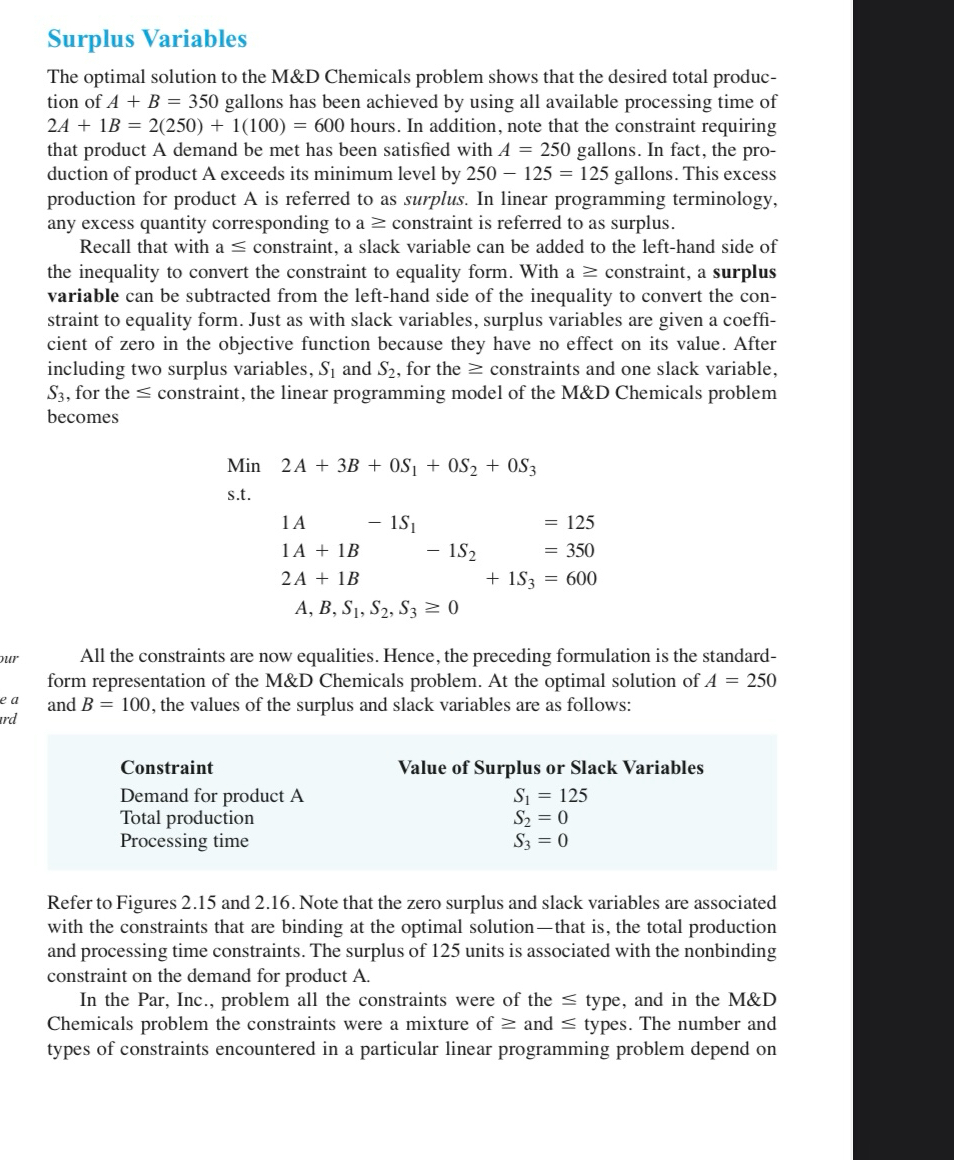
Question: Surplus Variables The optimal solution to the M&D Chemicals problem shows that the desired total production of A + B = 3 5 0 gallons
Surplus Variables
The optimal solution to the M&D Chemicals problem shows that the desired total production of gallons has been achieved by using all available processing time of hours. In addition, note that the constraint requiring that product A demand be met has been satisfied with gallons. In fact, the production of product A exceeds its minimum level by gallons. This excess production for product A is referred to as surplus. In linear programming terminology, any excess quantity corresponding to constraint is referred to as surplus.
Recall that with constraint, a slack variable can be added to the lefthand side of the inequality to convert the constraint to equality form. With constraint, a surplus variable can be subtracted from the lefthand side of the inequality to convert the constraint to equality form. Just as with slack variables, surplus variables are given a coefficient of zero in the objective function because they have no effect on its value. After including two surplus variables, and for the constraints and one slack variable, for the constraint, the linear programming model of the M&D Chemicals problem becomes
Min
All the constraints are now equalities. Hence, the preceding formulation is the standardform representation of the M&D Chemicals problem. At the optimal solution of and the values of the surplus and slack variables are as follows:
Constraint
Demand for product A
Total production
Processing time
Value of Surplus or Slack Variables
Refer to Figures and Note that the zero surplus and slack variables are associated with the constraints that are binding at the optimal solution that is the total production and processing time constraints. The surplus of units is associated with the nonbinding constraint on the demand for product
In the Par, Inc., problem all the constraints were of the type, and in the M&D Chemicals problem the constraints were a mixture of and types. The number and types of constraints encountered in a particular linear programming problem depend on
Step by Step Solution
There are 3 Steps involved in it
1 Expert Approved Answer
Step: 1 Unlock

Question Has Been Solved by an Expert!
Get step-by-step solutions from verified subject matter experts
Step: 2 Unlock
Step: 3 Unlock
 Study Help