







Question: Survey Assignment For this assignment, you are developing a questionnaire in Qualtrics to address the 2 research questions below. Please refer to examples in the
Survey Assignment
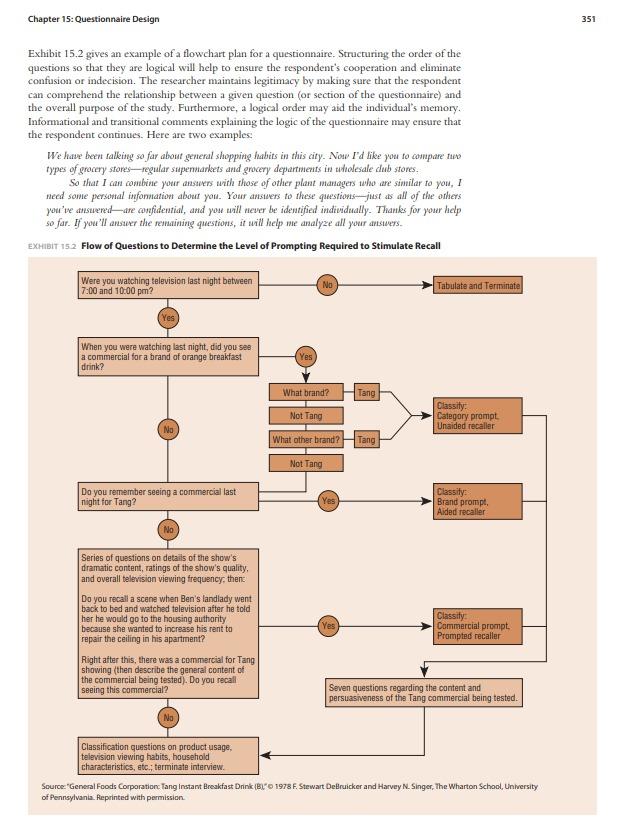
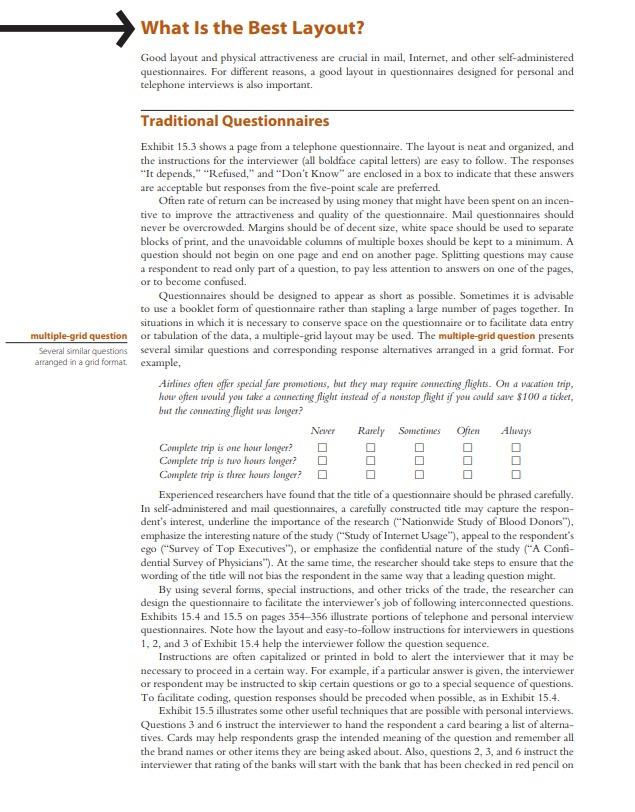
For this assignment, you are developing a questionnaire in Qualtrics to address the 2 research questions below. Please refer to examples in the text (e.g. Exhibit 15.2 on pg. 349 for the flow of a questionnaire and Exhibits 15.3 15.5 on pp 351- 354 for questionnaire examples) and the instructions/examples below for guidance. Be sure that your questions measure constructs/variables that will allow you to address the research questions.
For the questionnaire, I encourage you to use online and library resources to find good scales. Some constructs, like customer satisfaction, need to be measured with a multi-item scale. There are many sources available online and through the library. For the assignment, not all questions/items have to come from pre-established scales. However, most of your scales should so that they are more likely to be valid and reliable.
For some examples of scales, please see the examples below. For an example of a survey in Qualtrics, please see the class example in Qualtrics (to be shared with you once you receive access to Qualtrics). Remember, there are several kinds of attitude scales you may use.
Background and research questions
A hotel chain has recently undergone renovations to revitalize its brand. It has remodeled several of its hotels features/amenities such as their indoor pools, restaurants, and lobbies. Additionally, they have invested in retraining their staff to increase the quality of their service.
The hotel chain would like to know what effect the changes have had on customer satisfaction. Therefore, they are distributing surveys to guests at the hotel to answer the following research questions:
What do guests think about the remodeled hotel? Are they satisfied with the changes?
What features/amenities do they like/dislike about the hotel?
What do they think about the quality of the service?
Would they recommend the hotel to friends and family?
Which segments of customers are most satisfied with the remodeled hotel? Which segments are more likely to recommend the hotel?
Remember, the questions on the questionnaire should address the research questions. Think about the constructs you need to measure to answer the research questions. My advice is to list out the constructs you need to measure first. Then, decide how you will measure them. For segmentation questions, recall that there are several segmentation bases: demographics, geographics, etc. The slide deck for the assignment gives the segmentation bases and details. If you have any questions, please let me know. Good luck!
Example 1:
HOW DO YOU FEEL ABOUT THE BRAND YOU SELL?
For the question below, please let us know how well each of describes you and your relationship with the brand you sell.
| Brand Identification (Mael and Ashforth, 1992) | Strongly Disagree (1) | Disagree (2) | Disagree Somewhat (3) | Neither Agree nor Disagree (4) | Agree Somewhat (5) | Agree (6) | Strongly Agree (7) |
| When someone criticizes my brand, it feels like a personal insult. | |||||||
| I am very interested in what others think about my brand. | |||||||
| When I talk about my brand, I usually say we rather than they. | |||||||
| My brand's successes are my successes. | |||||||
| When someone praises my brand, it feels like a personal compliment. | |||||||
| If a story in the media criticized my brand, I would feel embarrassed. | |||||||
| I use this brand to communicate who I am to other people. | |||||||
| I can identify with this brand. |
Example 2:
Occupation
The following information is needed for classification and comparison purposes only. Your responses will remain confidential.
What is your primary role?
Sales Consultant
Sales Manager
Finance Manager
Other (Please Specify): ____________________
Chapter 15: Questionnaire Design Exhibit 15.2 gives an example of a flowchart plan for a questionnaire. Structuring the order of the questions so that they are logical will help to ensure the respondent's cooperation and eliminate confusion or indecision. The researcher maintains legitimacy by making sure that the respondent can comprehend the relationship between a given question (or section of the questionnaire) and the overall purpose of the study. Furthemore, a logical order may aid the individual's memory. Informational and transitional comments explaining the logic of the questionnaire may ensure that the respondent continues. Here are two examples: We have been talking so far about general shopping habits in this city. Now I'd like you to compare two types of grocery stores-regular supennarkets and grocery departments in thiolesale dlub stores. So that I can combine your ansavers with those of other plant managers who are similar to you, I need some personal infomnation about you. Your answers to these questions-just as all of the orhers You've ansuered-are confidential, and you nill never be identified individually. Thanks for your help so far. If you'll answer the renaining questions, it will help me analyze all your answers. EXHABiT 15. Flow of Questions to Determine the Level of Prompting Required to Stimulate Recall Good layout and physical attractiveness are crucial in mail, Internet, and other self-administered questionnaires. For different reasons, a good layout in questionnaires designed for personal and telephone interviews is also important. Traditional Questionnaires Exhibit 15.3 shows a page from a telephone questionnaire. The layout is neat and organized, and the instructions for the interviewer (all boldface capital letters) are easy to follow. The responses "It depends," "Refused," and "Don't Know" are enclosed in a box to indicate that these answers are acceptable but responses from the five-point scale are preferred. Often rate of return can be increased by using money that might have been spent on an incentive to improve the attractiveness and quality of the questionnaire. Mail questionnaires should never be overcrowded. Margins should be of decent size, white space should be used to separate blocks of print, and the unavoidable columns of multiple boxes should be kept to a minimum. A question should not begin on one page and end on another page. Splitting questions may cause a respondent to read only part of a question, to pay less attention to answers on one of the pages, or to become confused. Questionnaires should be designed to appear as short as possible. Sometimes it is advisable to use a booklet form of questionnaire rather than stapling a large number of pages together. In situations in which it is necessary to conserve space on the questionnaire or to facilitate data entry or tabulation of the data, a multiple-grid layout may be used. The multiple-grid question presents several similar questions and corresponding response alternatives arranged in a grid format. For example, Airlines often offer special fare promotions, but they may require connecting flights. On a vacation trip, how often would you take a connering flight instead of a nonstop flight if wou could sare $100 a tidket, but the connecting flight was longer? Experienced rescarchers have found that the title of a questionnaire should be phrased carefully. In self-administered and mail questionnaires, a carefully conscructed title may capture the respondent's interest, underline the importance of the research ("Nationwide Study of Blood Donors"), emphasize the interesting nature of the study ("Study of Intemet Usage"), appeal to the respondent's ego ("Survey of Top Executives"), or emphasize the confidential nature of the study ("A Confidential Survey of Physicians"). At the same time, the researcher should take steps to ensure that the wording of the tidle will not bias the respondent in the same way that a leading question might. By using several forms, special instructions, and other tricks of the trade, the researcher can design the questionnaire to facilitate the interviewer's job of following interconnected questions. Exhibits 15.4 and 15.5 on pages 354-356 illustrate portions of telephone and personal interview questionnaires. Note how the layout and easy-to-follow instructions for interviewers in questions 1,2 , and 3 of Exhibit 15.4 help the interviewer follow the question sequence. Instructions are often capitalized or printed in bold to alert the interviewer that it may be necessary to proceed in a certain way. For example, if a particular answer is given, the interviewer or respondent may be instructed to skip certain questions or go to a special sequence of questions. To facilitate coding, question responses should be precoded when possible, as in Exhibit 15.4. Exhibit 15.5 illustrates some other useful techniques that are possible with personal interviews. Questions 3 and 6 instruct the interviewer to hand the respondent a card bearing a list of alternarives. Cards may help respondents grasp the intended meaning of the question and remember all the brand names or other items they are being asked about. Also, questions 2,3 , and 6 instruct the interviewer that rating of the banks will start with the bank that has been checked in red pencil on
Step by Step Solution
There are 3 Steps involved in it

Get step-by-step solutions from verified subject matter experts
 Study Help