







Question: sustainability Management project. kindly write a report for this project posted below. thoroughly go through every heading and write the final report. I am not
sustainability Management project. kindly write a report for this project posted below. thoroughly go through every heading and write the final report. I am not asking for guidance on how to write but the complete report.
thank you
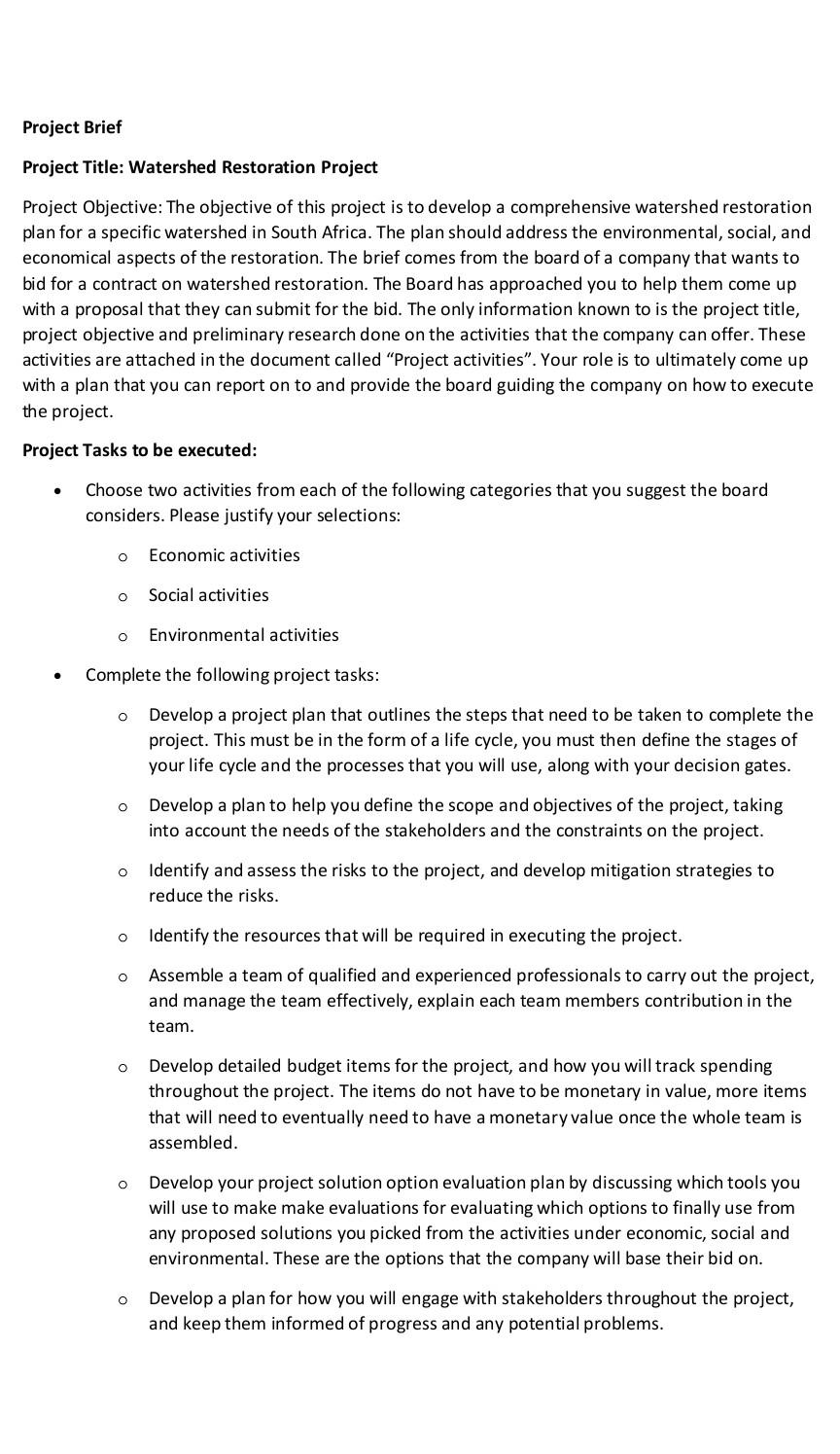
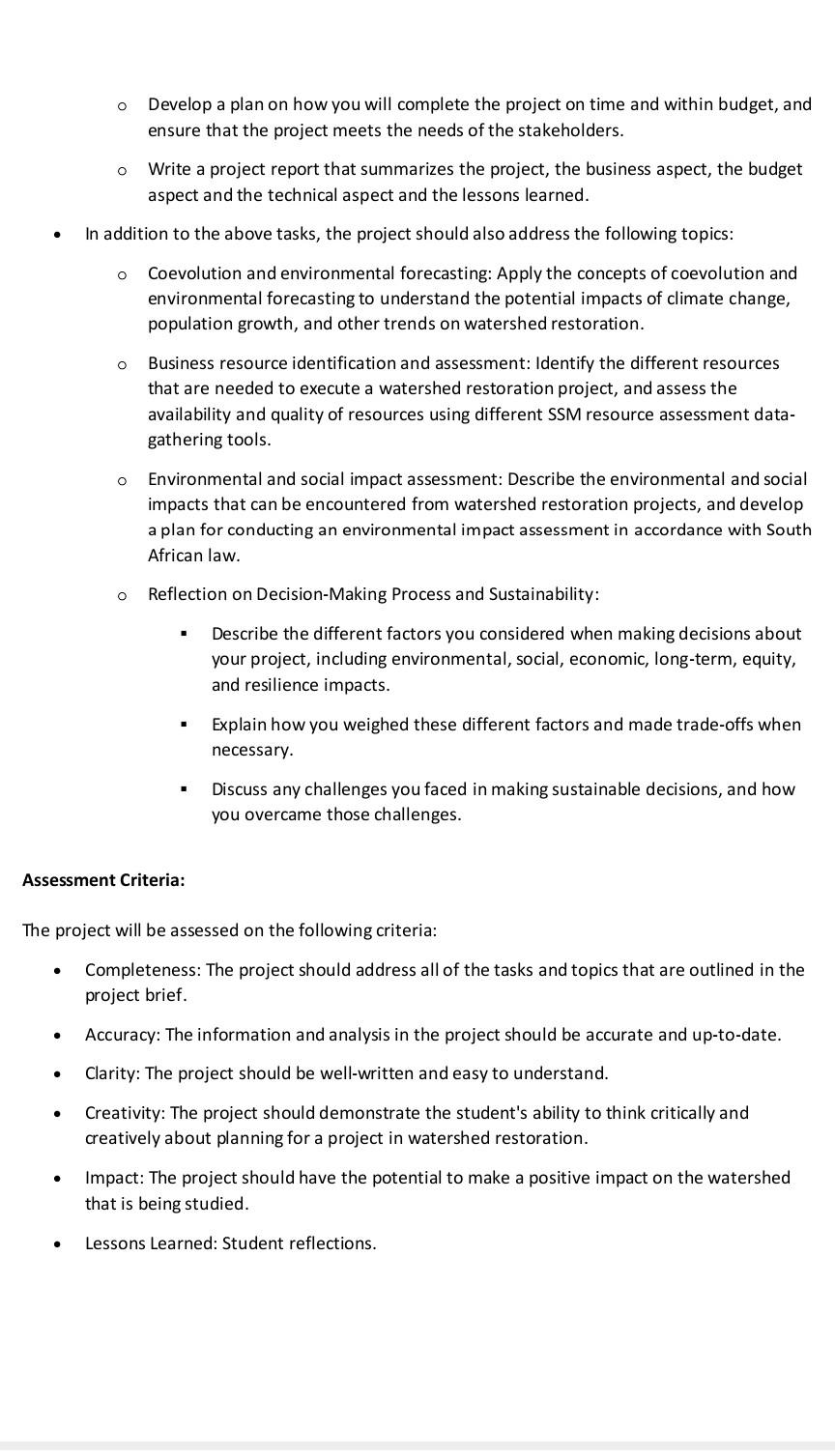
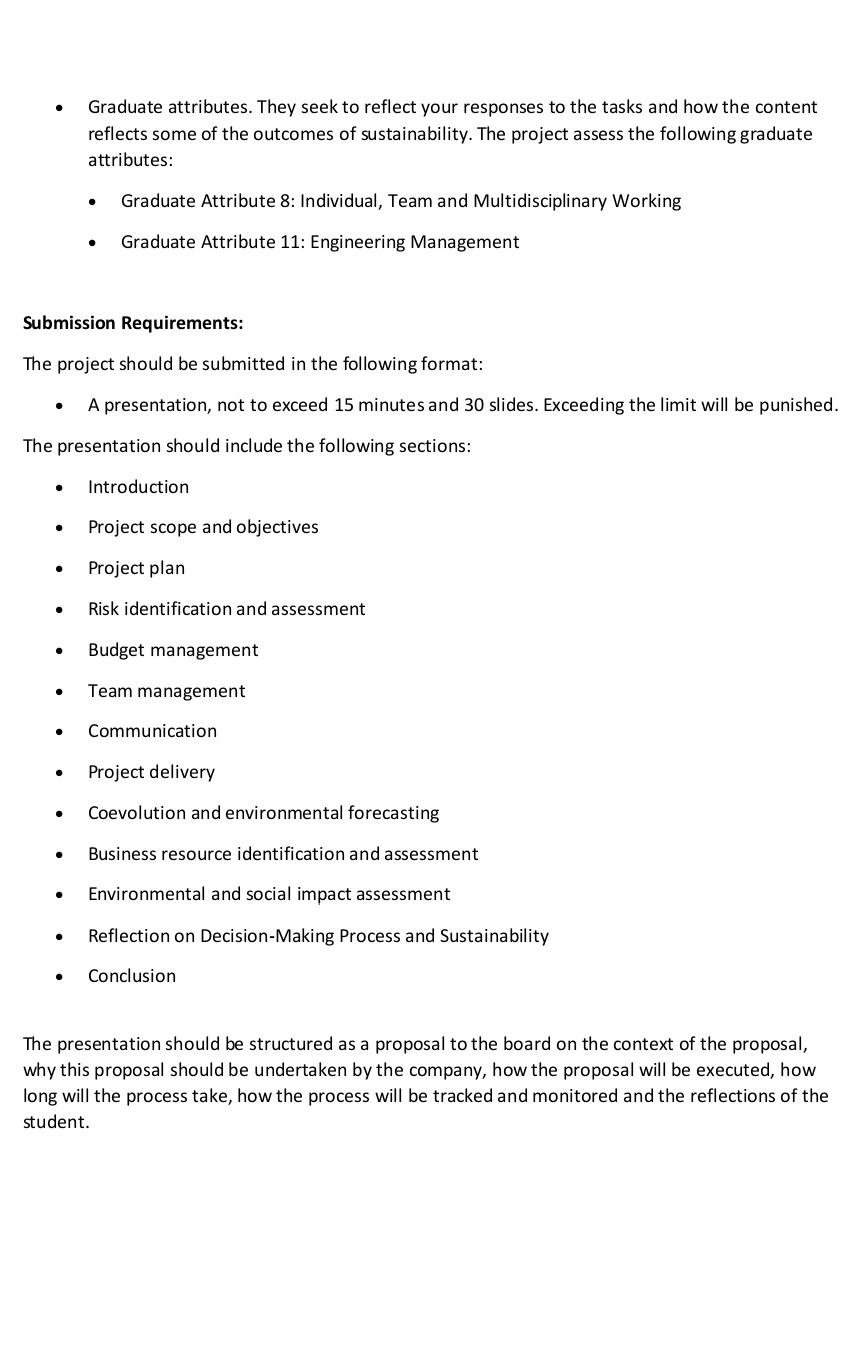
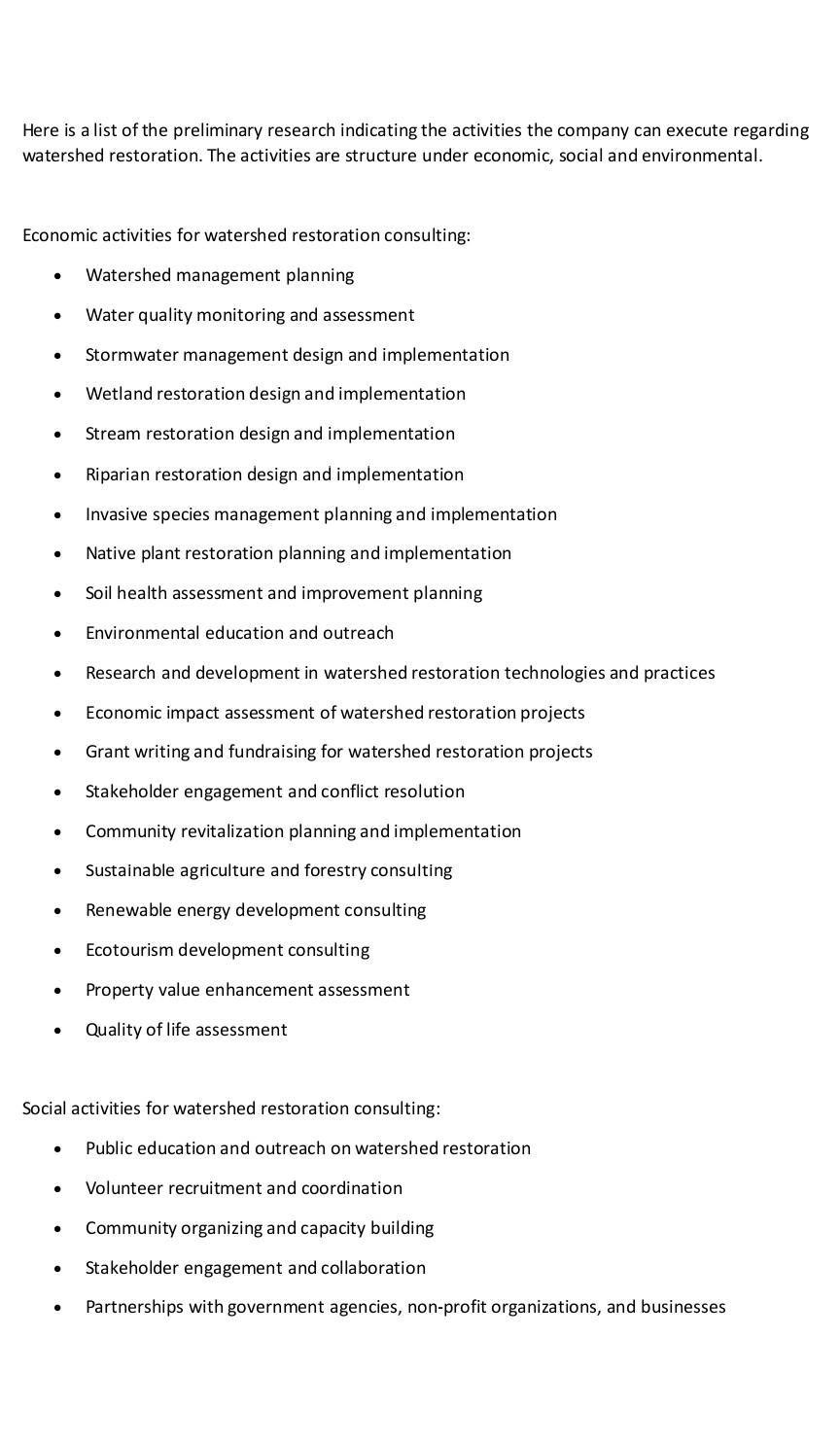
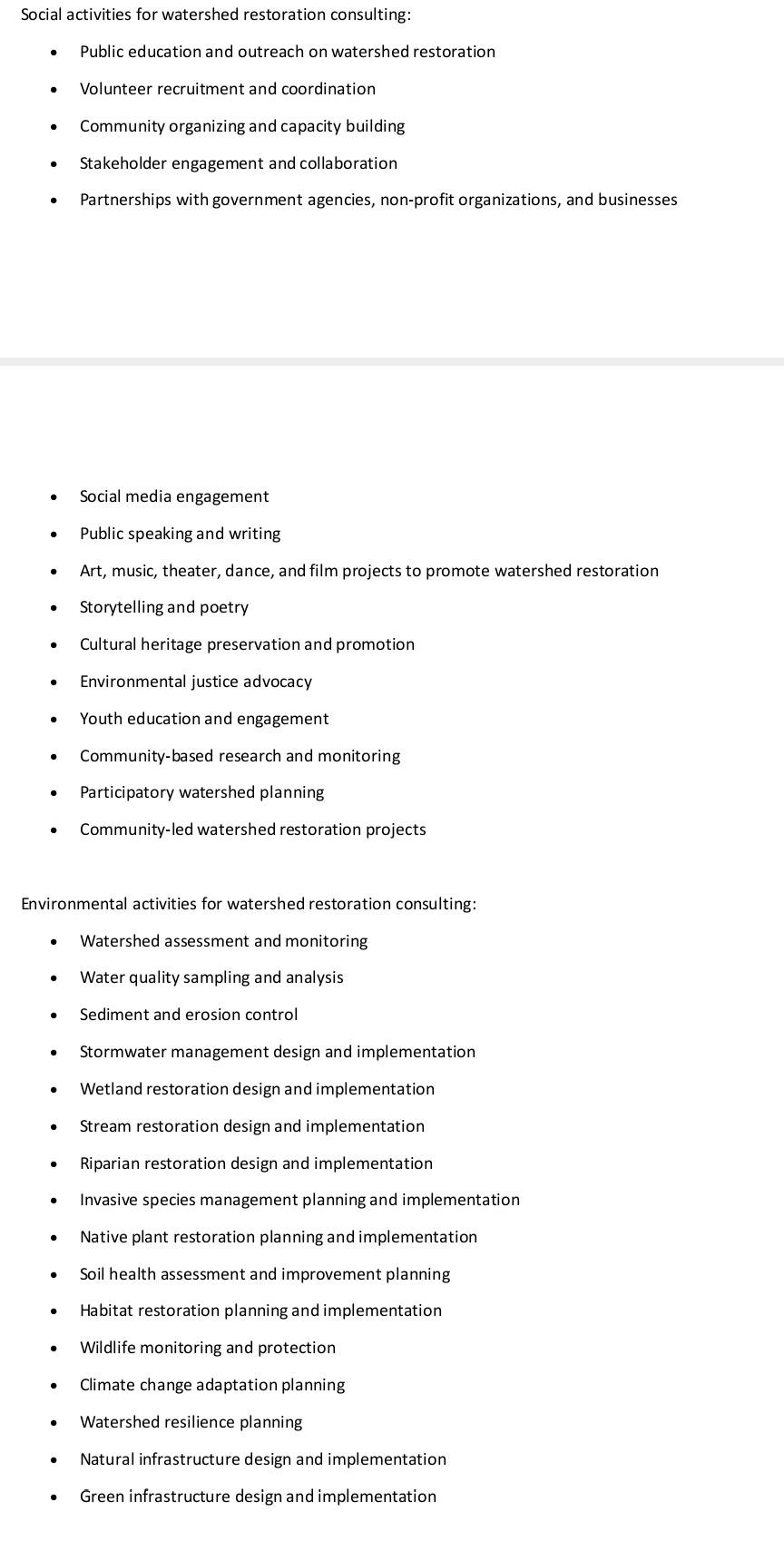
Project Brief Project Title: Watershed Restoration Project Project Objective: The objective of this project is to develop a comprehensive watershed restoration plan for a specific watershed in South Africa. The plan should address the environmental, social, and economical aspects of the restoration. The brief comes from the board of a company that wants to bid for a contract on watershed restoration. The Board has approached you to help them come up with a proposal that they can submit for the bid. The only information known to is the project title, project objective and preliminary research done on the activities that the company can offer. These activities are attached in the document called "Project activities". Your role is to ultimately come up with a plan that you can report on to and provide the board guiding the company on how to execute the project. Project Tasks to be executed: - Choose two activities from each of the following categories that you suggest the board considers. Please justify your selections: - Economic activities Social activities Environmental activities - Complete the following project tasks: - Develop a project plan that outlines the steps that need to be taken to complete the project. This must be in the form of a life cycle, you must then define the stages of your life cycle and the processes that you will use, along with your decision gates. - Develop a plan to help you define the scope and objectives of the project, taking into account the needs of the stakeholders and the constraints on the project. - Identify and assess the risks to the project, and develop mitigation strategies to reduce the risks. - Identify the resources that will be required in executing the project. - Assemble a team of qualified and experienced professionals to carry out the project, and manage the team effectively, explain each team members contribution in the team. - Develop detailed budget items for the project, and how you will track spending throughout the project. The items do not have to be monetary in value, more items that will need to eventually need to have a monetary value once the whole team is assembled. - Develop your project solution option evaluation plan by discussing which tools you will use to make make evaluations for evaluating which options to finally use from any proposed solutions you picked from the activities under economic, social and environmental. These are the options that the company will base their bid on. - Develop a plan for how you will engage with stakeholders throughout the project, and keep them informed of progress and any potential problems. - Develop a plan on how you will complete the project on time and within budget, and ensure that the project meets the needs of the stakeholders. - Write a project report that summarizes the project, the business aspect, the budget aspect and the technical aspect and the lessons learned. - In addition to the above tasks, the project should also address the following topics: - Coevolution and environmental forecasting: Apply the concepts of coevolution and environmental forecasting to understand the potential impacts of climate change, population growth, and other trends on watershed restoration. - Business resource identification and assessment: Identify the different resources that are needed to execute a watershed restoration project, and assess the availability and quality of resources using different SSM resource assessment datagathering tools. - Environmental and social impact assessment: Describe the environmental and social impacts that can be encountered from watershed restoration projects, and develop a plan for conducting an environmental impact assessment in accordance with South African law. - Reflection on Decision-Making Process and Sustainability: - Describe the different factors you considered when making decisions about your project, including environmental, social, economic, long-term, equity, and resilience impacts. - Explain how you weighed these different factors and made trade-offs when necessary. - Discuss any challenges you faced in making sustainable decisions, and how you overcame those challenges. Assessment Criteria: The project will be assessed on the following criteria: - Completeness: The project should address all of the tasks and topics that are outlined in the project brief. - Accuracy: The information and analysis in the project should be accurate and up-to-date. - Clarity: The project should be well-written and easy to understand. - Creativity: The project should demonstrate the student's ability to think critically and creatively about planning for a project in watershed restoration. - Impact: The project should have the potential to make a positive impact on the watershed that is being studied. - Lessons Learned: Student reflections. - Graduate attributes. They seek to reflect your responses to the tasks and how the content reflects some of the outcomes of sustainability. The project assess the following graduate attributes: - Graduate Attribute 8: Individual, Team and Multidisciplinary Working - Graduate Attribute 11: Engineering Management Submission Requirements: The project should be submitted in the following format: - A presentation, not to exceed 15 minutes and 30 slides. Exceeding the limit will be punished. The presentation should include the following sections: - Introduction - Project scope and objectives - Project plan - Risk identification and assessment - Budget management - Team management - Communication - Project delivery - Coevolution and environmental forecasting - Business resource identification and assessment - Environmental and social impact assessment - Reflection on Decision-Making Process and Sustainability - Conclusion The presentation should be structured as a proposal to the board on the context of the proposal, why this proposal should be undertaken by the company, how the proposal will be executed, how long will the process take, how the process will be tracked and monitored and the reflections of the student. Here is a list of the preliminary research indicating the activities the company can execute regardi watershed restoration. The activities are structure under economic, social and environmental. Economic activities for watershed restoration consulting: - Watershed management planning - Water quality monitoring and assessment - Stormwater management design and implementation - Wetland restoration design and implementation - Stream restoration design and implementation - Riparian restoration design and implementation - Invasive species management planning and implementation - Native plant restoration planning and implementation - Soil health assessment and improvement planning - Environmental education and outreach - Research and development in watershed restoration technologies and practices - Economic impact assessment of watershed restoration projects - Grant writing and fundraising for watershed restoration projects - Stakeholder engagement and conflict resolution - Community revitalization planning and implementation - Sustainable agriculture and forestry consulting - Renewable energy development consulting - Ecotourism development consulting - Property value enhancement assessment - Quality of life assessment Social activities for watershed restoration consulting: - Public education and outreach on watershed restoration - Volunteer recruitment and coordination - Community organizing and capacity building - Stakeholder engagement and collaboration - Partnerships with government agencies, non-profit organizations, and businesses Social activities for watershed restoration consulting: - Public education and outreach on watershed restoration - Volunteer recruitment and coordination - Community organizing and capacity building - Stakeholder engagement and collaboration - Partnerships with government agencies, non-profit organizations, and businesses - Social media engagement - Public speaking and writing - Art, music, theater, dance, and film projects to promote watershed restoration - Storytelling and poetry - Cultural heritage preservation and promotion - Environmental justice advocacy - Youth education and engagement - Community-based research and monitoring - Participatory watershed planning - Community-led watershed restoration projects Environmental activities for watershed restoration consulting: - Watershed assessment and monitoring - Water quality sampling and analysis - Sediment and erosion control - Stormwater management design and implementation - Wetland restoration design and implementation - Stream restoration design and implementation - Riparian restoration design and implementation - Invasive species management planning and implementation - Native plant restoration planning and implementation - Soil health assessment and improvement planning - Habitat restoration planning and implementation - Wildlife monitoring and protection - Climate change adaptation planning - Watershed resilience planning - Natural infrastructure design and implementation - Green infrastructure design and implementation
Step by Step Solution
There are 3 Steps involved in it

Get step-by-step solutions from verified subject matter experts
 Study Help