







Question: Syllabus 1. Introduction - Application Development Cycle in C++ - C++ Program Format 2. Language Basic Elements - Literals in C++ - Numerical Literals. Character
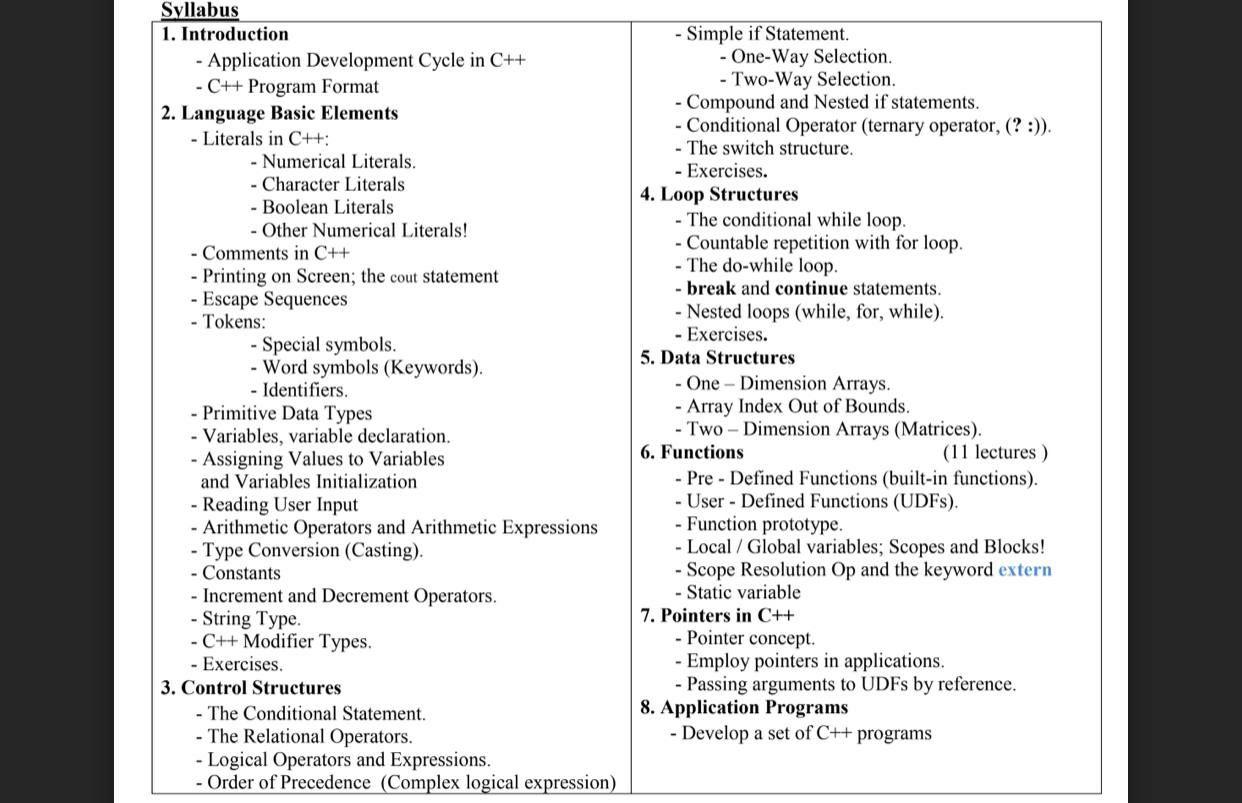
Syllabus 1. Introduction - Application Development Cycle in C++ - C++ Program Format 2. Language Basic Elements - Literals in C++ - Numerical Literals. Character Literals - Boolean Literals - Other Numerical Literals! - Comments in C++ - Printing on Screen; the cout statement - Escape Sequences - Tokens: - Special symbols. Word symbols (Keywords). - Identifiers. - Primitive Data Types - Variables, variable declaration. - Assigning Values to Variables and Variables Initialization - Reading User Input - Arithmetic Operators and Arithmetic Expressions - Type Conversion (Casting). - Constants - Increment and Decrement Operators. - String Type. - C++ Modifier Types. - Exercises. 3. Control Structures - The Conditional Statement. - The Relational Operators. - Logical Operators and Expressions. Order of Precedence (Complex logical expression) - Simple if Statement. One-Way Selection. Two-Way Selection. - Compound and Nested if statements. - Conditional Operator (ternary operator, (? :)). - The switch structure. - Exercises. 4. Loop Structures - The conditional while loop. - Countable repetition with for loop. - The do-while loop. - break and continue statements. - Nested loops (while, for, while). - Exercises. 5. Data Structures - One - Dimension Arrays. - Array Index Out of Bounds. - Two - Dimension Arrays (Matrices). 6. Functions (11 lectures) - Pre - Defined Functions (built-in functions). - User - Defined Functions (UDFs). - Function prototype. - Local / Global variables; Scopes and Blocks! - Scope Resolution Op and the keyword extern - Static variable 7. Pointers in C++ - Pointer concept. - Employ pointers in applications, - Passing arguments to UDFs by reference, 8. Application Programs - Develop a set of C++ programs Syllabus 1. Introduction - Application Development Cycle in C++ - C++ Program Format 2. Language Basic Elements - Literals in C++ - Numerical Literals. Character Literals - Boolean Literals - Other Numerical Literals! - Comments in C++ - Printing on Screen; the cout statement - Escape Sequences - Tokens: - Special symbols. Word symbols (Keywords). - Identifiers. - Primitive Data Types - Variables, variable declaration. - Assigning Values to Variables and Variables Initialization - Reading User Input - Arithmetic Operators and Arithmetic Expressions - Type Conversion (Casting). - Constants - Increment and Decrement Operators. - String Type. - C++ Modifier Types. - Exercises. 3. Control Structures - The Conditional Statement. - The Relational Operators. - Logical Operators and Expressions. Order of Precedence (Complex logical expression) - Simple if Statement. One-Way Selection. Two-Way Selection. - Compound and Nested if statements. - Conditional Operator (ternary operator, (? :)). - The switch structure. - Exercises. 4. Loop Structures - The conditional while loop. - Countable repetition with for loop. - The do-while loop. - break and continue statements. - Nested loops (while, for, while). - Exercises. 5. Data Structures - One - Dimension Arrays. - Array Index Out of Bounds. - Two - Dimension Arrays (Matrices). 6. Functions (11 lectures) - Pre - Defined Functions (built-in functions). - User - Defined Functions (UDFs). - Function prototype. - Local / Global variables; Scopes and Blocks! - Scope Resolution Op and the keyword extern - Static variable 7. Pointers in C++ - Pointer concept. - Employ pointers in applications, - Passing arguments to UDFs by reference, 8. Application Programs - Develop a set of C++ programs
Step by Step Solution
There are 3 Steps involved in it

Get step-by-step solutions from verified subject matter experts
 Study Help