







Question: Syntax Analyzer Consider the following grammar G: T-int bool where S, T, V are nonterminal symbols, int, bool, id. ; are terminal symbols, and is
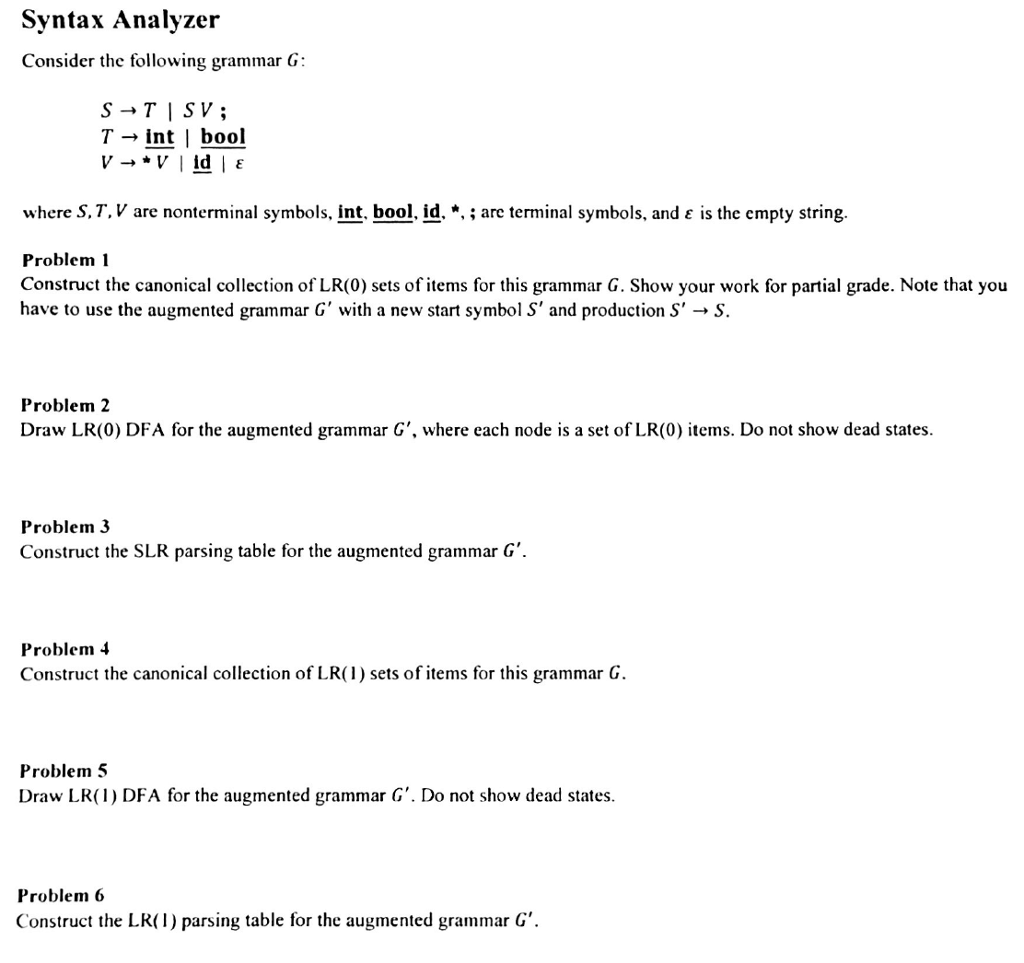
Syntax Analyzer Consider the following grammar G: T-int bool where S, T, V are nonterminal symbols, int, bool, id. ; are terminal symbols, and is the empty string Problem 1 Construct the canonical collection of LR(0) sets of items for this grammar G. Show your work for partial grade. Note that you have to use the augmented grammar G, with a new start symbol S, and production S' S. Problem 2 Draw LR(0) DFA for the augmented grammar G', where each node is a set of LR(0) items. Do not show dead states. Problem 3 Construct the SLR parsing table for the augmented grammar G" Problem4 Construct the canonical collection of LR(1) sets of items for this grammar G Problem 5 Draw LR(1) DFA for the augmented grammar G'. Do not show dead states Problem 6 Construct the LR(I) parsing table for the augmented grammar G'. Syntax Analyzer Consider the following grammar G: T-int bool where S, T, V are nonterminal symbols, int, bool, id. ; are terminal symbols, and is the empty string Problem 1 Construct the canonical collection of LR(0) sets of items for this grammar G. Show your work for partial grade. Note that you have to use the augmented grammar G, with a new start symbol S, and production S' S. Problem 2 Draw LR(0) DFA for the augmented grammar G', where each node is a set of LR(0) items. Do not show dead states. Problem 3 Construct the SLR parsing table for the augmented grammar G" Problem4 Construct the canonical collection of LR(1) sets of items for this grammar G Problem 5 Draw LR(1) DFA for the augmented grammar G'. Do not show dead states Problem 6 Construct the LR(I) parsing table for the augmented grammar G
Step by Step Solution
There are 3 Steps involved in it

Get step-by-step solutions from verified subject matter experts
 Study Help