







Question: Synthesis Problem: 6. Consider a chemical reaction where A- as: (a) Use na, n, nc to represent the populations of A, B, and C.
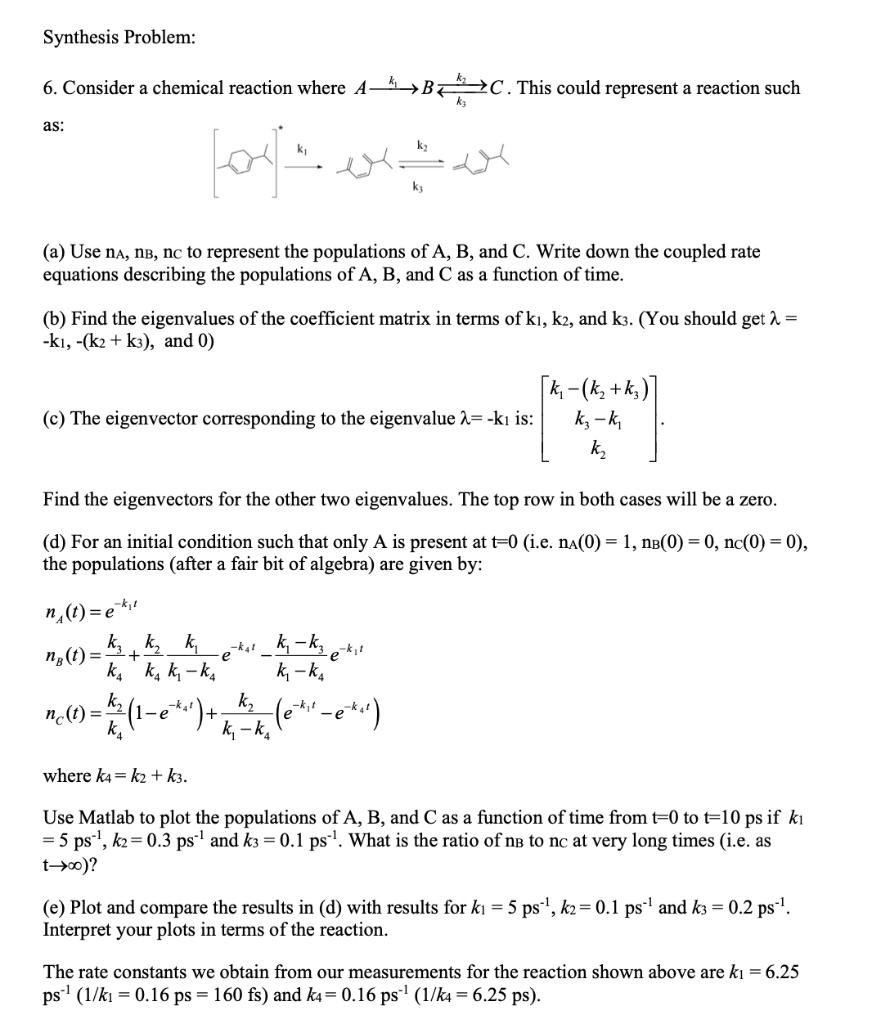
Synthesis Problem: 6. Consider a chemical reaction where A- as: (a) Use na, n, nc to represent the populations of A, B, and C. Write down the coupled rate equations describing the populations of A, B, and C as a function of time. (b) Find the eigenvalues of the coefficient matrix in terms of ki, k2, and k3. (You should get = -k, -(k2 + k3), and 0) (c) The eigenvector corresponding to the eigenvalue = -k is: n(t) = e = k1 k k, k ng(t)= + K K K-K -k. Find the eigenvectors for the other two eigenvalues. The top row in both cases will be a zero. (d) For an initial condition such that only A is present at t=0 (i.e. nA(0) = 1, n(0) = 0, nc(0) = 0), the populations (after a fair bit of algebra) are given by: nc(t)= 1-e k where k4= k2 + k3. BC. This could represent a reaction such -kal_k-k e-k. k-k e k k - K -k,t =(e^ - e^) [k-(k + k)] k-k Use Matlab to plot the populations of A, B, and C as a function of time from t=0 to t-10 ps if ki = 5 ps, k= 0.3 ps and k3 = 0.1 ps. What is the ratio of n to nc at very long times (i.e. as t0)? (e) Plot and compare the results in (d) with results for ki = 5 ps, k2= 0.1 ps and k3= 0.2 ps-. Interpret your plots in terms of the reaction. The rate constants we obtain from our measurements for the reaction shown above are k = 6.25 ps (1/k = 0.16 ps = 160 fs) and k4= 0.16 ps (1/k4= 6.25 ps).
Step by Step Solution
3.53 Rating (150 Votes )
There are 3 Steps involved in it
4 we write down the coupled sute equations descr... View full answer

Get step-by-step solutions from verified subject matter experts
 Study Help