







Question: System analysis In a data flow diagram (DFD), processes contain the business logic, also called business rules, which transform the data and produce the required
System analysis

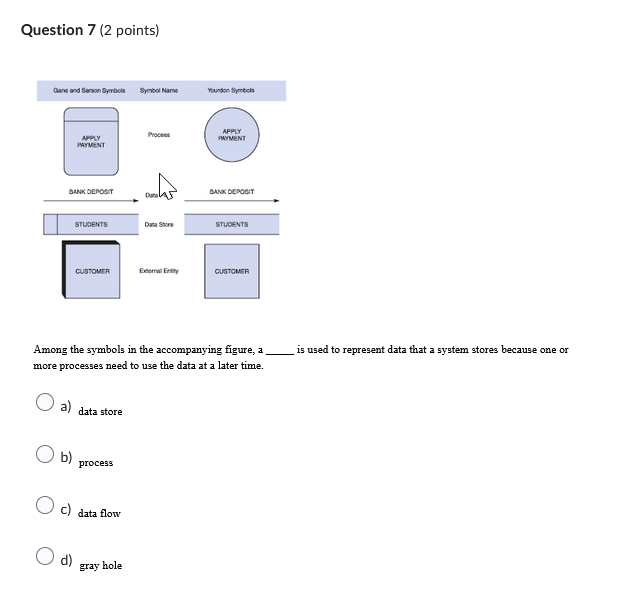

In a data flow diagram (DFD), processes contain the business logic, also called business rules, which transform the data and produce the required results. True False Question 2 (2 points) is the process of drawing a series of increasingly detailed data flow diagrams (DFDs), until all functional primitives are identified. a) Leveling b) Balancing C) Looping d) Indexing Question 3 (2 points) The data dictionary usually records and describes a default value, which is the a) value for the data element if a value otherwise is not entered for it b) specification for the origination point for the data element's value C) the set of values permitted for the data element d) identification of the user(s) responsible for changing values for the data element Many analysts follow , which means that they develop a physical model of the current system, a logical model of the current system, a logical model of the new system, and a physical model of the new system. a) a four-model approach b) the Gane and Sarson symbol C) a process description d) the Zachman Framework Question 5 (2 points) When a context diagram is expanded into data flow diagram (DFD) diagram 0 , all the connections that flow into and out of process 0 must be retained. True False Question 6 (2 points) A is a central storehouse of information about a system's data. a) data feed b) data mart C) data cube d) data repository Question 7 (2 points) Among the symbols in the accompanying figure, a is used to represent data that a system stores because one or more processes need to use the data at a later time. a) data store b) process C) data flow d) gray hole Structured Engligh might look familiar to programming students because it resembles which is used in program design. a) iterative code b) decision code C) a decision tree d) pseudocode Question 9 (2 points) When a data flow diagram (DFD) is exploded, the higher-level diagram is called the child diagram, and the lower-level diagram is referred to as the parent diagram. True False Question 10 (2 points) Later in the systems design phase, you build a logical model that describes how a system will be constructed. True False
Step by Step Solution
There are 3 Steps involved in it

Get step-by-step solutions from verified subject matter experts
 Study Help