







Question: T = 25C Printer head motion Thermal inkjet printer T-200C Electrical circuitry is written onto a photovoltaic panel by depositing a stream of small (D
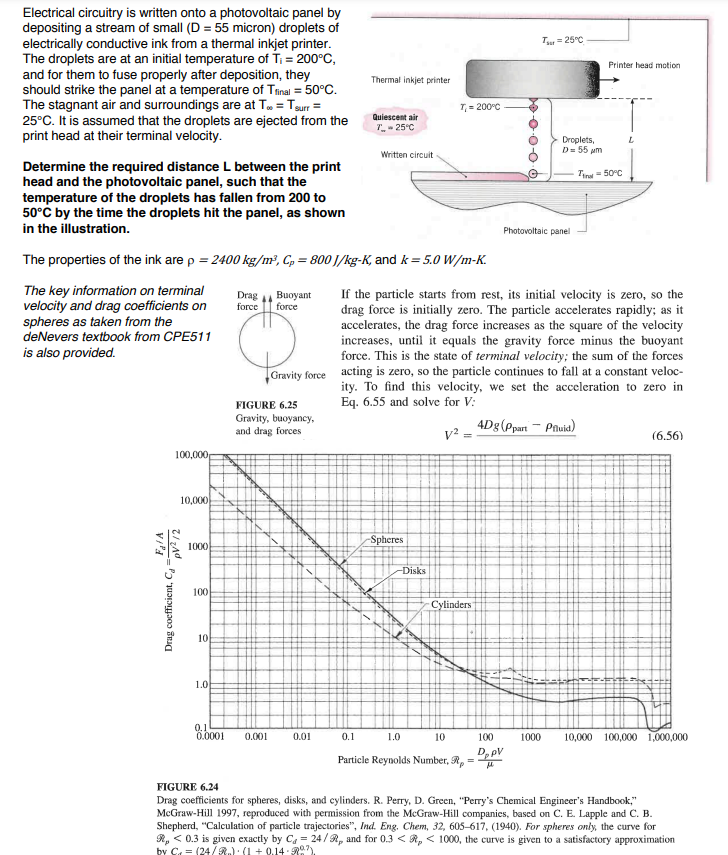
T = 25C Printer head motion Thermal inkjet printer T-200C Electrical circuitry is written onto a photovoltaic panel by depositing a stream of small (D = 55 micron) droplets of electrically conductive ink from a thermal inkjet printer. The droplets are at an initial temperature of Ti = 200C, and for them to fuse properly after deposition, they should strike the panel at a temperature of Trinal = 50C. The stagnant air and surroundings are at T = Tsurr = 25C. It is assumed that the droplets are ejected from the print head at their terminal velocity. Determine the required distance between the print head and the photovoltaic panel, such that the temperature of the droplets has fallen from 200 to 50C by the time the droplets hit the panel, as shown in the illustration. Quiescent air 7.-25C 9. 0-0-0-4 Droplets, D: 55 mm Written circuit T = 50C Photovoltaic panel force force The properties of the ink are p = 2400 kg/m, Co = 800 J/kg-K, and k=5.0 W/m-K. The key information on terminal Drag Buoyant If the particle starts from rest, its initial velocity is zero, so the velocity and drag coefficients on drag force is initially zero. The particle accelerates rapidly; as it spheres as taken from the accelerates, the drag force increases as the square of the velocity deNevers textbook from CPE511 increases, until it equals the gravity force minus the buoyant is also provided force. This is the state of terminal velocity, the sum of the forces Gravity force acting is zero, so the particle continues to fall at a constant veloc- ity. To find this velocity, we set the acceleration to zero in Eq. 6.55 and solve for V: Gravity, buoyancy, 4D: (Ppart - Phuid) V2 = FIGURE 6.25 and drag forces (6.56) 100,000 10,000 A 1000 Spheres -Disks Drag coefficient, CopV2/2 100 Cylinders 101 1.0 0.01 0.1! 0.0001 0.001 0.1 1.0 10 100 1000 10,000 100,000 1,000,000 Particle Reynolds Number, R. DpV FIGURE 6.24 Drag coefficients for spheres, disks, and cylinders. R. Perry, D. Green, "Perry's Chemical Engineer's Handbook," McGraw-Hill 1997, reproduced with permission from the McGraw-Hill companies, based on C. E. Lapple and C. B. Shepherd, "Calculation of particle trajectories, Ind. Eng. Chem, 32, 605-617. (1940). For spheres only, the curve for R
Step by Step Solution
There are 3 Steps involved in it

Get step-by-step solutions from verified subject matter experts
 Study Help