







Question: t The Binomial Distribution Suppose that a random experiment can result in two possible mutually ex- clusive and collectively exhaustive outcomes, success and failure, and
t
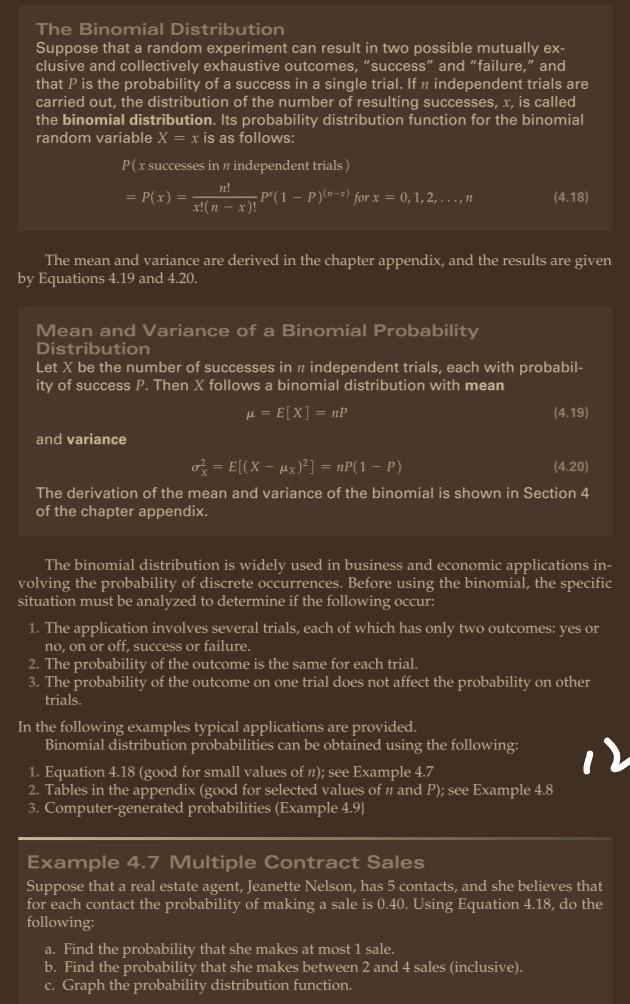
The Binomial Distribution Suppose that a random experiment can result in two possible mutually ex- clusive and collectively exhaustive outcomes, "success" and "failure," and that P is the probability of a success in a single trial. If n independent trials are carried out, the distribution of the number of resulting successes, x, is called the binomial distribution. Its probability distribution function for the binomial random variable X = x is as follows: P(x successes in n independent trials) n! = P(x) = p"(1-P)(-for x = 0,1,2,..., 1 (4.18) x!(n - x)! The mean and variance are derived in the chapter appendix, and the results are given by Equations 4.19 and 4.20. Mean and Variance of a Binomial Probability Distribution Let X be the number of successes in n independent trials, each with probabil- ity of success P. Then X follows a binomial distribution with mean = E[X] =P 14.19) and variance = E[( X - Mx)] = nP(1-P) (4.20) The derivation of the mean and variance of the binomial is shown in Section 4 of the chapter appendix. The binomial distribution is widely used in business and economic applications in- volving the probability of discrete occurrences. Before using the binomial, the specific situation must be analyzed to determine if the following occur: 1. The application involves several trials, each of which has only two outcomes: yes or no, on or off, success or failure. 2. The probability of the outcome is the same for each trial. 3. The probability of the outcome on one trial does not affect the probability on other trials. In the following examples typical applications are provided. Binomial distribution probabilities can be obtained using the following: 1. Equation 4.18 (good for small values of n); see Example 4.7 2. Tables in the appendix (good for selected values of n and P); see Example 4.8 3. Computer-generated probabilities (Example 4.9) IL Example 4.7 Multiple Contract Sales Suppose that a real estate agent, Jeanette Nelson, has 5 contacts, and she believes that for each contact the probability of making a sale is 0.40. Using Equation 4.18, do the following: a. Find the probability that she makes at most 1 sale. b. Find the probability that she makes between 2 and 4 sales (inclusive). c. Graph the probability distribution functionStep by Step Solution
There are 3 Steps involved in it
1 Expert Approved Answer
Step: 1 Unlock

Question Has Been Solved by an Expert!
Get step-by-step solutions from verified subject matter experts
Step: 2 Unlock
Step: 3 Unlock
 Study Help