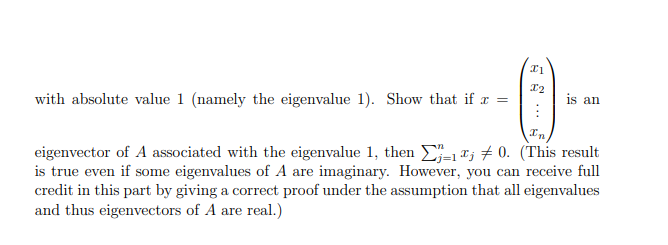
Question: T2 with absolute value 1 (namely the eigenvalue 1). Show that if r = is an In eigenvector of A associated with the eigenvalue 1,
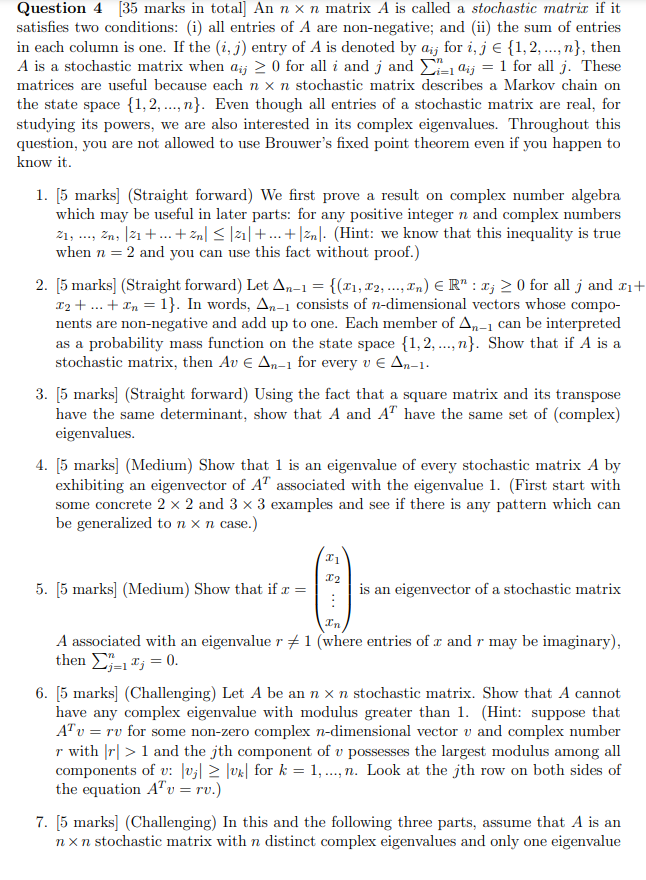
T2 with absolute value 1 (namely the eigenvalue 1). Show that if r = is an In eigenvector of A associated with the eigenvalue 1, then _1, * 0. (This result is true even if some eigenvalues of A are imaginary. However, you can receive full credit in this part by giving a correct proof under the assumption that all eigenvalues and thus eigenvectors of A are real.)Question 4 [35 marks in total] An 11 X 11 matrix A is called a stochastic metric: if it satises two conditions: {i} all entries of A are nonnegative; and {ii} the sum of entries in each column is one. [fthe {i,j} entry ofA is denoted by n.5,.- for i,j E {1,2, ...,n}, then A is a stochastic matrix when g 2 i} for all i and j and ELI-11,,- = 1 for all 3'. These matrices are useful because each n K n stochastic matrix describes a Markov chain on the state space {1, 2, ....,n} Even though all entries of a stochastic matrix are real, for studying its powers, we are also interested in its complex eigenvalues. Throughout this question, you are not allowed to use Brouwer's fixed point theorem even if you happen to know it. 1. [5 marks] [Straight forward} We rst prove a result on complex number algebra which may be useful in later parts: for any positive integer n and complex numbers 2:1, en, I21 +... +33] 5 I21] + ...+ Iznl. (Hint: we know that this inequality is true when n = 2 and you can use this fact without proof.) 2. [5 marks] {Straight forward} Letnq = {{31,Ig,...11'n} E R" : .'r_, E {i for allj and r1+ :3 + + :1:n = 1}. [n words, $.14 consists of ndimensional vectors whose compo nents are non-negative and add up to one. Each member of nJ, can be interpreted as a probability mass function on the state space {1,2, ..., 11}. Show that if A is a stochastic matrix, then AU E 33,14 for everyr t: E $54. 3. [5 marks] [Straight forward} Using the fact that a square matrix and its transpose have the same determinant, show that A and AT have the same set of {complex} eigenvalues. 4. {5 marks] {Medium} Show that 1 is an eigenvalue of every stochastic matrix A by exhibiting an eigenvector of AT associated with the eigenvalue 1. [First start with some concrete 2 x 2 and 3 K 3 examples and see if there is any pattern which can be generalized to n X n case.) 27:1 r 5. [5 marks] {Medium} Show that if :r = ,2 is an eigenvector of a stochastic matrix In A associated with an eigenvalue 1' y 1 [where entries of r and 1" may be imaginary}, then 2;, r,- = U. E. [5 marks] {Challenging} Let A be an n x n stochastic matrix. Show that A cannot have any complex eigenvalue with modulus greater than 1. (Hint: suppose that Are 2 re for some nonzero complex ndimensional vector u and complex number 1" with IT] 3:- 1 and the jth component of :1: possesses the largest modulus among all component-s of u: |U_,-| E In] for k = 1, ...,n. Look at the ~jith row on both sides of the equation ATIJ = ru.} T". [5 marks] [Challenging] In this and the following three parts, assume that A is an n. x n stochastic matrix with n distinct complex eigenvalues and only one eigenvalue









 Study Help