







Question: 1 Consider an Einstein solid consisting of NA = 1 atom (three oscillators). Each oscillator can store any inte- ger number of energy units
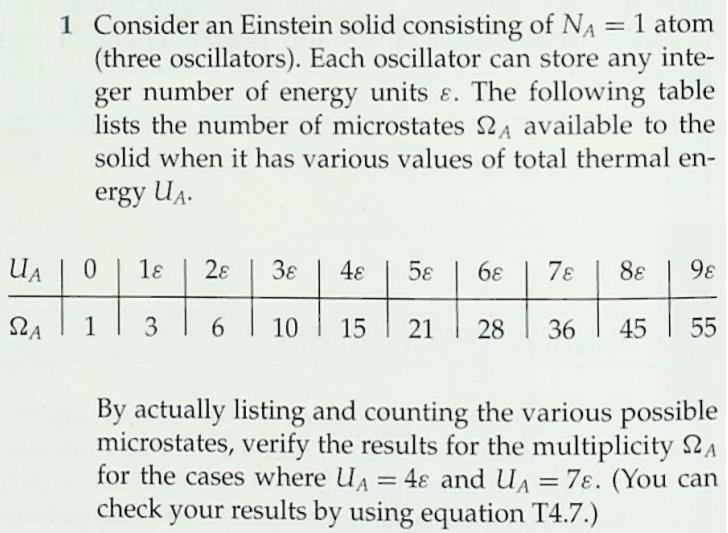
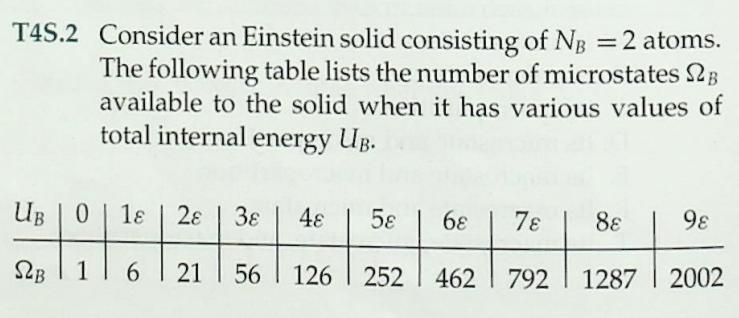
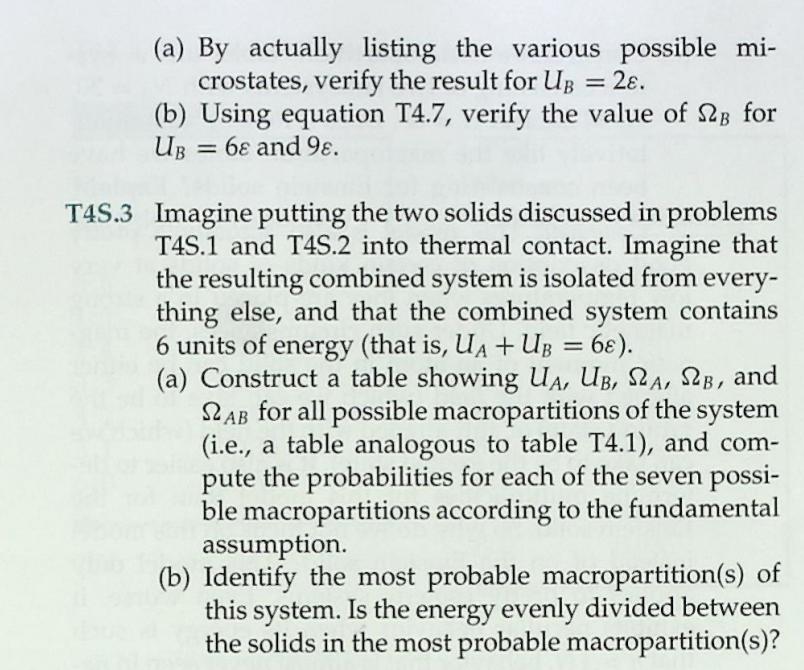
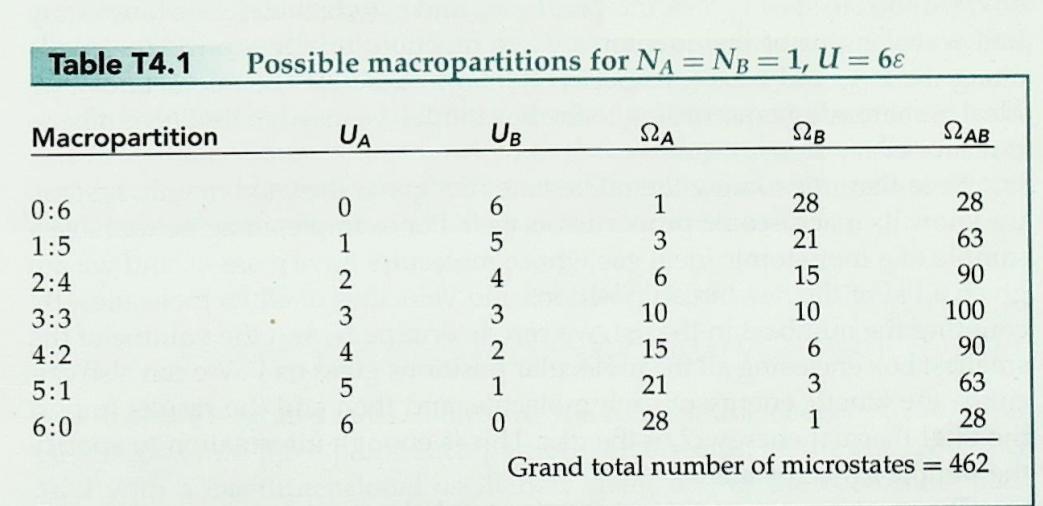
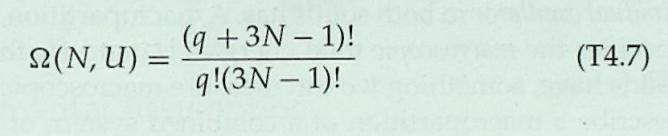
1 Consider an Einstein solid consisting of NA = 1 atom (three oscillators). Each oscillator can store any inte- ger number of energy units . The following table lists the number of microstates 2A available to the %3D solid when it has various values of total thermal en- ergy UA. UA 0. 1 38 48 5 6 78 8 98 1 SLA 6. 10 15 21 28 36 45 55 By actually listing and counting the various possible microstates, verify the results for the multiplicity 2A for the cases where UA = 4 and UA = check your results by using equation T4.7.) 78. (You can %3D 3. T4S.2 Consider an Einstein solid consisting of NB =2 atoms. The following table lists the number of microstates 2B available to the solid when it has various values of total internal energy UB. UB | 0 1 28 48 5 6 78 88 9 S2B | 1 21 56 126 | 252 | 462 792 1287 2002 (a) By actually listing the various possible mi- crostates, verify the result for UB = 2. (b) Using equation T4.7, verify the value of 2B for UB = 6 and 9. %3D T4S.3 Imagine putting the two solids discussed in problems T4S.1 and T4S.2 into thermal contact. Imagine that the resulting combined system is isolated from every- thing else, and that the combined system contains 6 units of energy (that is, UA + UB = 6). (a) Construct a table showing UA, UB, SA, SB, and LAB for all possible macropartitions of the system (i.e., a table analogous to table T4.1), and com- pute the probabilities for each of the seven possi- ble macropartitions according to the fundamental assumption. (b) Identify the most probable macropartition(s) of this system. Is the energy evenly divided between the solids in the most probable macropartition(s)? %3D Table T4.1 Possible macropartitions for NA = NB =1, U = 6 %3D Macropartition UA UB SZA SB SLAB 0:6 0. 1 28 28 1:5 1 3 21 63 2:4 2 15 90 3:3 3 10 10 100 4:2 4 15 6. 90 5:1 21 3 63 6:0 6. 28 1 28 Grand total number of microstates = 462 6 54 m21 (9+3N 1)! 9!(3N 1)! 2(N, U) = (T4.7) %3D
Step by Step Solution
3.45 Rating (168 Votes )
There are 3 Steps involved in it
To address the given problems related to Einstein solids we will go through each part systematically T4S1 Verify microstates for UA 4epsilon and UA 7e... View full answer

Get step-by-step solutions from verified subject matter experts
 Study Help