







Question: Table 1: Data for Put Example .4 .02 Time to expiry (T) 1.0 years Strike Price $100 Initial asset price So $100 where K
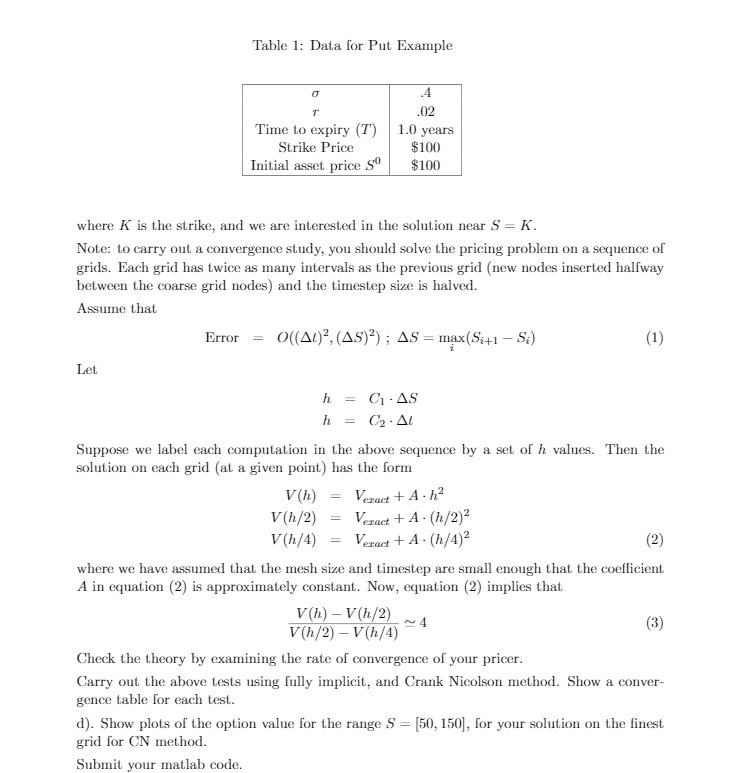
Table 1: Data for Put Example .4 .02 Time to expiry (T) 1.0 years Strike Price $100 Initial asset price So $100 where K is the strike, and we are interested in the solution near S = K. Note: to carry out a convergence study, you should solve the pricing problem on a sequence of grids. Each grid has twice as many intervals as the previous grid (new nodes inserted halfway between the coarse grid nodes) and the timestep size is halved. Assume that Let Error = O((A), (AS)2); AS max(S+1 - S;) = (1) h == C AS h = C-Al Suppose we label each computation in the above sequence by a set of h values. Then the solution on each grid (at a given point) has the form V(h) = V(h/2) = Veract + A-h Veract + A. (h/2) V(h/4) = Veract + A- (h/4)2 where we have assumed that the mesh size and timestep are small enough that the coefficient A in equation (2) is approximately constant. Now, equation (2) implies that V(h)-V(h/2) V(h/2) - V(h/4) ~ 4 Check the theory by examining the rate of convergence of your pricer. Carry out the above tests using fully implicit, and Crank Nicolson method. Show a conver- gence table for each test. == d). Show plots of the option value for the range S = [50, 150], for your solution on the finest grid for CN method. Submit your matlab code.
Step by Step Solution
There are 3 Steps involved in it

Get step-by-step solutions from verified subject matter experts
 Study Help