







Question: Table 1 displays the two-period binomial tree containing the evolution of the annual discretely compounded one-period rates. Each period in the tree equals one year,
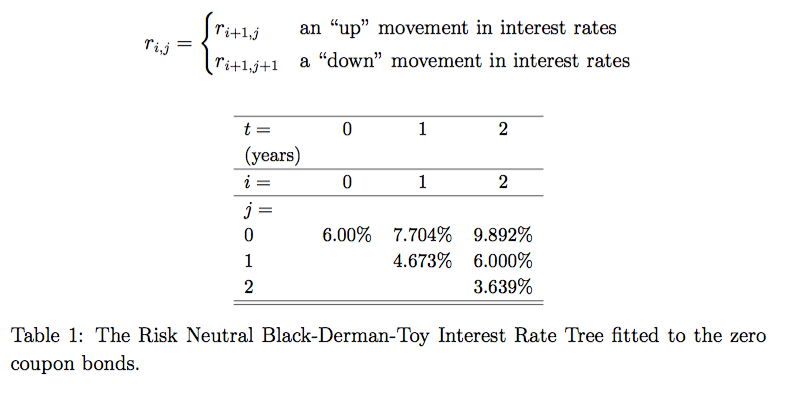
Table 1 displays the two-period binomial tree containing the evolution of the annual discretely compounded one-period rates. Each period in the tree equals one year, that is = 1 where denotes the time interval between steps. The tree is fitted using the Black-Derman-Toy model. Recall that such a tree is developed by starting with the original term structure of zero coupon bond prices for all maturities. We shall use 0.5 as the up-state probability and 0.5 as the down-state probability. These are, of course, the risk neutral probabilities, not the actual probabilities. Finally, recall the following notation:
1. Recall that the payoff of a plain vanilla cap as of time Ti, T2, ....T is
CF(Ti)=Nmax(rn(Ti ,Ti)rK,0)
where n is the number of payments per year, is the amount of time between payments, and rn(Ti , Ti) is the reference floating rate with compounding frequency n. On each caplet expiration date Ti, the cap pays off the one-period rate minus the strike rate, if the latter is lower and zero otherwise. Note that the payoff determined at Ti1 = Ti is made one period later, i.e. at time Ti. Consider a three-year cap indexed to the yearly rate displayed in Table 1, and struck at rK = 7.5%. The payments are annual, i.e. = 1, and the notional value of the cap is N = $100. Given the interest rate tree in Table 1 find the value today (i.e. at t = 0) of the cap.
ri+1,3 an up movement in interest rates rij = 3 rir1.i+1 a "down" movement in interest rates 0 1 2 t= (years) i= j= 0 0 1 2 6.00% 7.704% 4.673% 9.892% 6.000% 3.639% Table 1: The Risk Neutral Black-Derman-Toy Interest Rate Tree fitted to the zero coupon bonds. ri+1,3 an up movement in interest rates rij = 3 rir1.i+1 a "down" movement in interest rates 0 1 2 t= (years) i= j= 0 0 1 2 6.00% 7.704% 4.673% 9.892% 6.000% 3.639% Table 1: The Risk Neutral Black-Derman-Toy Interest Rate Tree fitted to the zero coupon bonds
Step by Step Solution
There are 3 Steps involved in it

Get step-by-step solutions from verified subject matter experts
 Study Help