







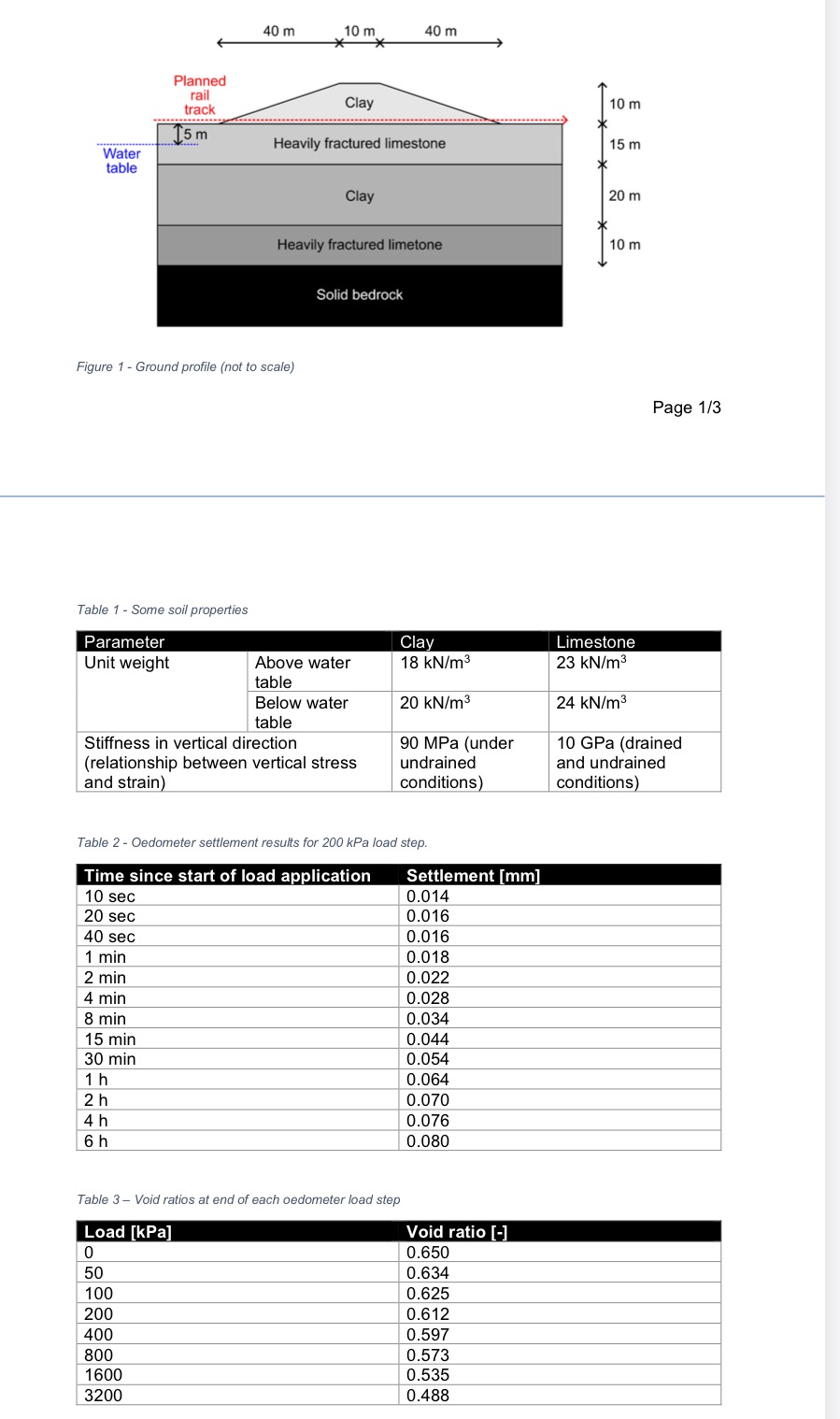
Question: Table 1 - Some soil properties Table 2 - Oedometer settlement results for 2 0 0 kPa load step. Table 3 - Void ratios at
Table Some soil properties
Table Oedometer settlement results for kPa load step.
Table Void ratios at end of each oedometer load step
This is a soil mechanics mathematical question. You should use all tables and the oedometer measurements.
The ground profile consists of layers of relatively impermeable clays and very permeable heavy fractured limestone The ground water table is located at m depth. Some soil properties for these layers are given in Table An oedometer test was conducted on a clay smaple taken from the middle of the m thick clay layer. The data for this test can be found in Tables and The oedometer sample diameter was mm and its initial thickness was mm The m hgh clay hill on the surface was entirely excavated to allow construction, see Figure
Calculate heave resulting from the removal of the clay hill as a function of time at the location where you think heave will be the largest.
Draw a graph showinghow the longterm heave varies along the rail track and estimate the largest gradient anywhere along the rail track indicating where along the track these may occur.
You may assume:
ignore any heave associate with soil creep
assume planestrain conditions linear elastic theory
assume any soil movements are purely vertical horizontal strains are
Step by Step Solution
There are 3 Steps involved in it
1 Expert Approved Answer
Step: 1 Unlock

Question Has Been Solved by an Expert!
Get step-by-step solutions from verified subject matter experts
Step: 2 Unlock
Step: 3 Unlock
 Study Help