







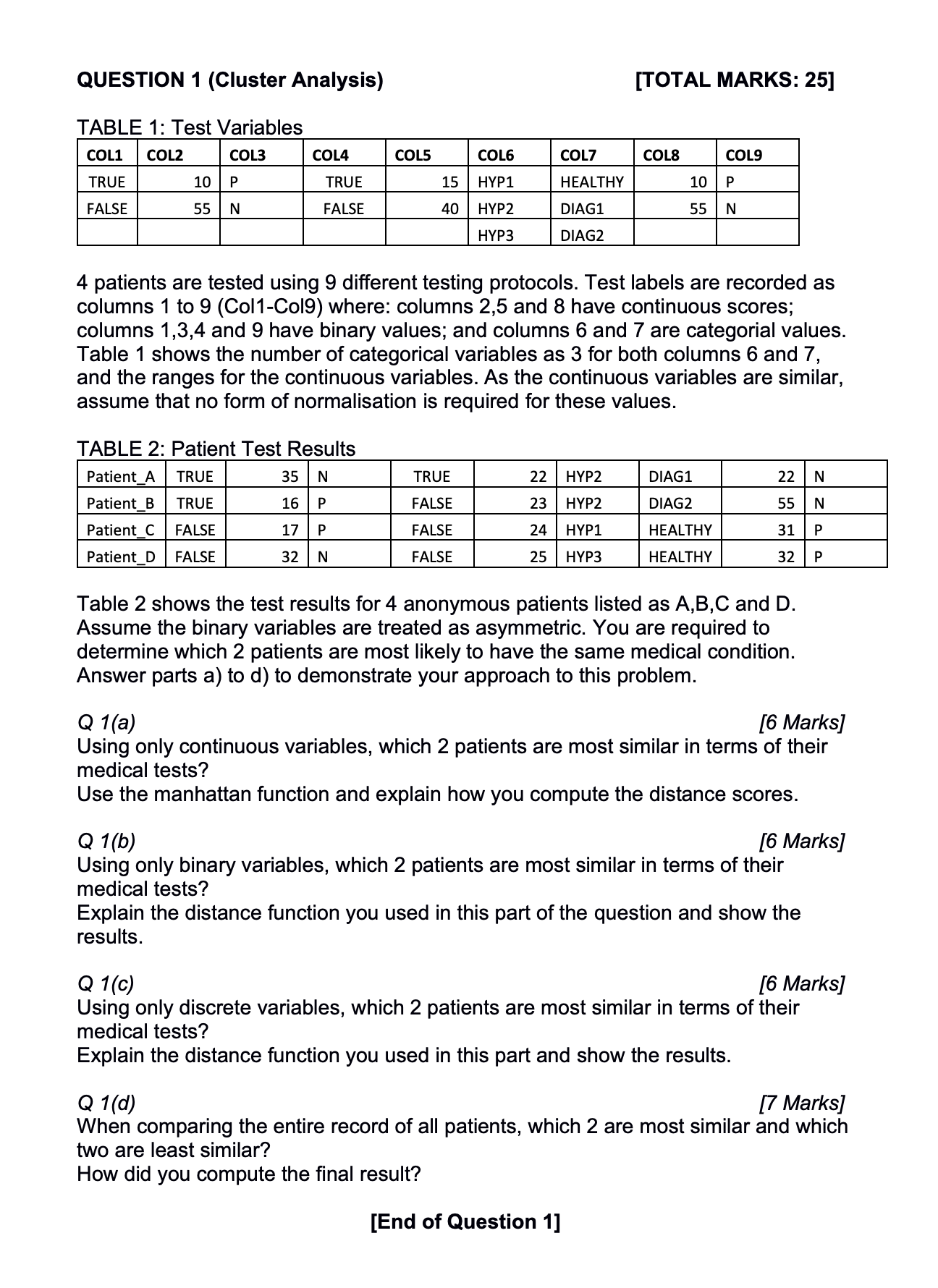
Question: TABLE 1 : Test Variables 4 patients are tested using 9 different testing protocols. Test labels are recorded as columns 1 to 9 ( Col
TABLE : Test Variables
patients are tested using different testing protocols. Test labels are recorded as columns to ColCol where: columns and have continuous scores; columns and have binary values; and columns and are categorial values. Table shows the number of categorical variables as for both columns and and the ranges for the continuous variables. As the continuous variables are similar, assume that no form of normalisation is required for these values.
TABLE : Patient Test Results
Table shows the test results for anonymous patients listed as A B C and D Assume the binary variables are treated as asymmetric. You are required to determine which patients are most likely to have the same medical condition. Answer parts a to d to demonstrate your approach to this problem.
Q a
Using only continuous variables, which patients are most similar in terms of their medical tests?
Use the manhattan function and explain how you compute the distance scores.
Q b
Marks
Using only binary variables, which patients are most similar in terms of their medical tests?
Explain the distance function you used in this part of the question and show the results.
Q c
Marks
Using only discrete variables, which patients are most similar in terms of their medical tests?
Explain the distance function you used in this part and show the results.
Q d
Marks
When comparing the entire record of all patients, which are most similar and which two are least similar?
How did you compute the final result?
End of Question
Step by Step Solution
There are 3 Steps involved in it
1 Expert Approved Answer
Step: 1 Unlock

Question Has Been Solved by an Expert!
Get step-by-step solutions from verified subject matter experts
Step: 2 Unlock
Step: 3 Unlock
 Study Help