Question: TABLE 13.4 The Distribution, F(Q), and Expected Inventory, I(Q), Functions for the Standard Normal Distribution Function z F(z) z A(z) .0000 -4.0 .0000 -3.9 0000
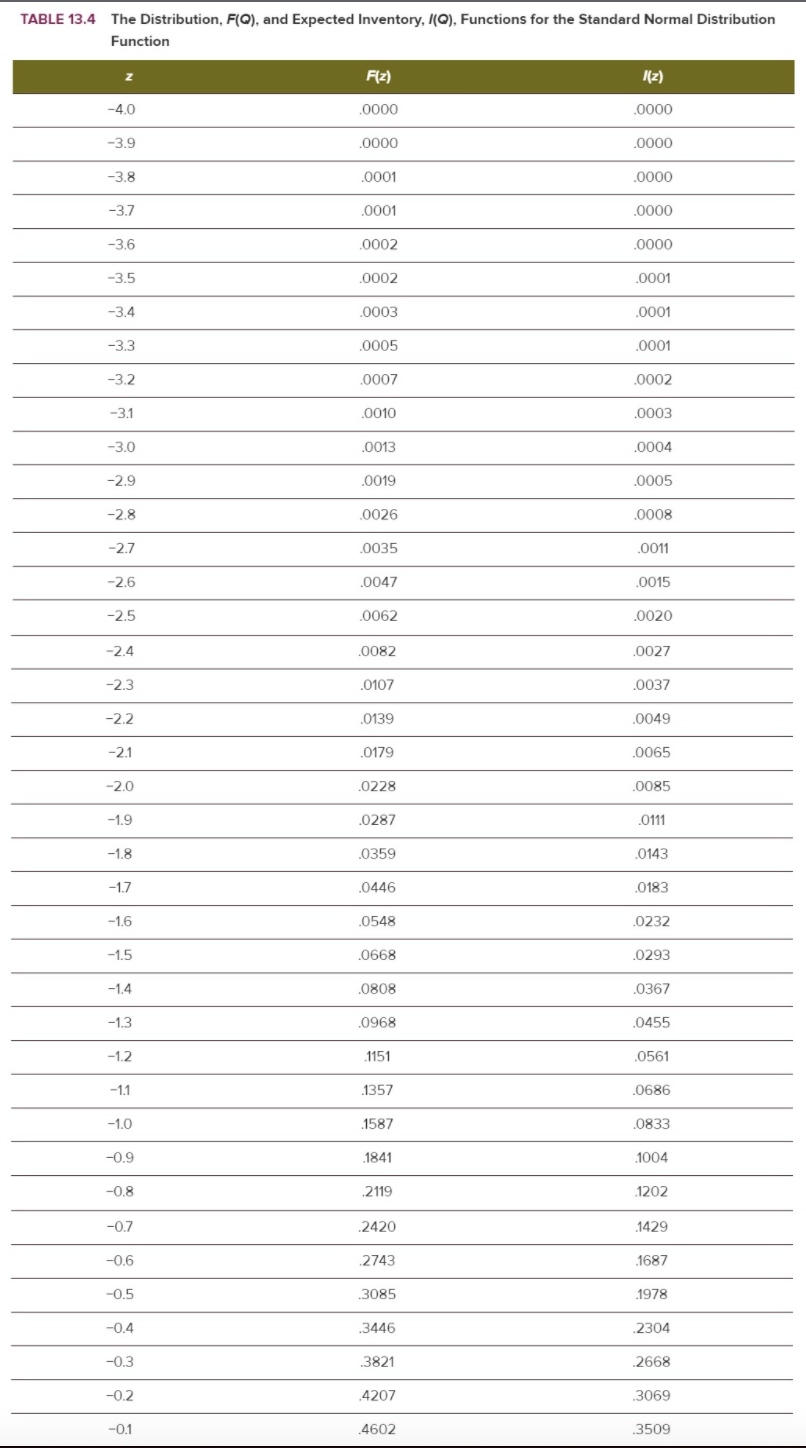
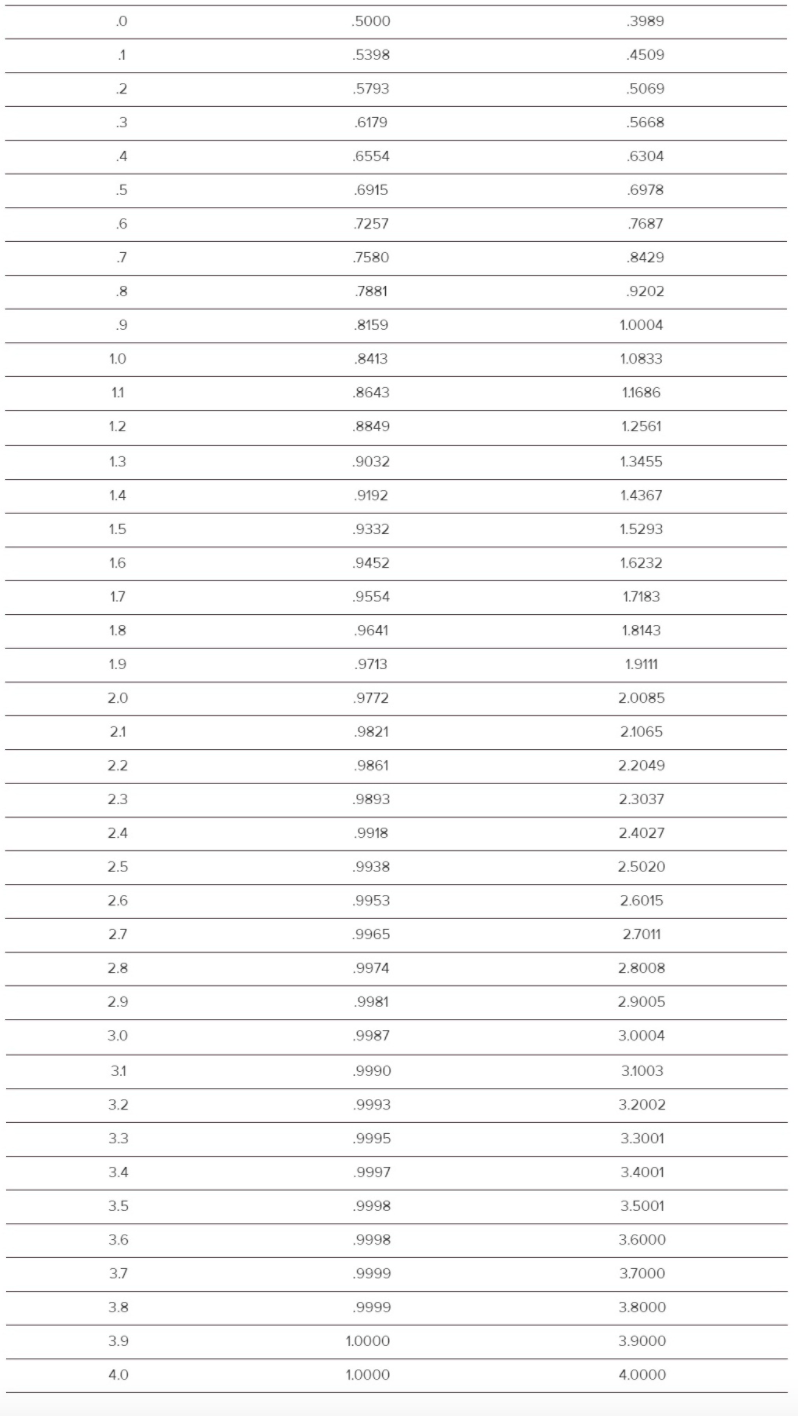
TABLE 13.4 The Distribution, F(Q), and ExpectedTABLE 13.4 The Distribution, F(Q), and ExpectedTABLE 13.4 The Distribution, F(Q), and ExpectedTABLE 13.4 The Distribution, F(Q), and Expected

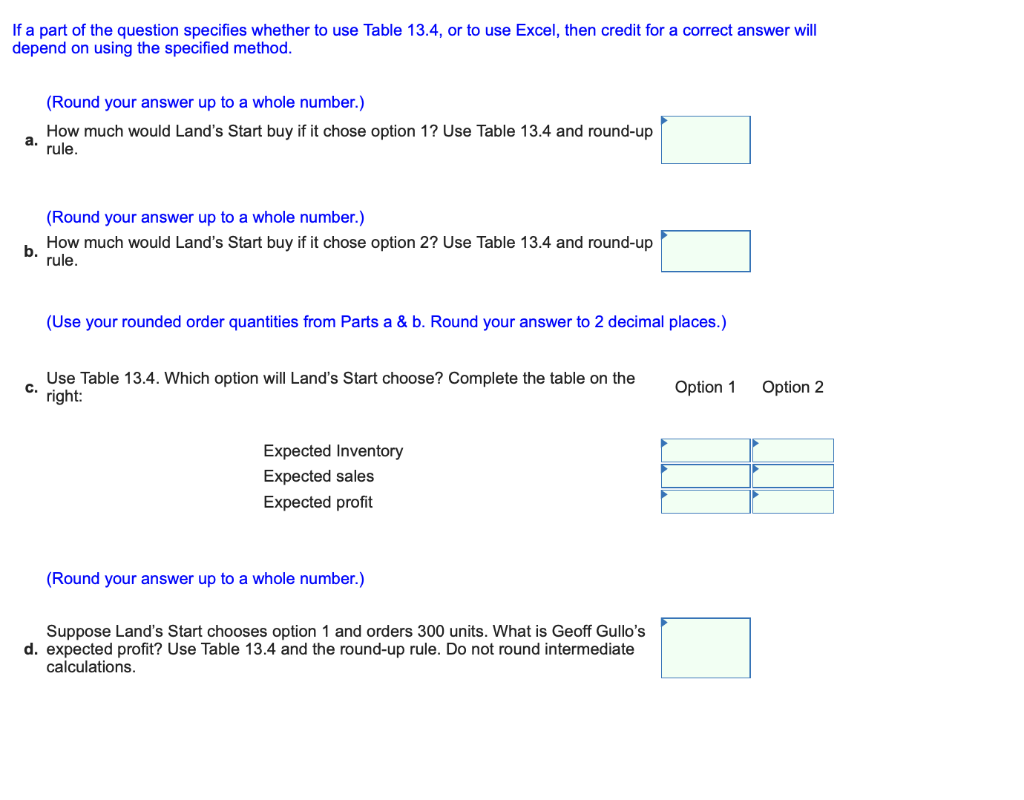
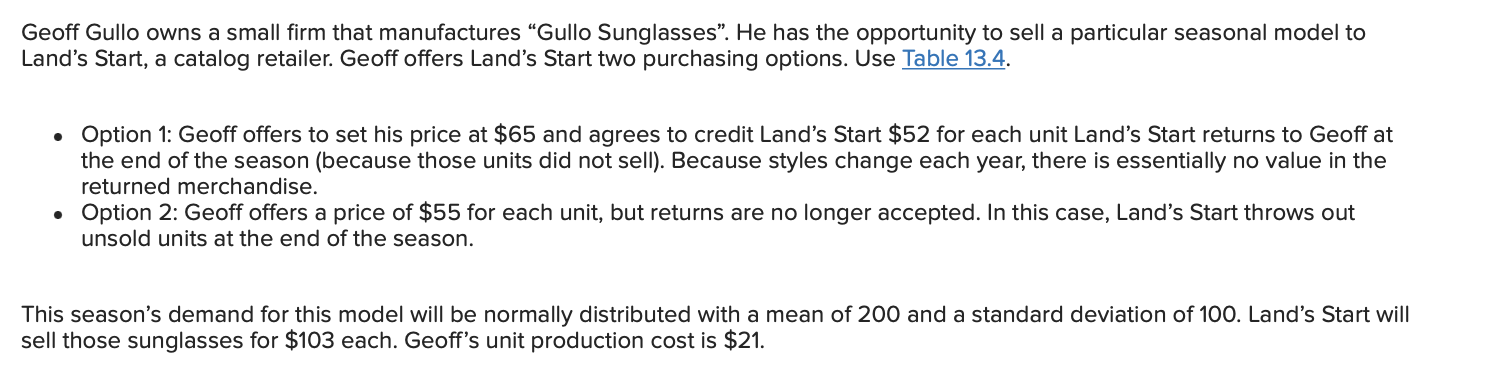
TABLE 13.4 The Distribution, F(Q), and Expected Inventory, I(Q), Functions for the Standard Normal Distribution Function z F(z) z A(z) .0000 -4.0 .0000 -3.9 0000 .0000 -3.8 .0001 .0000 -3.7 .0001 .0000 -3.6 .0002 .0000 -3.5 .0002 .0001 -3.4 .0003 .0001 -3.3 .0005 .0001 -3.2 0007 .0002 -3.1 .0010 .0003 -3.0 .0013 .0004 -2.9 .0019 .0005 -2.8 .0026 .0008 -2.7 0035 .0011 -2.6 .0047 .0015 -2.5 .0062 .0020 -2.4 .0082 .0027 -2.3 .0107 .0037 -2.2 .0139 .0049 -2.1 .0179 .0065 -2.0 .0228 .0085 -1.9 .0287 .0111 -1.8 .0359 .0143 -1.7 0446 .0183 -1.6 .0548 .0232 -1.5 .0668 .0293 -1.4 .0808 .0367 -1.3 0968 0455 -1.2 .1151 .0561 -1.1 .1357 .0686 -1.0 .1587 .0833 -0.9 .1841 1004 -0.8 2119 .1202 -0.7 .2420 .1429 -0.6 2743 .1687 -0.5 .3085 .1978 -0.4 .3446 .2304 -0.3 .3821 .2668 -0.2 4207 .3069 -0.1 4602 .3509 0 .5000 .3989 .1 .5398 .4509 2 5793 .5069 .3 .6179 .5668 4 .6554 .6304 .5 .6915 .6978 .6 .7257 .7687 .7 .7580 .8429 .8 .7881 .9202 9 .8159 1.0004 1.0 .8413 1.0833 1.1 .8643 1.1686 1.2 .8849 1.2561 1.3 .9032 1.3455 1.4 .9192 1.4367 1.5 .9332 1.5293 1.6 .9452 1.6232 1.7 .9554 1.7183 1.8 .9641 1.8143 1.9 .9713 1.9111 2.0 .9772 2.0085 2.1 9821 2.1065 2.2 .9861 2.2049 2.3 .9893 2.3037 2.4 .9918 2.4027 2.5 .9938 2.5020 2.6 .9953 2.6015 2.7 .9965 2.7011 2.8 .9974 2.8008 2.9 .9981 2.9005 3.0 .9987 3.0004 3.1 .9990 3.1003 3.2 .9993 3.2002 3.3 .9995 3.3001 3.4 .9997 3.4001 3.5 .9998 3.5001 3.6 .9998 3.6000 3.7 .9999 3.7000 3.8 9999 3.8000 3.9 1.0000 3.9000 40 1.0000 4.0000 Geoff Gullo owns a small firm that manufactures "Gullo Sunglasses. He has the opportunity to sell a particular seasonal model to Land's Start, a catalog retailer. Geoff offers Land's Start two purchasing options. Use Table 13.4. Option 1: Geoff offers to set his price at $65 and agrees to credit Land's Start $52 for each unit Land's Start returns to Geoff at the end of the season (because those units did not sell). Because styles change each year, there is essentially no value in the returned merchandise. Option 2: Geoff offers a price of $55 for each unit, but returns are no longer accepted. In this case, Land's Start throws out unsold units at the end of the season. . This season's demand for this model will be normally distributed with a mean of 200 and a standard deviation of 100. Land's Start will sell those sunglasses for $103 each. Geoff's unit production cost is $21. If a part of the question specifies whether to use Table 13.4, or to use Excel, then credit for a correct answer will depend on using the specified method. (Round your answer up to a whole number.) How much would Land's Start buy if it chose option 1? Use Table 13.4 and round-up rule. a. (Round your answer up to a whole number.) How much would Land's Start buy if it chose option 2? Use Table 13.4 and round-up rule. b. (Use your rounded order quantities from Parts a & b. Round your answer to 2 decimal places.) C. Use Table 13.4. Which option will Land's Start choose? Complete the table on the right: Option 1 Option 2 Expected Inventory Expected sales Expected profit (Round your answer up to a whole number.) Suppose Land's Start chooses option 1 and orders 300 units. What is Geoff Gullo's d. expected profit? Use Table 13.4 and the round-up rule. Do not round intermediate calculations
Step by Step Solution

There are 3 Steps involved in it

1 Expert Approved Answer
Step: 1 Unlock blur-text-image

Question Has Been Solved by an Expert!

Get step-by-step solutions from verified subject matter experts

Step: 2 Unlock
Step: 3 Unlock

Students Have Also Explored These Related General Management Questions!