







Question: Table 2 Empirical Results WEEK 6: STATISTICS EXTRA CREDIT: PROBABILITY TOPICS First Second How many using With How many using Without 1. Save the
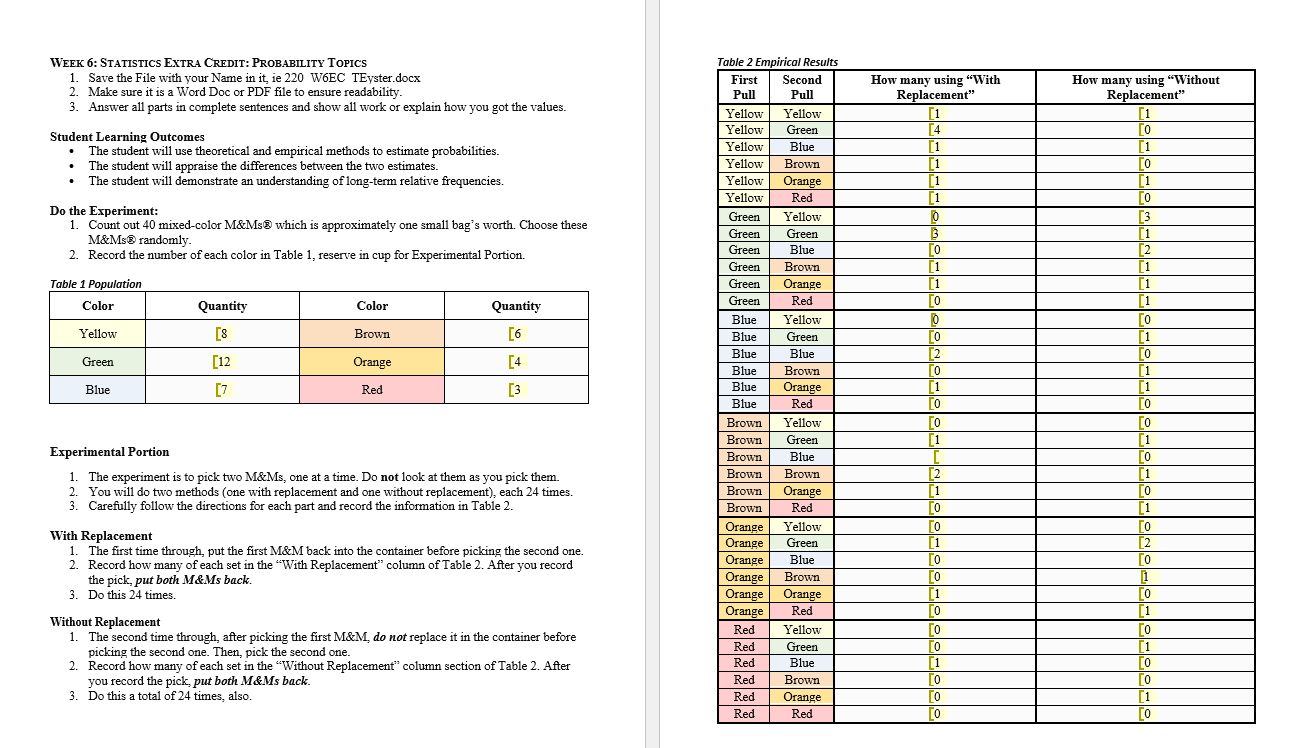
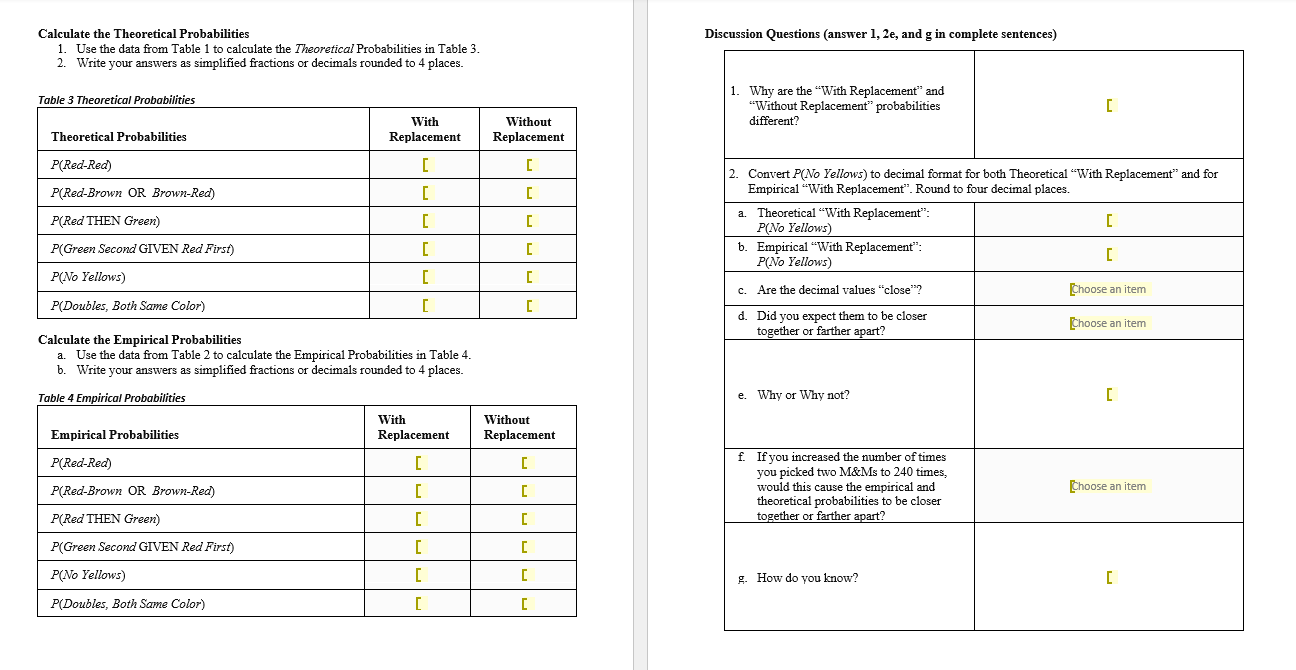
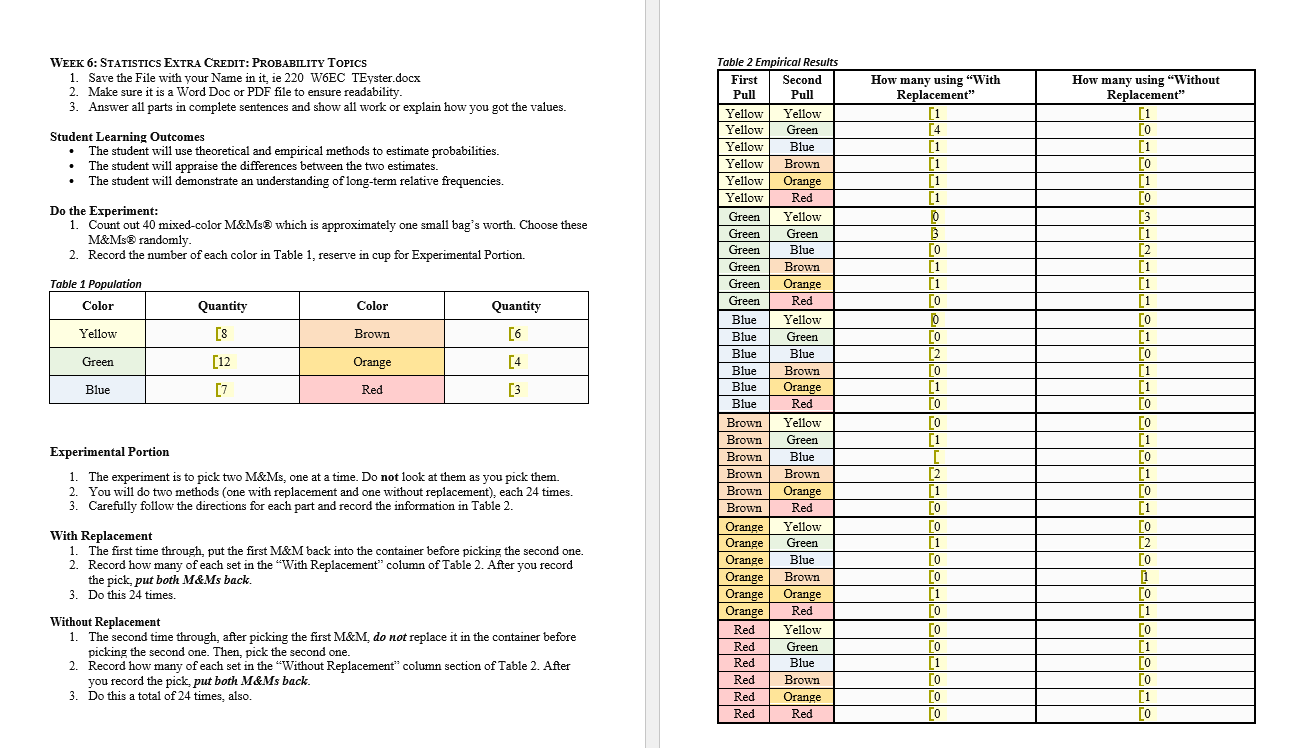
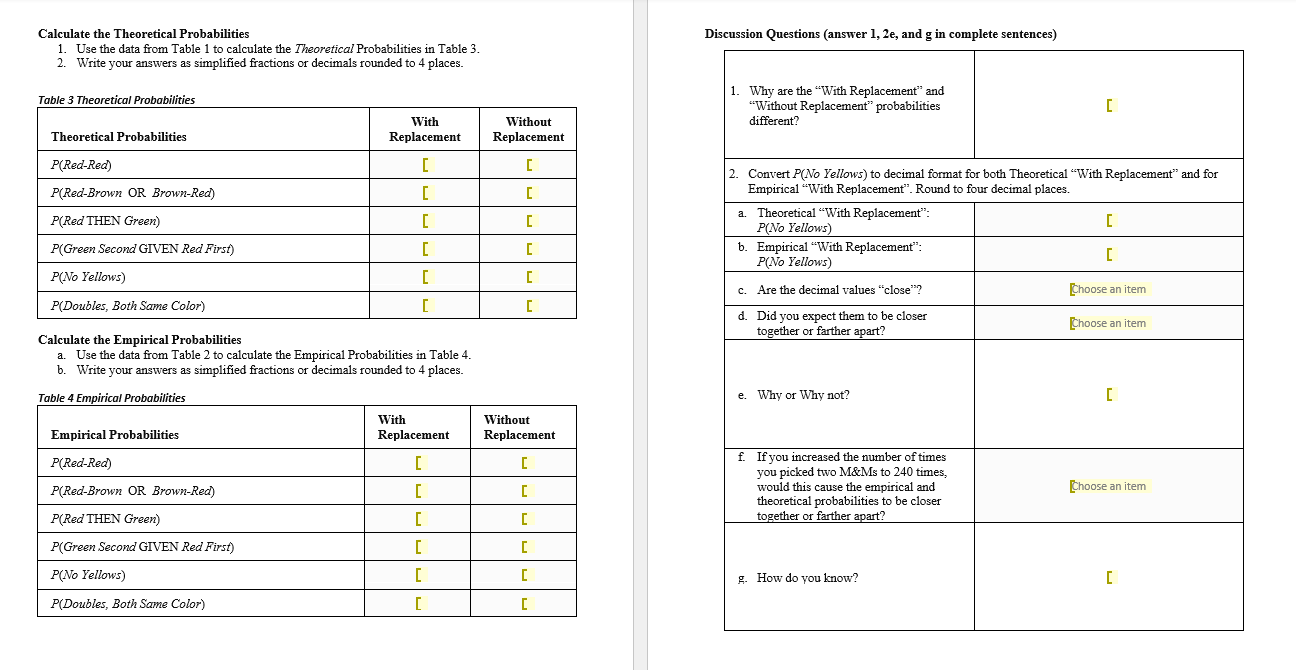
Table 2 Empirical Results WEEK 6: STATISTICS EXTRA CREDIT: PROBABILITY TOPICS First Second How many using "With How many using " Without 1. Save the File with your Name in it, ie 220 W6EC TEyster.docx Pull Pull Replacement" Replacement' 2. Make sure it is a Word Doc or PDF file to ensure readability. 3. Answer all parts in complete sentences and show all work or explain how you got the values. Yellow Yellow [1 [1 Yellow Green TO Student Learning Outcomes Yellow Blue [1 The student will use theoretical and empirical methods to estimate probabilities. Yellow Brown CO . The student will appraise the differences between the two estimates. Orange The student will demonstrate an understanding of long-term relative frequencies. Yellow Yellow Red Do the Experiment: Green Yellow 1. Count out 40 mixed-color M&Ms@ which is approximately one small bag's worth. Choose these Green Green M&Ms@ randomly. Green Blue 2. Record the number of each color in Table 1, reserve in cup for Experimental Portion. Green Brown Green Orange Table 1 Population Green Red Quantity Color Quantity Color Blue Yellow [8 Brown [6 Blue Green Yellow Blue Blue Green [12 Orange [4 Blue Brown Blue Orange Blue [7 Red [3 Blue Red Brown Yellow Brown Green Experimental Portion Brown Blue Brown Brown 1. The experiment is to pick two M&Ms, one at a time. Do not look at them as you pick them. Orange 2. You will do two methods (one with replacement and one without replacement), each 24 times. Brown 3. Carefully follow the directions for each part and record the information in Table 2. Brown Red Orange Yellow To With Replacement Orange Green 1. The first time through, put the first M&M back into the container before picking the second one. Orange Blue To 2. Record how many of each set in the "With Replacement" column of Table 2. After you record Orange Brown Co the pick, put both M &Ms back. Orange Orange 3. Do this 24 times. Orange Red TO Red Yellow To Without Replacement 1. The second time through, after picking the first M&M, do not replace it in the container before Red Green picking the second one. Then, pick the second one. Red Blue 2. Record how many of each set in the "Without Replacement" column section of Table 2. After Red Brown To you record the pick, put both M&Ms back. Red Orange 3. Do this a total of 24 times, also. Red Red TOCalculate the Theoretical Probabilities Discussion Questions (answer 1, 2e, and g in complete sentences) 1. Use the data from Table 1 to calculate the Theoretical Probabilities in Table 3. 2. Write your answers as simplified fractions or decimals rounded to 4 places. 1. Why are the "With Replacement" and Table 3 Theoretical Probabilities "Without Replacement" probabilities With Without different? Theoretical Probabilities Replacement Replacement P(Red-Red) C C 2. Convert P(No Yellows) to decimal format for both Theoretical "With Replacement" and for P(Red-Brown OR Brown-Red) C Empirical "With Replacement". Round to four decimal places. a. Theoretical "With Replacement": P(Red THEN Green) C C P(No Yellows) P(Green Second GIVEN Red First) C b. Empirical "With Replacement": P(No Yellows) C P(No Yellows) C C c. Are the decimal values "close"? Choose an item P(Doubles, Both Same Color) d. Did you expect them to be closer Choose an item together or farther apart? Calculate the Empirical Probabilities a. Use the data from Table 2 to calculate the Empirical Probabilities in Table 4. b. Write your answers as simplified fractions or decimals rounded to 4 places. Table 4 Empirical Probabilities e. Why or Why not? With Without Empirical Probabilities Replacement Replacement P(Red-Red) C f. If you increased the number of times you picked two M&Ms to 240 times, P(Red-Brown OR. Brown-Red) C would this cause the empirical and Choose an item theoretical probabilities to be closer P(Red THEN Green) C together or farther apart? P(Green Second GIVEN Red First) C P(No Yellows) 4. How do you know? n P(Doubles, Both Same Color) n
Step by Step Solution
There are 3 Steps involved in it

Get step-by-step solutions from verified subject matter experts
 Study Help