



Question: Table 3 DMM reading and observed bulbs' brightness for the circuits in Fig. 6. Source Cases DMM Voltage Observed bulbs' brightness reading bulb #1 bulb
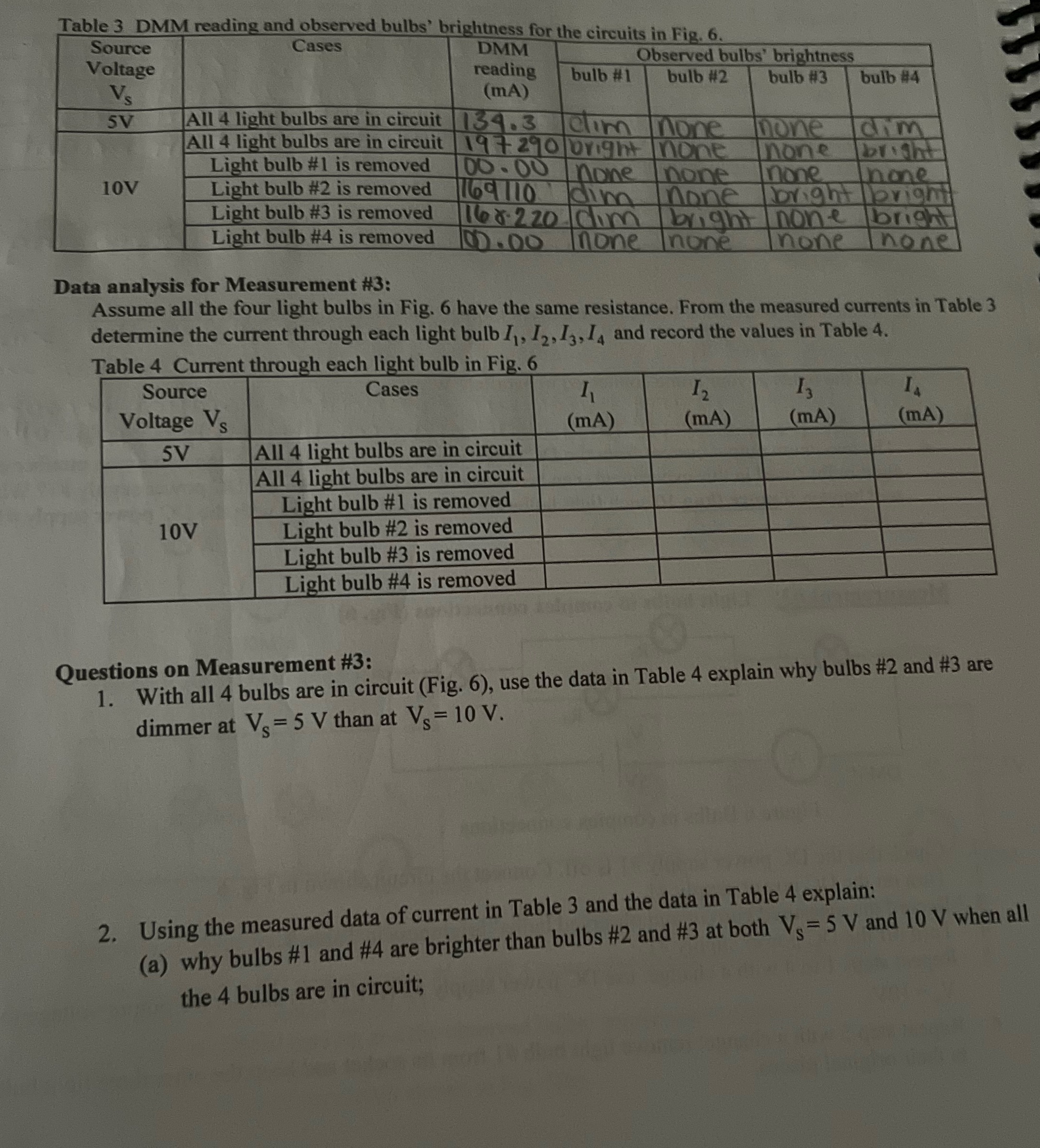
Table 3 DMM reading and observed bulbs' brightness for the circuits in Fig. 6. Source Cases DMM Voltage Observed bulbs' brightness reading bulb #1 bulb #2 bulb #3 bulb #4 Vs (mA) 5V All 4 light bulbs are in circuit |34. 3 Cum none All 4 light bulbs are in circuit 19 7 290 0right none CAM Light bulb #1 is removed none none bright DO . DO none 10V Light bulb #2 is removed none none none 169 710 dim none bright lovight Light bulb #3 is removed 16 8.220 dim bright none bright Light bulb #4 is removed 0.00 none none Inone Inone Data analysis for Measurement #3: Assume all the four light bulbs in Fig. 6 have the same resistance. From the measured currents in Table 3 determine the current through each light bulb /1, 12, 13, I4 and record the values in Table 4. Table 4 Current through each light bulb in Fig. 6 Source Cases 12 13 Voltage Vs (mA) (mA) (mA) (mA) 5V All 4 light bulbs are in circuit All 4 light bulbs are in circuit Light bulb #1 is removed 10V Light bulb #2 is removed Light bulb #3 is removed Light bulb #4 is removed Questions on Measurement #3: 1. With all 4 bulbs are in circuit (Fig. 6), use the data in Table 4 explain why bulbs #2 and #3 are dimmer at Vs = 5 V than at Vs = 10 V. 2. Using the measured data of current in Table 3 and the data in Table 4 explain: (a) why bulbs #1 and #4 are brighter than bulbs #2 and #3 at both Vs = 5 V and 10 V when all the 4 bulbs are in circuit
Step by Step Solution
There are 3 Steps involved in it

Get step-by-step solutions from verified subject matter experts