



Question: Table 4.16 gives a Vigen`ere ciphertext for you to analyze from scratch. It is probably easiest to do so by writing a computer program in
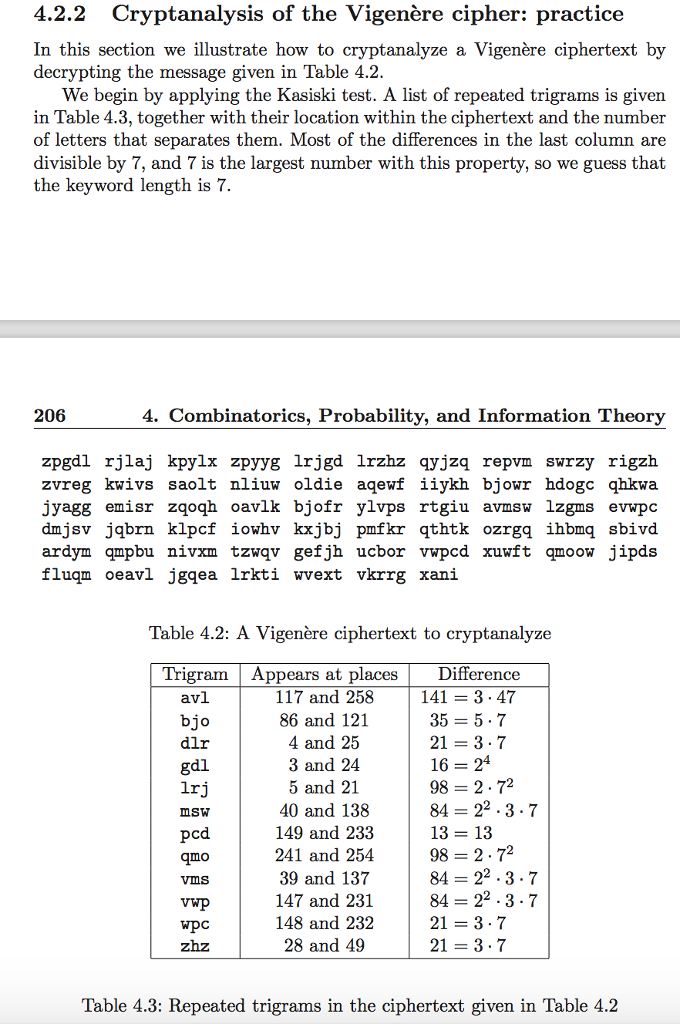
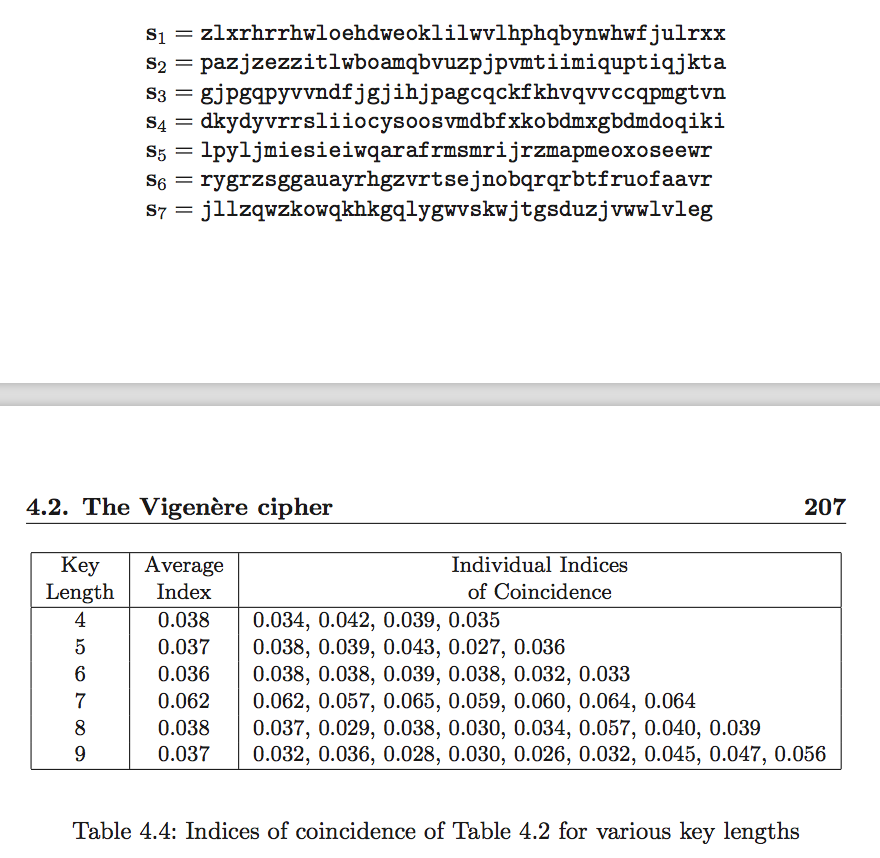
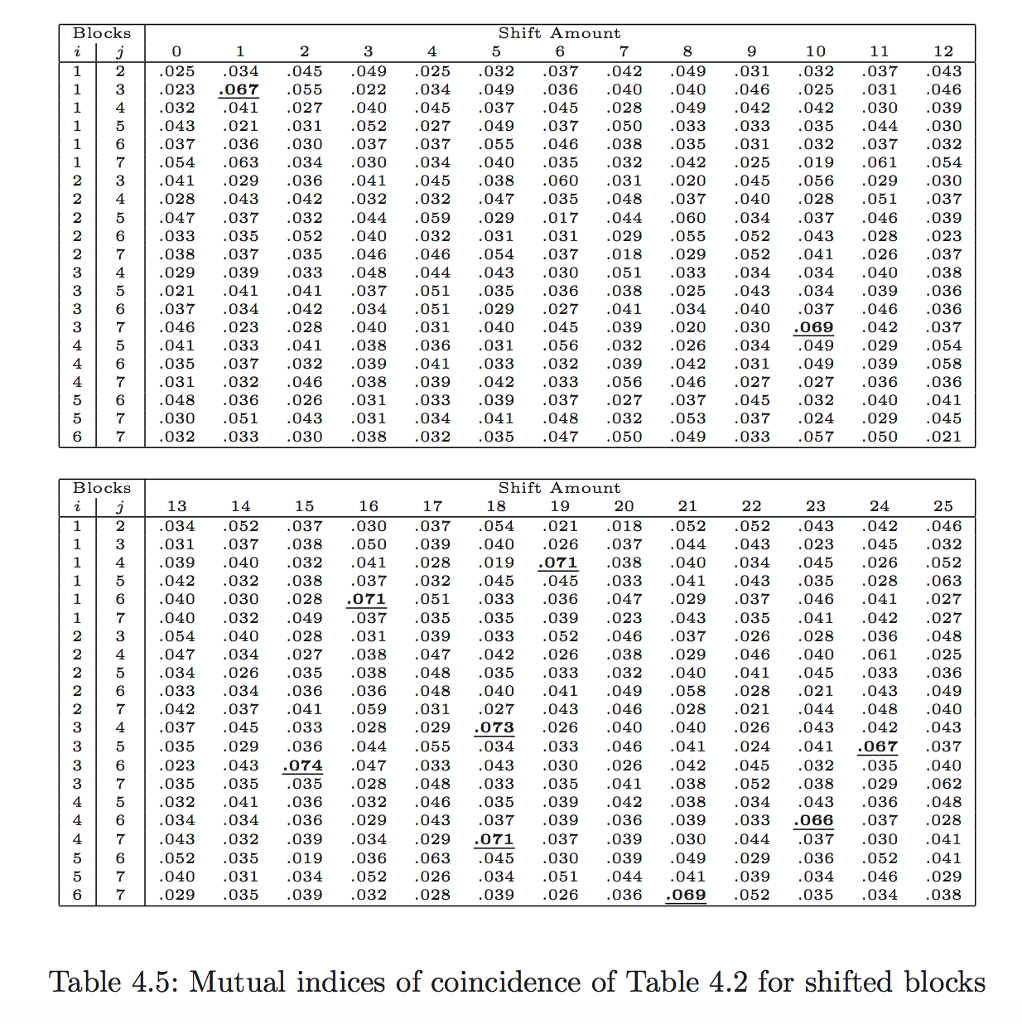
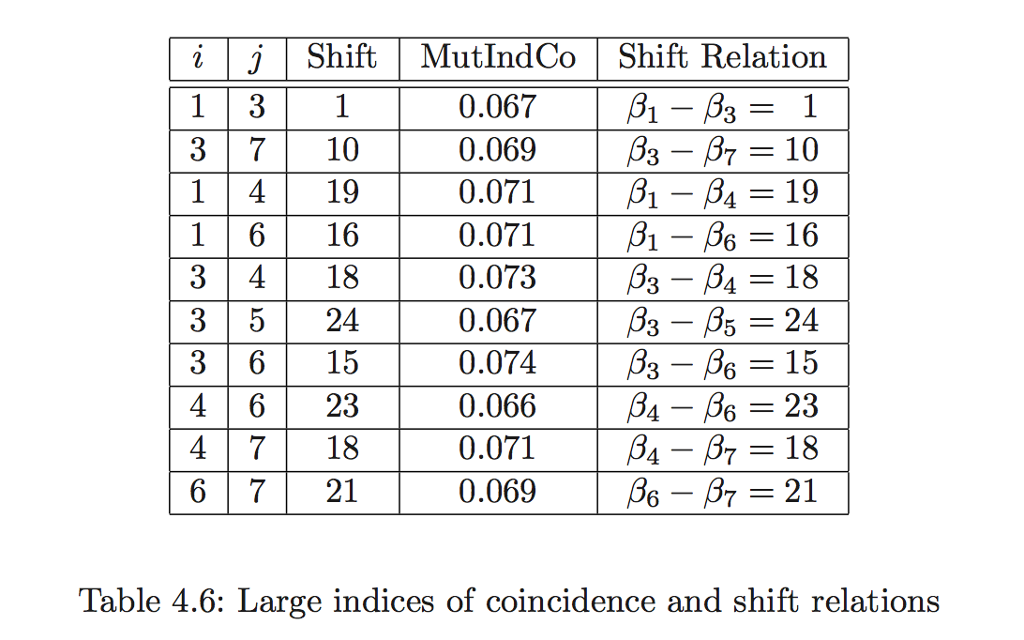
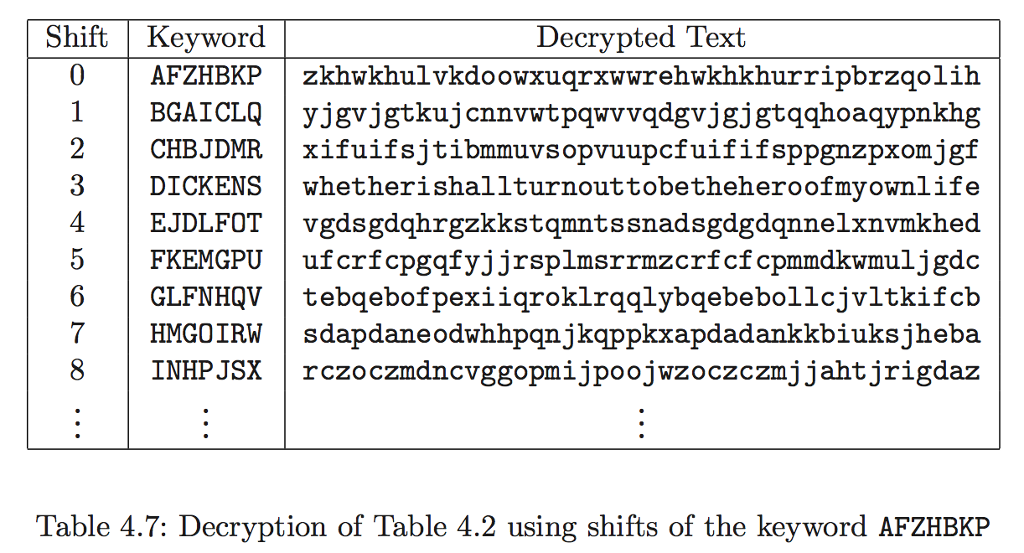
Table 4.16 gives a Vigen`ere ciphertext for you to analyze from scratch. It is probably easiest to do so by writing a computer program in Java, but you are welcome to try to decrypt it with just paper and pencil.
(a) Make a list of matching trigrams as we did in Table 4.3. Use the Kasiski test on matching trigrams to find the likely key length.
(b) Make a table of indices of coincidence for various key lengths, as we did in Table 4.4. Use your results to guess the probable key length.
(c) Using the probable key length from (a) or (b), make a table of mutual indices of coincidence between rotated blocks, as we did in Table 4.5. Pick the largest indices from your table and use them to guess the relative rotations of the blocks, as we did in Table 4.6.
mgodt beida psgls akowu hxukc iawlr csoyh prtrt udrqh cengx
uuqtu habxw dgkie ktsnp sekld zlvnh wefss glzrn peaoy lbyig
uaafv eqgjo ewabz saawl rzjpv feyky gylwu btlyd kroec bpfvt
psgki puxfb uxfuq cvymy okagl sactt uwlrx psgiy ytpsf rjfuw
igxhr oyazd rakce dxeyr pdobr buehr uwcue ekfic zehrq ijezr
xsyor tcylf egcy
Table 4.16: A Vigen`ere ciphertext for Exercise 4.18
(d) Use your results from (c) to guess a rotated version of the keyword, and then try the different rotations as we did in Table 4.7 to find the correct keyword and decrypt the text.
It should be a computer science question.
4.2.2 Cryptanalysis of the Vigenre cipher: practice In this section we illustrate how to cryptanalyze a Vigenre ciphertext by decrypting the message given in Table 4.2 We begin by applying the Kasiski test. A list of repeated trigrams is given in Table 4.3, together with their location within the ciphertext and the number of letters that separates them. Most of the differences in the last column are divisible by 7, and 7 is the largest number with this property, so we guess that the keyword length is 7. 206 4. Combinatorics, Probability, and Information Theory zpgdl rjlaj kpylx zpyyg lrjgd lrzhz qyjz repvm swrzy rigzh jyagg emisr zqoqh oavlk bjofr ylvps rtgiu avmsw lzgms evwpc dmjsv jqbrn klpcf iowhv kxjbj pmfkr qthtk ozrgq ihbmq sbivd ardym qmpbu nivxm tzwav gefjh ucbor vwpcd xuwft qmoow Jpds fluqm oeavl jgqea lrkti wvext vkrrg xani Table 4.2: A Vigenre ciphertext to cryptanalyze Trigram |Appears at places Difference 117 and 258 86 and 121 4 and 25 3 and 24 5 and 21 40 and 138 149 and 233 241 and 254 39 and 137 147 and 231 148 and 232 28 and 49 avl 141 3-47 35 5.7 21=3.7 16:24 98 = 2.72 84=22 . 3.7 13 13 98 2.7 84=22 . 3-7 84 22-3-7 21=3.7 21=3.7 dlr dl mSw qmo Vwp wpc zhz Table 4.3: Repeated trigrams in the ciphertext given in Table 4.2
Step by Step Solution
There are 3 Steps involved in it

Get step-by-step solutions from verified subject matter experts