







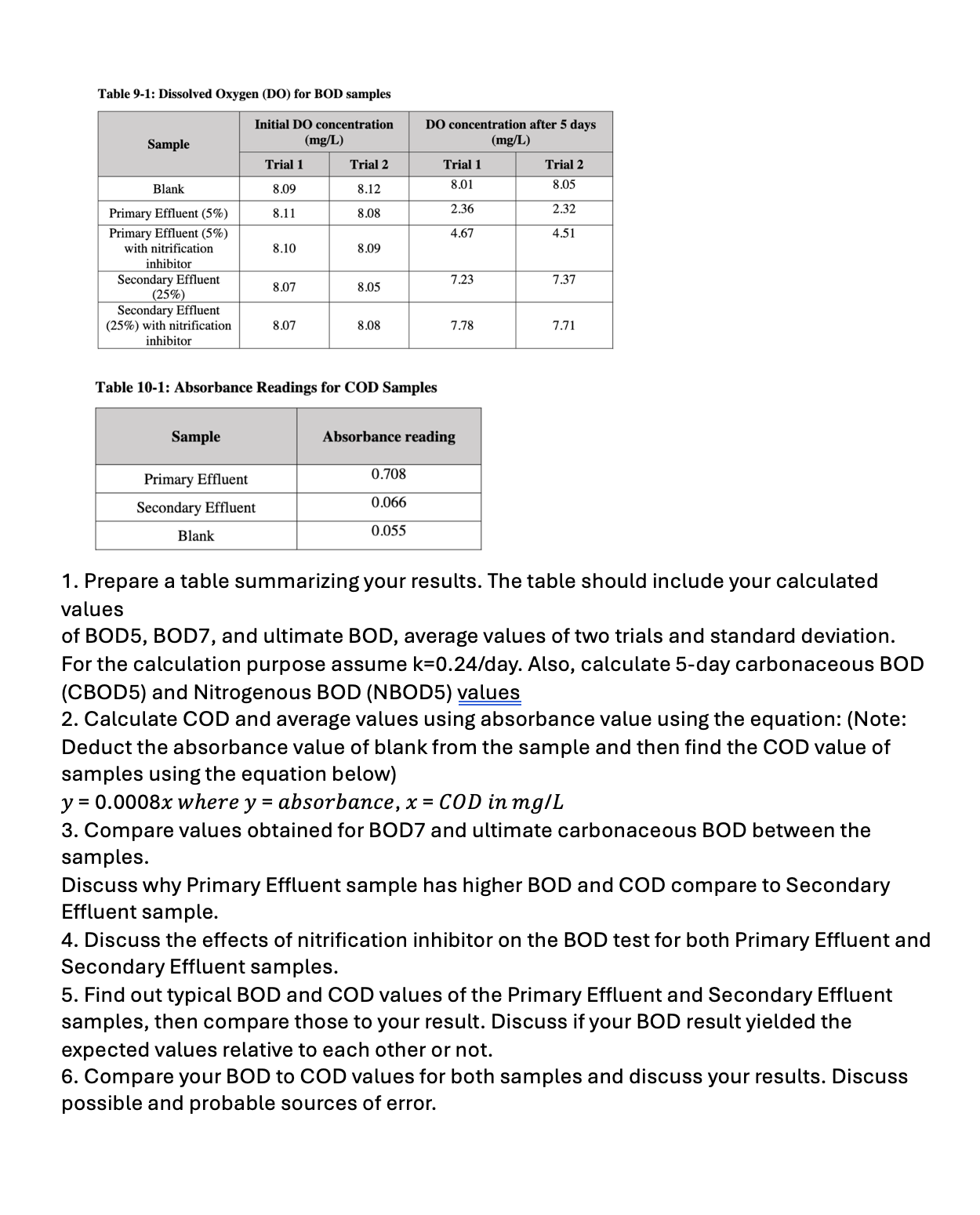
Question: Table 9 - 1 : Dissolved Oxygen ( DO ) for BOD samples Table 1 0 - 1 : Absorbance Readings for COD Samples Prepare
Table : Dissolved Oxygen DO for BOD samples
Table : Absorbance Readings for COD Samples
Prepare a table summarizing your results. The table should include your calculated
values
of BOD BOD and ultimate BOD, average values of two trials and standard deviation.
For the calculation purpose assume day. Also, calculate day carbonaceous BOD
CBOD and Nitrogenous BOD NBOD values
Calculate COD and average values using absorbance value using the equation: Note:
Deduct the absorbance value of blank from the sample and then find the COD value of
samples using the equation below
where absorbanceCOD in
Compare values obtained for BOD and ultimate carbonaceous BOD between the
samples.
Discuss why Primary Effluent sample has higher BOD and COD compare to Secondary
Effluent sample.
Discuss the effects of nitrification inhibitor on the BOD test for both Primary Effluent and
Secondary Effluent samples.
Find out typical BOD and COD values of the Primary Effluent and Secondary Effluent
samples, then compare those to your result. Discuss if your BOD result yielded the
expected values relative to each other or not.
Compare your BOD to COD values for both samples and discuss your results. Discuss
possible and probable sources of error.
Step by Step Solution
There are 3 Steps involved in it
1 Expert Approved Answer
Step: 1 Unlock

Question Has Been Solved by an Expert!
Get step-by-step solutions from verified subject matter experts
Step: 2 Unlock
Step: 3 Unlock
 Study Help