







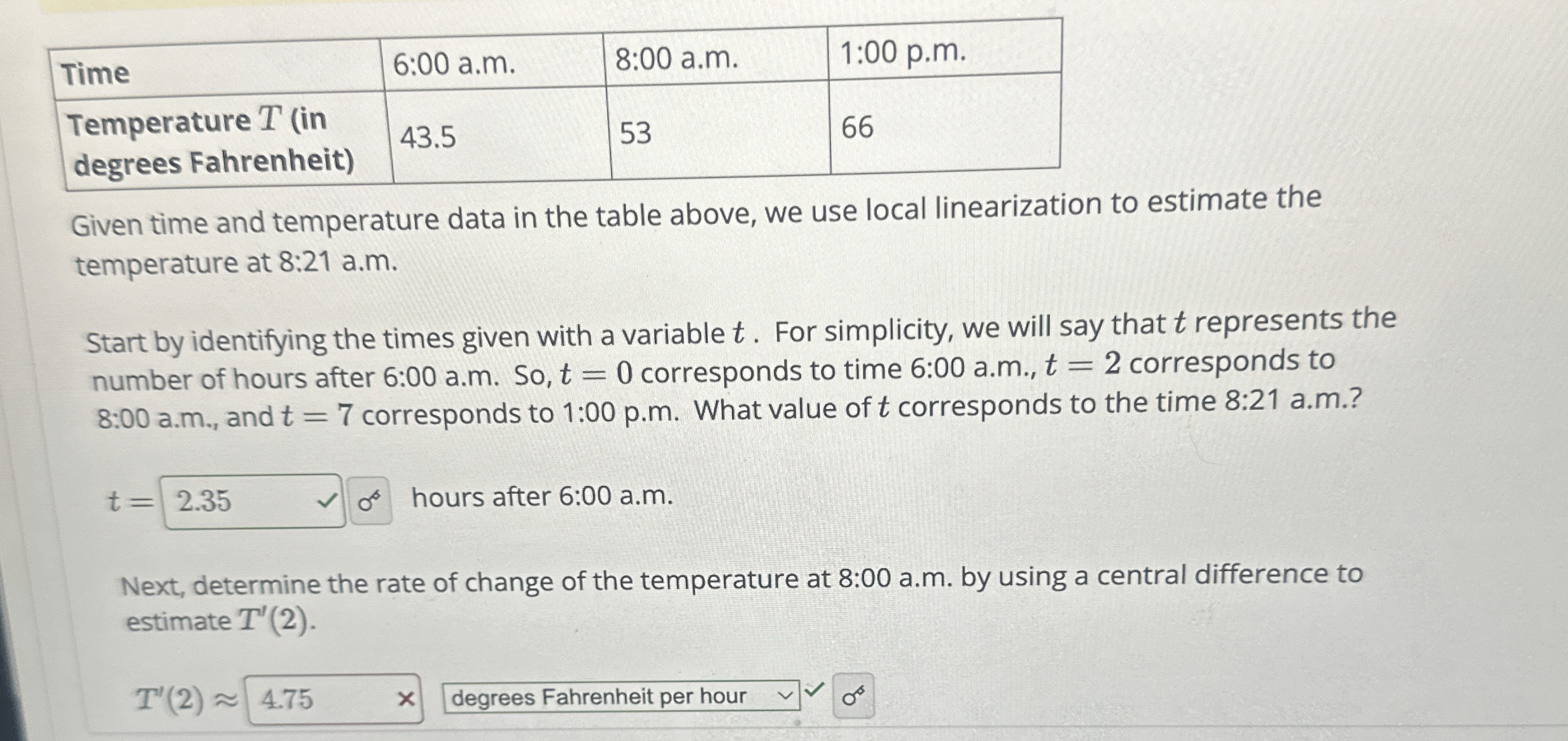
Question: table [ [ Time , 6 : 0 0 a . m . , 8 : 0 0 a . m . , 1
tableTime: am: am: pmtableTemperature indegrees Fahrenheit
Given time and temperature data in the table above, we use local linearization to estimate the temperature at : am
Start by identifying the times given with a variable For simplicity, we will say that represents the number of hours after : am So corresponds to time : am corresponds to : am and corresponds to : pm What value of corresponds to the time : am
hours after : am
Next, determine the rate of change of the temperature at : am by using a central difference to estimate
~~ Start by identifying the times given with a variable For simplicity, we will say that represe number of hours after : am So corresponds to time : am corresponds : am and corresponds to : pm What value of corresponds to the time : a
hours after : am
Next, determine the rate of change of the temperature at : am by using a central differenc estimate
~~
Finally, use a local linearization for at to estimate the temperature at : am
Estimated temperature at time : am: degrees Fahrenheit
Step by Step Solution
There are 3 Steps involved in it
1 Expert Approved Answer
Step: 1 Unlock

Question Has Been Solved by an Expert!
Get step-by-step solutions from verified subject matter experts
Step: 2 Unlock
Step: 3 Unlock
 Study Help