





Question: Tables given below are obtained using the WINQSB software. Table 1- Input problem X2 X3 Direction R.H.S. 40 1 X1 Maximize 50 60 C1 2
Tables given below are obtained using the WINQSB

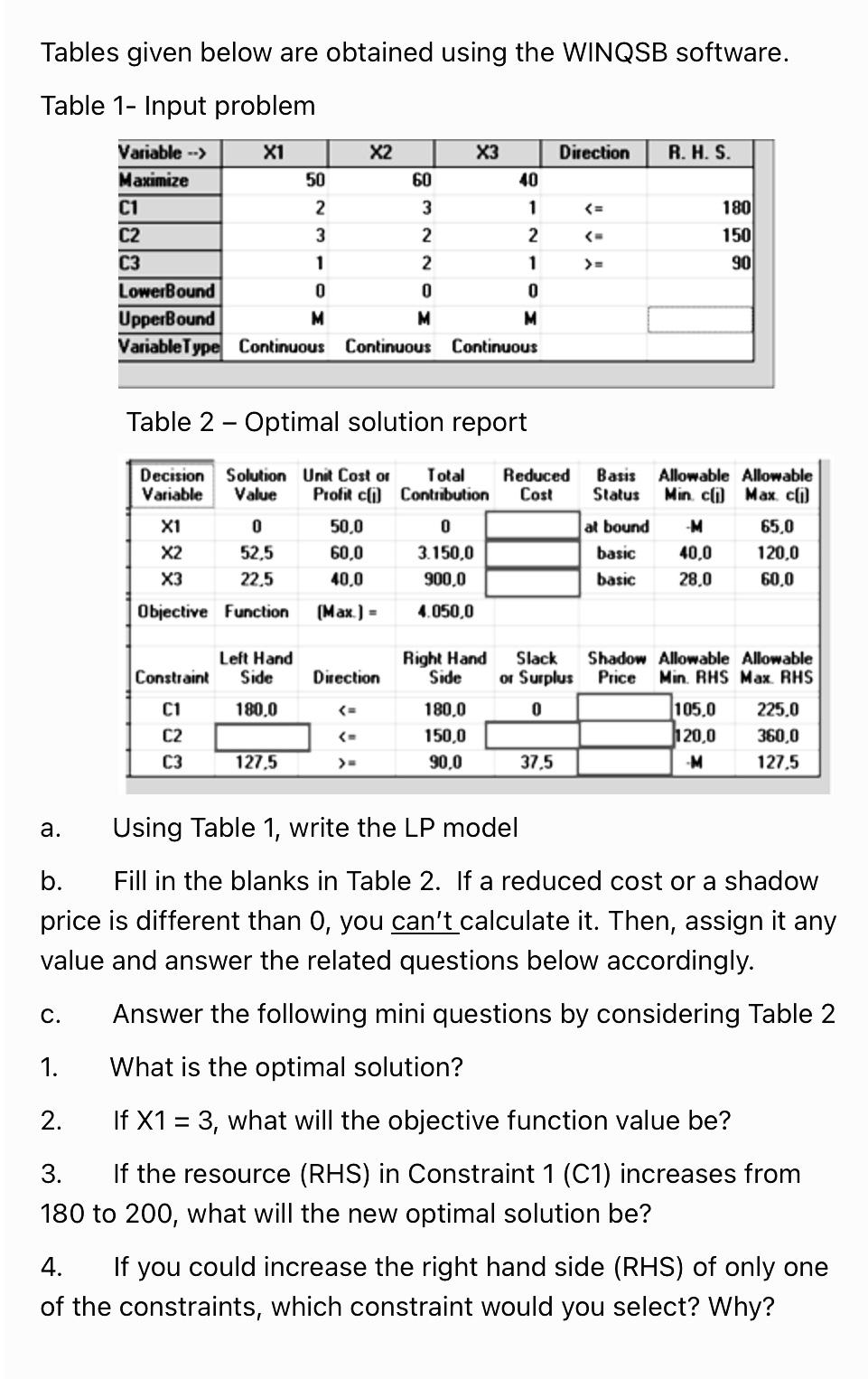
Tables given below are obtained using the WINQSB software. Table 1- Input problem X2 X3 Direction R.H.S. 40 1 X1 Maximize 50 60 C1 2 3 C2 3 2 C3 1 2 LowerBound 0 0 UpperBound M M VariableType Continuous Continuous 180 150 90 1 0 M Continuous Table 2 - Optimal solution report Reduced Cost Decision Solution Unit Cost or Total Variable Value Profil c) Contribution X1 0 50,0 0 X2 52,5 60,0 3.150,0 X3 22.5 40.0 900.0 Objective Function (Max) - 4.050,0 www Basis Allowable Allowable Status Min. cli) Max. c) al bound -M 65,0 basic 40,0 120,0 basic 28.0 60,0 Left Hand Side Right Hand Constraint Direction Side Slack or Surplus 180.0 0 C1 C2 C3 180.0 150,0 90,0 Shadow Allowable Allowable Price Min. RHS Max. RHS 105.0 225.0 [120,0 360,0 M 127.5 127.5 37.5 a. Using Table 1, write the LP model C. b. Fill in the blanks in Table 2. If a reduced cost or a shadow price is different than 0, you can't calculate it. Then, assign it any value and answer the related questions below accordingly. Answer the following mini questions by considering Table 2 1. What is the optimal solution? 2. If X1 = 3, what will the objective function value be? 3. If the resource (RHS) in Constraint 1 (C1) increases from 180 to 200, what will the new optimal solution be? 4. If you could increase the right hand side (RHS) of only one of the constraints, which constraint would you select? Why

Step by Step Solution

There are 3 Steps involved in it

1 Expert Approved Answer
Step: 1 Unlock blur-text-image

Question Has Been Solved by an Expert!

Get step-by-step solutions from verified subject matter experts

Step: 2 Unlock
Step: 3 Unlock

Students Have Also Explored These Related General Management Questions!