







Question: Tabria and Marshall both have a six-sided dice. The sides of their dice are displayed below: 2 2 3 3 3 Assuming that their dice
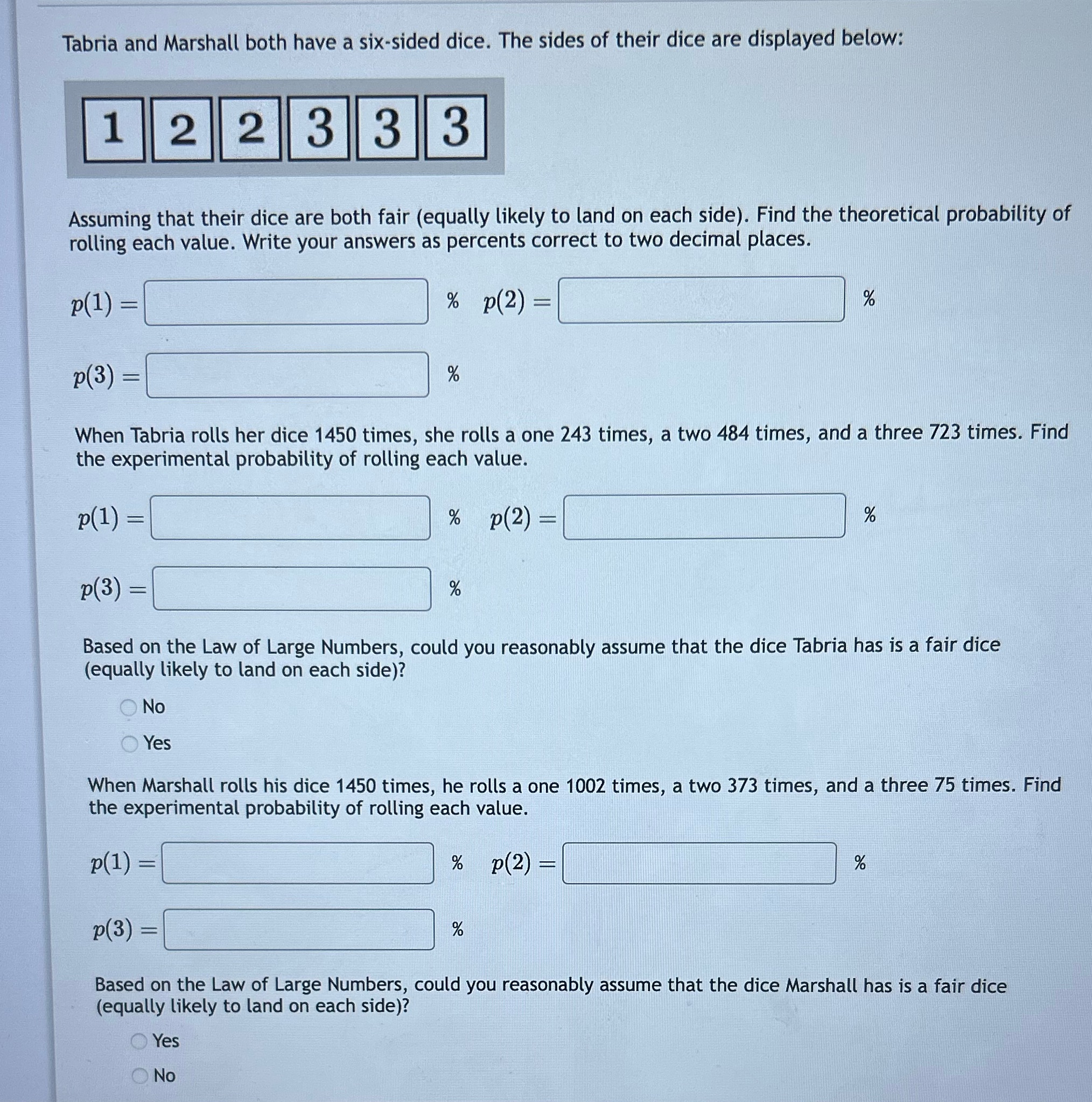
Tabria and Marshall both have a six-sided dice. The sides of their dice are displayed below: 2 2 3 3 3 Assuming that their dice are both fair (equally likely to land on each side). Find the theoretical probability of rolling each value. Write your answers as percents correct to two decimal places. p(1) = % p ( 2) = % p(3) % When Tabria rolls her dice 1450 times, she rolls a one 243 times, a two 484 times, and a three 723 times. Find the experimental probability of rolling each value. p(1) = % % p(3) : % Based on the Law of Large Numbers, could you reasonably assume that the dice Tabria has is a fair dice (equally likely to land on each side)? No Yes When Marshall rolls his dice 1450 times, he rolls a one 1002 times, a two 373 times, and a three 75 times. Find the experimental probability of rolling each value. p(1) = % p ( 2) = % p( 3) = % Based on the Law of Large Numbers, could you reasonably assume that the dice Marshall has is a fair dice (equally likely to land on each side)? Yes No
Step by Step Solution
There are 3 Steps involved in it

Get step-by-step solutions from verified subject matter experts
 Study Help