



Question: Take a look at this image: This is an image of a star from a CCD detector. Its a simulation. You see the bright star,
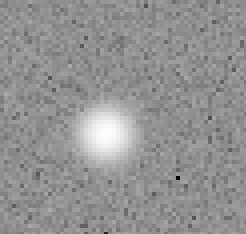
Take a look at this image:
This is an image of a star from a CCD detector. Its a simulation. You see the bright star, some background and the pixelated nature of these images.
Stars are very far away so when viewed through a telescope they are effectively point sources. However, we dont see a tiny dot in a single pixel but an extended object many pixels wide. This is because of the point spread function or PSF of the instrument/telescope/site/atmosphere that blurs every image. In case your are wondering, this is part of the reason why the images from the Hubble Space telescope are so sharp and detailed - there is no atmosphere in space and the PSF is much narrower.
The detailed shape of a PSF is complex but in good approximation its a Gaussian profile.
Around the star image you see a speckle pattern. This is noise. Noise comes from the readout of the CCD but mostly (the details depend on the observing conditions) from sky background. Even at an observatory at an isolated site the sky is not completely dark/black.
So here is your challenge:
Write a Python script that generates a simulated star image similar to the picture shown.
Assume a Gaussian PSF and include a random noise background. Maybe you can even find a way to plot your simulated image.
As I said before, Python is easy to learn. There are plenty of tutorials online and you can run it on your laptop. In less than a day you will be able to write simple scripts.
Knowing Python will be a valuable skill for your entire college career and beyond.
Step by Step Solution
There are 3 Steps involved in it
1 Expert Approved Answer
Step: 1 Unlock

Question Has Been Solved by an Expert!
Get step-by-step solutions from verified subject matter experts
Step: 2 Unlock
Step: 3 Unlock